
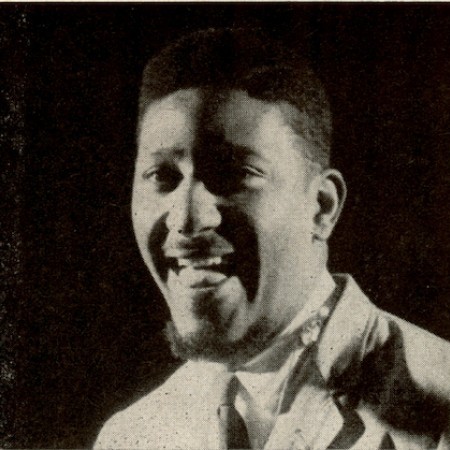
Sonny Rollins: a very conscientious blindfoldee.
(Photo: DownBeat Archive)Editor’s Note: In tribute to the late Sonny Rollins, who passed away on May 25 at age 95, we present his first DownBeat Blindfold Test with Leonard Feather, creator of the column, from our Dec. 12, 1957, issue.
The significance lies in Sonny’s having been able, during the past year or two, to practice what he preaches. More than any other tenor player of the younger generation, he has succeeded in developing a sound and style that can be called original rather than derivative.
Sonny has been important in another area of jazz development. He has played a part in the murder of the myth that jazz and the waltz are incompatible. In addition to writing “Valse Hot” and other attractive 3/4 themes, he took part in an entire album of jazz waltzes recently with Max Roach on EmArcy.
Sonny was given no information at all about the records played for him — not even the fact that they were all going to be waltzes. He was a very conscientious blindfoldee, taking copious notes and reading off his comments into the tape recorder after each number was played.
Randy Weston
“Little Niles” (Riverside) Weston, piano; Cecil Payne, baritone sax.
This is a better-than-good pianist named Randy Weston. An interesting baritone solo by Cecil Payne and a very effective use of 3/4 rhythm. I’ll give this 4½ stars. Randy has been influenced more by Monk than anybody else. He uses Monk’s unorthodox approach to piano playing more than any other young player.
Thelonious Monk
“Carolina Moon” (Blue Note) Monk, piano; Lou Donaldson, alto sax; Kenny Dorham, trumpet; Lucky Thompson, tenor sax; Max Roach, drums.
This is the old master painter, Thelonious Monk, and it’s an exciting excursion into what sounds like 12/8 time. He was obviously assisted by Lou Donaldson, Kenny Dorham, Lucky Thompson, and perhaps Max Roach on drums — I’ll take a guess on Max Roach. This is, of course, “Carolina Moon” — I’ve heard this before. I would rate this 5 stars for the idea, and I’d rate it 4 stars for the execution of it.
Johnny Richards
“Waltz, Anyone?” (Bethlehem) Charlie Mariano, alto sax; Richards, comp. and arr.
This tune has very nice chord progressions; however, it seems to be slightly over-arranged. The alto soloist is heavily Bird-influenced and because of this it is reminiscent to me of the wonderful Machito-Bird things that were done a few years ago. Unfortunately, however, it suffers by comparison. Overall I’ll give it 2 stars. Sounded like it could have been Phil Woods on alto, but I’m not sure.
Art Pepper
“Waltz Me Blues” (Contemporary) Pepper, alto sax; Paul Chambers, bass; Red Garland, piano; Philly Joe Jones, drums.
Everybody seems to be playing 3/4 these days! Anyhow, I recognize Paul Chambers on bass. Possibly Sonny Clark, piano, and a wild guess — Arthur Taylor on drums. But on his name, it’s a question-mark. As for the alto player, who was, I guess, the leader, he was Bird-influenced, that’s all I can say. Other than that it could have been any one of three or four people — or more. They did have some nice solos. I’d rate it for solos and the idea, 3½ stars.
Duke Ellington
“Lady Mac” (Such Sweet Thunder, Columbia) Russell Procope, alto; Clark Terry, trumpet.
This record is immediately recognizable as having a Duke Ellington sound. The soloists sound like Russell Procope, possibly, and Clark Terry on trumpet. It’s very important to have a sound that you can recognize immediately, and of course Duke is an institution now in music. He’s one of my particular favorites. Always has been a great inspiration to me. This was very well arranged, in contrast to the other big band thing you played which was over-arranged. This is put together much more effectively. All the parts have a significance to the whole thing. I’d rate this 4½ stars.
Mary Lou Williams
“Mary’s Waltz” (Storyville) Don Byas, tenor sax; Williams, comp.
That was Duke-flavored once again. I think it was Duke Ellington, and Paul Gonsalves on tenor. It was also in the 3/4 medium. Very good execution on that record. The idea was played very well. The musicians were very well recorded — very good sound and unique idea. I think I’ll give this 5 stars. I liked the melody very much, too.
Bob Harrington Quartet
“Three-Fourths” (Imperial) Bob Carter, bass and comp.
I don’t recognize any of the musicians. It sounded like the bass player was influenced by Percy Heath. There is nothing outstanding about the tune, but for the fact that they played it in 3/4 time, which is gradually beginning to lose its value, by the way. I’ll give it 2 stars.
Dick Hyman Trio
“Flutter Waltz” (Hi-Fi Suite, MGM) Hyman, organ; Leonard Feather, comp.
That’s a very good jazz organ, I’d say. It can’t be Jimmy Smith. If it is, he gets a much more clean sound than he has in some of his other things. Perhaps he was recorded better — if it is Jimmy Smith. It’s an interesting tune — fairly interesting, I’d say, and I’d rate it 3½ stars.
Woody Herman
“Tenderly” (Verve) Cy Touff, bass trumpet; Neal Hefti, arr.; tenor sax not credited.
I like the arrangement very much. It was well executed. I can’t recognize the soloists. I know the trombonist is Bill Harris-influenced and the tenor sax is Stan Getz-influenced. Because of this, these people have no identity of their own, and I can’t name them. The band got a very nice sound. I think I’d give that 4 stars.
John Graas
“6/4 And Even” (Decca) Graas, comp.
This is an attempt at small combo jazz which doesn’t come off. The arrangement is hackneyed and cliched, although they did make an attempt to engender complexity and originality through the use of a few unorthodox chord progressions. However, my rating is ½ star. DB
The “Blindfold Test” is a listening test that challenges the featured artist to discuss and identify the music and musicians who performed on selected recordings. The artist is then asked to rate each tune using a 5-star system. No information is given to the artist prior to the test.