
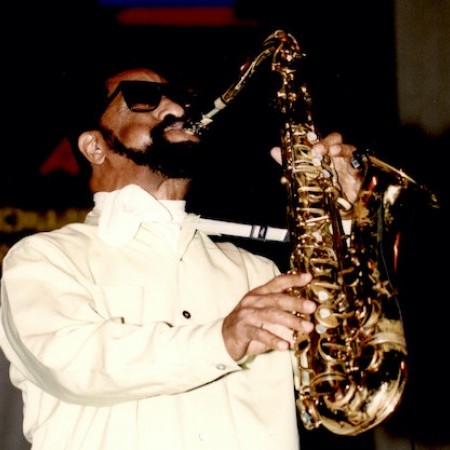
Sonny Rollins performing at the Chicago Jazz Festival in 1992
(Photo: Ronald Heard)“Is this going to be another negative, punch-Sonny-Rollins-in-the-eye article for DownBeat?” the man asked with weary resignation as he plopped into a den chair. “Well, I agreed to do it. I know how it’s going to come out anyway. So, go ahead, ask me. I’m ready.”
It was a telephone interview. I imagined Sonny Rollins sitting there in his Hudson River Valley country home north of Rhinebeck, New York; sitting there in a nimbus of ennui waiting to be prodded and poked with an assortment of those unpleasant, blunt instruments we journalists call questions.
His wife, Lucille, had answered the phone and handed it to her husband. “This sure is going to be a mighty short interview,” she thought as she walked out the door, got into her car, and drove off on some mid-morning errands. Maybe she even pitied the poor schnook on the other end of the line a bit. She was surprised — actually “astonished,” she admitted later — to return in an hour and a half and find the conversation still pumping along and probing the merits of cowboy actor Ken Maynard, “B” westerns and actress Joan Leslie.
How Sonny Rollins got down from DownBeat to Joan Leslie within 90 minutes is the subject of this modest tale at hand. He took the scenic route, by and large, along the little roads of conversation not always traveled in the music interviews. The kind that demand a little improvisation. But Rollins knows about that, doesn’t he? The talk avoided the long and familiar chronological expressways that wind past more than 40 years of various “sabbaticals,” crises, triumphs and what have you. All that’s been well mapped in insightful essays by such career cartographers as Gary Giddins, Francis Davis, Bob Blumenthal (in his booklet accompanying the new seven-CD Prestige set, The Complete Prestige Recordings) and Charles Blanca in his book Sonny Rollins: The Journey of a Jazzman.
So, the assumption in this article will be that no reader needs to be instructed on any of this; or on Rollins’ immensity and influence as a tenor saxophonist, an influence that may in the aggregate dwarf that of his one-time contemporary, the late John Coltrane. With all this as given, then, back to DownBeat.
“I find it petty,” he groused on. “I find the things it says about great musicians petty. It tries to denigrate people with these John Simon-type reviews. I guess that’s what pays off, though. Writers have to write this type of piece to become famous. I know that’s the way it goes. I also know you won’t print any of this.” (Thus insuring that every word would get printed. Rollins is no media amateur.)
In the ’20s, I reminded him, H.L. Mencken liked to say of his fellow journalists that it was their duty “to comfort the afflicted and afflict the comfortable.” To which Rollins replied that no jazz musician is ever comfortable.
“There are those celebrities who are comfortable,” he admitted. “Movie stars and rock musicians. But jazz musicians are not movie stars. Knowing what it takes to play jazz, and live the jazz life, I would disagree with any writer who assumed that the jazz musician in this society is comfortable, and thus fair game for attack. I know DownBeat’s been pretty hard on me recently, which I suppose is a kind of badge of honor. Maybe now that Miles is dead, they figure they have me to kick around. I’m not saying I’m beyond criticism. That’s not where I’m coming from. I’m my biggest critic. I know when I’m not sounding good before DownBeat or anyone else tells me so. But I object to DownBeat for what I’ve seen it do to other musicians.” He didn’t offer a bill of particulars; his wife, whom he met in 1956 and who stills hates the word “gig,” reads the articles and reviews, only occasionally passing one along to him. But then he said this:
“I think that the jazz business is fragile enough. It’s a real art, and it should be boosted. That’s how I feel.”
Aha, now it was clear. Of course! That’s exactly how he should feel. He’s a jazz musician. Naturally he identifies with the world that has defined him. A more disinterested third person, however, might have looked at the two of us — musician and writer — and seen it another way. How little these writers often know about the reality of the world they cover, he might say; and how little musicians understand that writers have nothing if not their independence. They must resist the temptation to be liked by the famous subjects they hobnob with by becoming “boosters.”
Whichever side you might favor in this gentlemen’s disagreement, one fact is immutable: Rollins, like all the finest jazz artists, will be remembered by his recordings, not his press clippings or reviews, in this magazine or any other. Through many label associations, he has always taken his recordings very seriously. Differences between labels? “Mainly whether they pay me my royalties,” he said. “Some pay, some don’t.” Over the decades, he has worked with the most astute jazz producers in the industry — Bob Weinstock, Ira Gitler, Orrin Keepnews, Norman Granz, George Avakian and Bob Thiele. In recent years, his wife has held that function. All have been astute enough to let him produce himself. “The creative decisions on arrangements and material were always mine. That’s why I don’t think whether the producer was George or Orrin was ever particularly material in terms of the final product. They may disagree, but that’s the way I see it.”
Even his 1962–’64 period with a major non-jazz label, RCA, presented no pressures to “expand his audience.” “The contract at RCA,” he said, “was a big contract at the time and called for a certain amount of product within a certain period. It was stricter in terms of what had to be done — three records a year, maybe. It was very high-profile. Paul Desmond was signed, too. But they took us both on our own terms. They didn’t expect me to sell like Elvis Presley, and they didn’t pay me like Elvis Presley, either. But there was no interference.”
Rollins says he rarely gives much thought to his record sales or calculates ways to boost them. To him they are almost a peripheral concern, serving more a publicity than an income function. “I’ve been recording for many years and get certain royalties from my compositions and record sales,” he explains. “But I couldn’t live on that sum. Most of my income comes from live performances. If I break my arm or can’t play, I’m out of luck. That’s how close to the edge a jazz musician lives.”
Happily Rollins gets princely concert fees, which he deserves and which help keep that “edge” rounded down to something more like a gently sloping hill. Although he won’t discuss fees, he reportedly received more than $20,000 for one 50-minute set at the recent Chicago Jazz Festival. Rollins knows his full value and doesn’t quibble or give anything away. He would not consider, for instance, permitting National Public Radio to air his Chicago Jazz Festival appearance on the network. Yet, he is one of the relatively few jazz artists today who can maintain an active concert schedule within the United States. Most have to trot the globe to find a steady concert circuit. He plays almost no clubs anymore. And the preferred bookings are the ones where he doesn’t have to share the bill, says wife Lucille.
Although the albums he turns out every year and a half or so don’t generate great cash windfalls, they keep his profile high in the marketplace. That, in turn, produces the awareness, the interest and the personal-appearance bookings that generate the real money. In this, he is no different than any other aging music legend. Neither Frank Sinatra nor the Rolling Stones have been able to generate important record sales lately; Sinatra seems to have given up, in fact. Yet, on the road they mint money. On the jazz world’s smaller fiscal scale, the same is true of Rollins. “You have to record to stay famous, to keep your name out there,” he says. “Albums are more a publicity thing in a lot of ways.”
They’re also a record of his musical career. And history — and his place in it — is something he’s keenly alert to. Maybe this is why he is said to have such mixed feelings about the whole recording process. If it’s not my best, I don’t want it preserved, seems to be the standing policy. That way there’s no danger of anything slipping out.
When something does, Rollins is not a happy man. A French RCA collection of alternate takes from the ’60s, for instance, came out this year on a Bluebird CD (Alternatives). Orrin Keepnews’ album notes will provide the details for anyone who wishes to inquire. But they are of little consolation to Rollins.
“I feel it’s an invasion of my prerogative to decide how I want to be represented on records,” he said. “I used to go ballistic over these things. Now I realize it’s done a lot. All kinds of performances are subject to this sort of thing [including radio broadcasts]. But if I don’t like the way I sound, I don’t want the world to hear it more than once. It’s an issue of privacy almost.” It’s also something that only the most important musicians experience, artists whose work is considered so vital that even the scraps have value. It’s the ultimate honor. “I understand that,” he says. “But I’m a musician. Music is my living. I have to control the product I produce.”
If Rollins is conscious of history, he still finds it hard to see himself as an historical figure. Most of the leading young players of jazz today never knew a world in which Sonny Rollins was not a star — just as Rollins never knew a world in which Armstrong or Ellington were not stars. In their eyes, Rollins is Ellington. “Yes,” he grants, “but it’s impossible for me to look at myself as these young people might. I think of myself as I always have. The good thing is that when I play somewhere I don’t have to fight for acceptance. The bad part is I have to produce at a standard I set for myself 30 or 40 years ago. You can’t go stink up the joint just because you’re supposed to be great. But I can’t be sucked in by the fact that some people may think I’m an icon. That would be as ridiculous as taking all the bad things writers write seriously. My own assessments are the most important. They’re also the harshest, but that’s for me to live with.”
Still, when Rollins plays “Oleo” or “St. Thomas” and hears that wave of recognition roll across an audience, he feels good about it. “I want to communicate, even though I basically play for myself,” he admits. “When I can reach an audience, I feel as if I’ve persuaded them to come into my camp and accept what I am. You have to be careful not to let that tempt you either to phone in a performance or to become solicitous of the crowd. That’s why I stopped playing at one time. The pressure I felt from the audience made me want to do something for them I wasn’t able to do.”
If an audience doesn’t recognize one of Rollins’ own pieces, such as “Oleo,” they’ll certainly recognize familiar melodies like “Tennessee Waltz,” which he turned into an aria at this year’s Chicago Jazz Festival. No jazz musician, of course, plays such an unexpected repertoire. The hippest in his audiences, who can’t resist sneering at Irving Berlin, have always preferred to regard this Rollins trademark as part of some imagined sardonic side to his personality. They think he’s kidding. But the joke’s on them. He seems almost offended when someone refers to pieces like “There’s No Business Like Show Business” or “I’m An Old Cowhand” as corn. He certainly never condescends to them in performance. These songs are rooted in memories of his childhood, in some cases. Maybe he even remembers Benny Goodman and Gene Krupa’s “The Last Roundup,” circa 1935. In any case, he can bring a child’s excitement and straightforwardness to them.
Rollins gives the impression of being a pessimist. Sometimes it’s more than an impression. When he speaks of the world’s future, it’s often with a conditional “if.” He seems discouraged by the state of the environment, the government, the media. “I’m concerned about the state of the world,” he says grimly, “but I’m also too sophisticated to read newspapers or watch TV and think I’m being seriously informed.” He recommends Bill McKibbon’s recent book, The Age of Missing Information, to friends. It puts everything in perspective, he says. “Things are happening that nobody is seeing. Don’t miss it.”
So he retreats to the things he trusts most: his home, his family, his friends. And, oh yes, his old movies. There’s a wonderfully healthy innocence in this passionate affection he holds for “the stuff that dreams are made of.” “They’re the best thing on TV,” he insists. “They’re television’s one redeeming virtue.” At home he’s probably more likely to leaf through a movie book or watch a film than listen to music. His video shelf, like his repertoire, is packed with the greats: John Huston’s The Maltese Falcon, Marlene Dietrich in Sternberg’s The Blue Angel, Humphrey Bogart in Casablanca, and W.C. Fields’ The Bank Dick.
“I like those older black-and-white ones particularly,” he confesses. “In fact, the ones I really look for are the B-pictures, especially westerns. I grew up on guys like Ken Maynard, Hoot Gibson, Buck Jones, Bob Steele and Johnnie Mack Brown.
“There’re a few musicals I’ve been trying to find, too. I’d love to get The Sky’s the Limit. That’s the one in which [Fred] Astaire introduced ‘My Shining Hour’ and ‘One for My Baby’ in 1942 — a great Harold Arlen score. Joan Leslie was the young ingenue at the time. She was beautiful.”
The interview had been going on about 80 minutes by the time we got to Ken Maynard and Joan Leslie. Lucille Rollins was back from her errands by now, and it seemed we’d covered enough. “Should I have my wife read this when it comes out?” he said. “Or should we just pretend it never happened?”
I was noncommittal. But if anyone can get Sonny Rollins a copy of The Sky’s the Limit, let him know. And when you do, tell him DownBeat asked you to do it. DB