
By Michael J. West | Published September 2026
As a critic, I often use Ella Fitzgerald’s stereo recordings as guideposts for standards I’m less familiar with; her fidelity to the written melody, attention to detail and interpretative brilliance are nonpareil. Yet this makes it easy to forget how thoroughly she makes the songs her own, especially in concert — and what a blast it is when she does so.
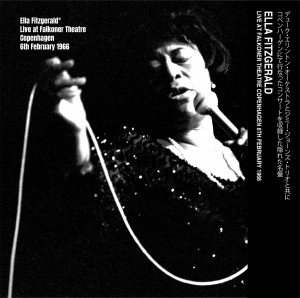
On Live At Falkoner Theatre Copenhagen 6th February 1966 (special thanks to Gearbox Records for squeezing most of the historical context just into the album title), she eases into it. The only real customizing of opener “Satin Doll” comes when she reprises the last eight bars, and there’s just slightly more decoration on Burt Bacharach’s “Wives And Lovers,” which oddly enough might be the gig’s hardest-swinging number. (Accompanying Ella on the gig is the Duke Ellington Orchestra, minus Duke and the rhythm section: pianist Jimmy Johnson and his trio sit in.) Yet by the time she’s done with both, you can barely imagine anyone else singing them.
By the time of “Sweet Georgia Brown,” however, she’s recomposing top to bottom: It’s an oddly monotonous rewriting, but she fills it with her panoply of oomph. She growls, hollers, belts, shrieks and shouts so that even the Johnny Hodges/Paul Gonsalves reed section is just barely able to keep up. Almost as much fun, though, is “Só Danço Samba,” which she barely alters at all, but merely punches in all the right spots. Then there’s “How High The Moon,” by this time Ella’s traditional showstopper; if it’s not quite the dizzying heights of her famous 1960 Berlin recording, it’s not because she doesn’t put just as much energy into it.
The most astonishing trick of all, though, comes in the set’s two ballads, Billy Strayhorn’s “Something To Live For” and Ellington’s “I’m A Lucky So-and-So.” On the former, particularly, she’s as precise and on-the-page perfect as one can fathom; on the latter, she surely sounds exactly as Duke intended for the song. Yet in her hands, they no longer belong to those giants and it sounds like they never did. How did she do that?