
By Michael J. West | Published January 2026
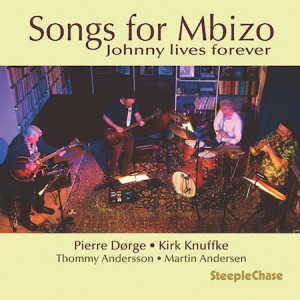
Danish guitarist Pierre Dørge is so thoroughly identified with his 10-piece New Jungle Orchestra that finding him in a stripped-down, one-horn format like this can throw one for a loop. Push through it. Songs For Mbizo is a delight, as brimful of melodies as it is with Dørge’s quirks.
A quartet with cornetist Kirk Knuffke (a frequent collaborator), bassist Thommy Andersson and drummer Martin Andersen (the orchestra’s regular rhythm section), the album features the compositions of South African bassist Johnny “Mbizo” Dyani, another regular collaborator of Dørge’s before his passing in 1986. (The album’s subtitle, Johnny Lives Forever, references 1987’s Johnny Lives, the album Dørge made to mark Dyani’s death.)
Mbizo loved a good melody almost as much as he loved a good groove, and the album suitably abounds in both. Not always at the same time, mind you; the gallop of “Heart With Minors Face,” for one, is a far greater concern than a memorable tune, while “Embrace” takes a minute-and-a-half to even get to the rhythm. For each of these, though, there’s a “Year Of The Child,” where the Andersson’s sly funk contains the melodic core, or two versions of “Song For Biko,” on which Dørge and Knuffke serve up the hooks in both brisk swing and slow lope.
Title and composer credits notwithstanding, Songs For Mbizo sounds less like Dyani’s music and more like Dørge’s. The guitarist’s sound is flush with African rhythmic, harmonic and textural concepts in its own right — it’s what made Dyani such a complementary force — so even a tune called “Jo’burg–New York” fits his aesthetic without feeling like an affectation. Add in the Dørge-flavored guitar, with its thick, slightly abrasive chords and a sliver of distortion, and Knuffke’s warm cornet pitch bends (and maybe it’s the context, but he evokes Hugh Masakela here), and fans of the Dane’s previous music will be right at home.
The album’s highlight is “Year Of The Child.” Andersson establishes a gentle, bobbing rhythm that Andersen illuminates with his toms and cymbals, while Knuffke renders the melody such that it manages to allude to both “Organ Grinder’s Swing” and Albert Ayler’s “Ghosts.” Dørge evinces an impossibly light touch that makes his solo delectable.