
By Michael J. West | Published May 2026
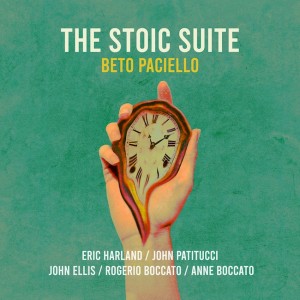
Beto Paciello plays piano on The Stoic Suite; mysteriously, he’s all but uncredited for it anywhere on the album package. Perhaps the relatively unknown Brazilian wants to play up the caliber of his collaborators: John Patitucci, John Ellis, Rogerio and Anne Boccato and Eric Harland? Don’t you want to hear that already?
Or maybe Paciello’s more interested in presenting himself as a composer, which he is, on all seven of The Stoic Suite’s tracks. The compositions certainly merit the attention. If it’s Brazilian jazz per se, it’s not overtly so — more like straightahead post-bop with some Brazilian flair. “Sunset Skies” comes the closest to the hardcore stuff, with Harland and Rogerio combining into a driving samba (or at least samba-adjacent) groove, with Ellis’ soprano, Paciello’s piano and Anne Boccato’s wordless vocals expressing a Jobim-like melody. Meanwhile, true to its name, “Mediterranean Sea” evinces an Italian flavor with its waltz rhythm and bass clarinet lilt. “Tempus Fugit” (no relation to the Bud Powell classic) is an edgy foursquare tempered by a sweet but soaring melody for Ellis’ bass clarinet and flute and Boccato’s vocals. All are distinguished by the composer’s intoxicating melody and rich, gorgeous harmony. But there’s also stellar solo work: Ellis is particularly fine with his flute on “Tempus Fugit,” Patitucci magnificent on “Sunset Skies.”
All the same, Paciello also deserves more credit as a pianist than he gives himself. His harmonically adventurous, tango-flirting solo on the opening “Amor Fati” is one of the album’s highlights, and his intro (in partnership with an arco Patitucci) on “Memento Mori” is a sensitive passage that deftly sets up Boccato’s melody line. He takes a feature on the haunting closer “Nostalgia (For My Mother),” so he’s not completely without self-esteem; even so, The Stoic Suite deserves to be celebrated.