
By Carlo Wolff | Published December 2025
Doc Pomus never had a hit under his own name, but the songs he wrote from the 1940s through the ’60s became so popular, you know them even if you didn’t know he created them.
Pomus and his key collaborator, Mort Shuman, wrote playlets of angst and desire, songs that have become lore: “Save The Last Dance For Me” by the Drifters; “A Teenager In Love” by Dion and the Belmonts; “This Magic Moment” by Jay and the Americans; and a gang of tunes sung by Elvis Presley, including “Viva Las Vegas,” “Little Sister” and “Suspicion.”
Jerome Solon Felder, alias Doc Pomus, was born in Brooklyn on June 7, 1925, and died of lung cancer on March 4, 1991. His work encompassed pop, rock and the blues, his original inspiration. Early on, Pomus led New York club bands that included the likes of fellow sax player King Curtis and guitarist Mickey Baker. He also performed alongside such legends as Lester Young and Horace Silver. But jazz would never be his métier.
Pomus cut a singular figure as he made his labored way to a club to perform or check out the latest sound. Crippled by polio as a child, he got around on crutches and used them to prop himself up when he belted the blues. Toward the end of the ’40s, he began to shift from performing to a more private pursuit; songwriting became full-time for him in 1955, and it is what he is known for.
Pomus wrote for Big Joe Turner, who turned him onto the blues, and for Ray Charles, the great soul singer who made Pomus’ remarkable “Lonely Avenue” as stark a classic as “Heartbreak Hotel,” Presley’s similarly themed breakout. The discipline Pomus ruled was the two- to three-minute single, an AM radio format requiring drama, melody and a captivating rhythm. Pomus and Shuman, like their West Coast counterparts Jerry Leiber and Mike Stoller, excelled at that form.
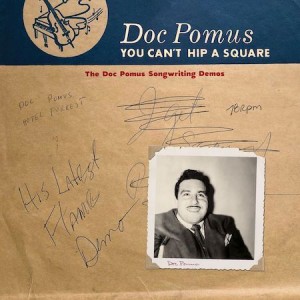
Pomus gets his due and much more on You Can’t Hip A Square: The Doc Pomus Songwriting Demos (Omnivore; 370:00), a six-CD, 165-track box arranged in book format. Disc 5 is dedicated to Pomus and Shuman songs that Presley recorded; disc 6 largely features Pomus as vocalist rather than Shuman, who sings and plays piano on most of the rest of this handsome and painstakingly informative collection.
Pomus and his young protégé were quite a pair, Geoffrey Himes suggests in the title essay. He “was rapidly creating his own songwriting duo to rival Leiber and Stoller,” Himes writes. “He realized his hard-blues tunes weren’t going to fly on pop radio, where the real money was. He needed his own Mike Stoller, who could integrate catchy melodies, sophisticated chord changes and Latin rhythms into the songs. Doc found him in a classmate of his kid cousin Neysha Ross, a teenage pianist named Mort Shuman.”
Listening to these psychologically acute songs brings on a severe case of whataboutism. Why didn’t “You Better Believe It,” a cautionary tale with a great hook, become a hit? Why didn’t “Foxy Little Mama,” a Jerry Lee Lewis-styled rocker? Trawl another 100 tracks and you’re sure to find more that should have (or could have) been hits. Immersing yourself in this embarrassment of riches sparks the playlist gene.
You Can’t Hip A Square: The Doc Pomus Songwriting Demos celebrates the 100th anniversary of Pomus’ birth, capturing him and Shuman in the act of creation as they talk a song into being, embellishing riffs, refining descriptions, freeing the emotions they’re trying to express. Their collaboration was profound, their chemistry undeniable.
This exceptional box was a labor of love for Sharyn Felder, Pomus’ daughter, namechecked on “I Ain’t Sharin’ Sharon,” a track on the first CD. It began when Sharyn, who was organizing Pomus’ archives, discovered a closetful of these demos. They present many styles and they’re malleable, stylistically neutral enough to be turned into whatever genre the eventual artist prefers. That doesn’t mean they’re generic and lack personality or substance. It only means they’re adaptable.
It’s a privilege to hear these songs unfiltered, in their original form. What makes them fascinating is speculating what other ways they might have turned out. What makes them satisfying is their passion. That never dates.