
By Ed Enright
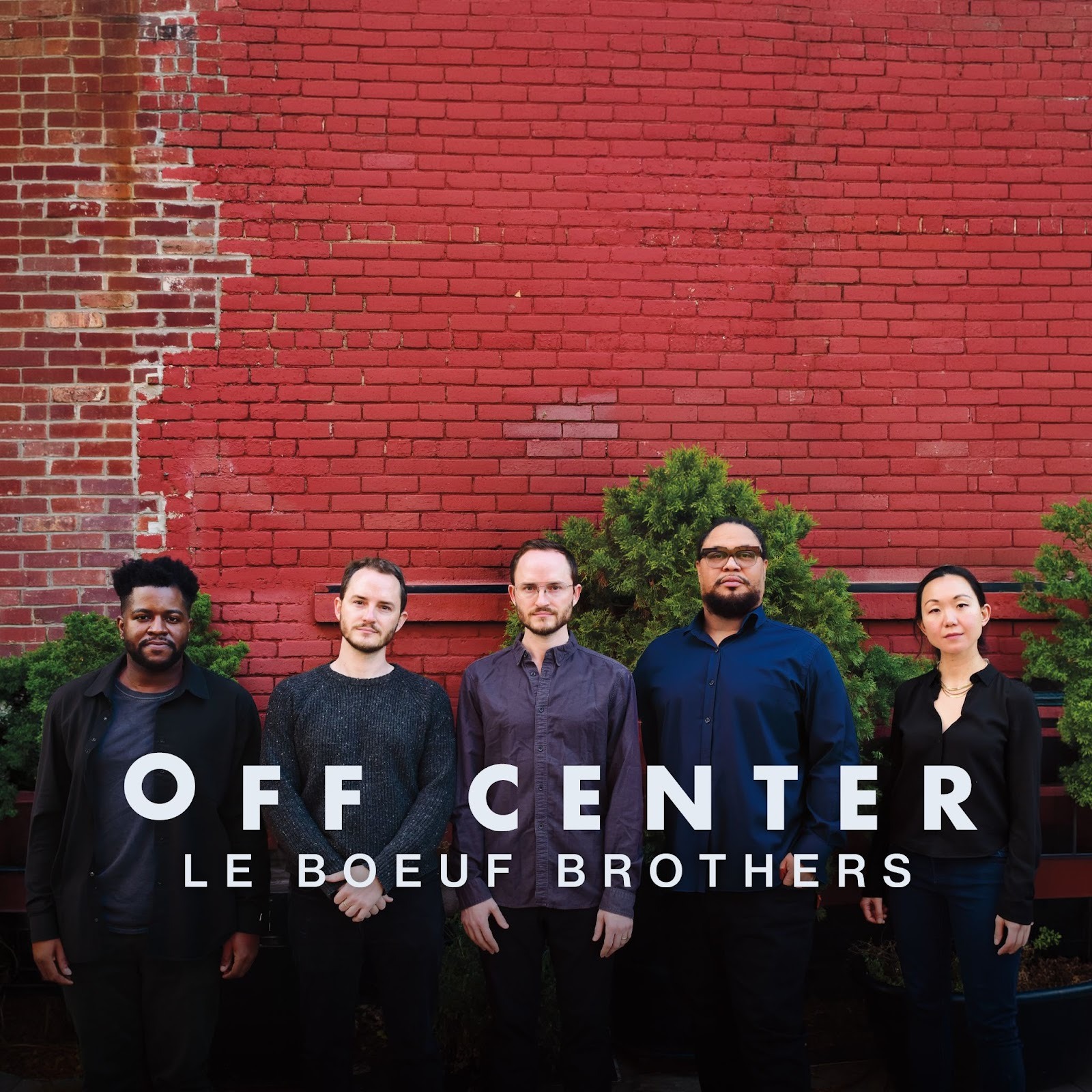
Remy and Pascal Le Boeuf, twin brothers from Santa Cruz who have teamed up to release six albums that embrace their jazz upbringing and venture bravely into contemporary classical and indie-rock realms, are currently at the top of their game as composers, having recently won individual Grammy Awards for Best Instrumental Composition. The upcoming Le Boeuf Brothers album Off Center, a follow-up to their whisper-quiet 2023 recording HUSH, jacks up the excitement factor with a program of all-original material that goes even further in engaging the simpatico members of their quintet, which includes alto saxophonist Remy and pianist Pascal joined by longtime co-conspirators Dayna Stephens (tenor saxophone), Linda May Han Oh (bass) and Christian Euman (drums). It’s an all-acoustic affair that finds the group leaning into spontaneity and elasticity in search of the unconventional, stretching the compositions (six by Pascal, five by Remy) far beyond what’s written on the page in a delightful adventure of shared risk and mutual trust. The Le Boeufs — who became involved with high-profile West Coast educational jazz programs at a young age, attended Manhattan School of Music and went on to get advanced degrees — have carved out neat career paths of their own. They have each produced significant bodies of work, releasing their own recordings as bandleaders, attaining high-level job roles in prominent educational institutions, garnering awards galore and delivering masterful compositions in connection with commissions and grants. And let’s not forget their well-honed chops, in-the-moment instincts and their seemingly second-nature ability to navigate and manipulate chord changes while improvising — qualities that come to prominence in this quintet environment and set in motion the more exciting and engaging aspects of Off Center. Since even before the 2009 release of their debut recording, House Without A Door, Remy and Pascale Le Boeuf have constituted one of the most compelling creative partnerships in jazz and contemporary music. They have developed into essential contributors to the modern jazz canon, and are well worth checking out on record and in live performance. Upcoming tour dates for Le Boeuf Brothers include shows on June 5 at Sam First in Los Angeles, June 6 at Kuumbwa Jazz Center in Santa Cruz, California, and June 7 at the Palo Alto Art Center Auditorium in Palo Alto, California. To listen to the single “In Captivity” from Off Center, CLICK HERE.
By Michael J. West
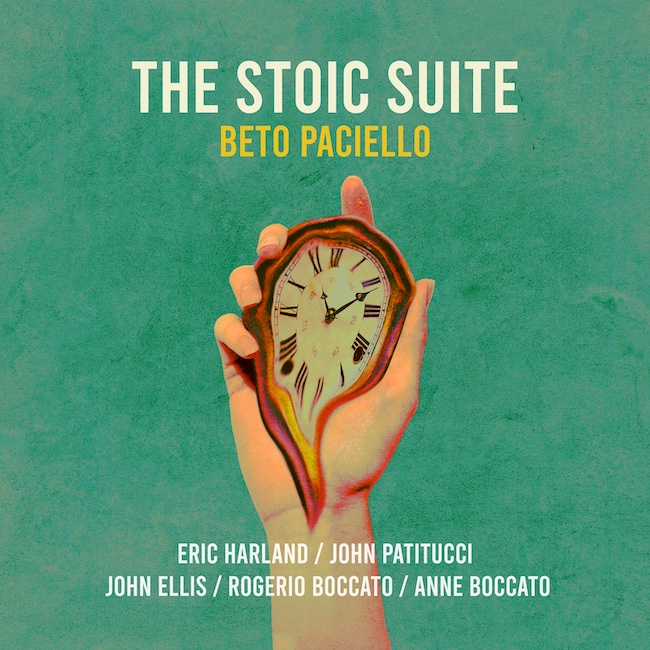
Beto Paciello plays piano on The Stoic Suite; mysteriously, he’s all but uncredited for it anywhere on the album package. Perhaps the relatively unknown Brazilian wants to play up the caliber of his collaborators: John Patitucci, John Ellis, Rogerio and Anne Boccato and Eric Harland? Don’t you want to hear that already?
Or maybe Paciello’s more interested in presenting himself as a composer, which he is, on all seven of The Stoic Suite’s tracks. The compositions certainly merit the attention. If it’s Brazilian jazz per se, it’s not overtly so — more like straightahead post-bop with some Brazilian flair. “Sunset Skies” comes the closest to the hardcore stuff, with Harland and Rogerio combining into a driving samba (or at least samba-adjacent) groove, with Ellis’ soprano, Paciello’s piano and Anne Boccato’s wordless vocals expressing a Jobim-like melody. Meanwhile, true to its name, “Mediterranean Sea” evinces an Italian flavor with its waltz rhythm and bass clarinet lilt. “Tempus Fugit” (no relation to the Bud Powell classic) is an edgy foursquare tempered by a sweet but soaring melody for Ellis’ bass clarinet and flute and Boccato’s vocals. All are distinguished by the composer’s intoxicating melody and rich, gorgeous harmony. But there’s also stellar solo work: Ellis is particularly fine with his flute on “Tempus Fugit,” Patitucci magnificent on “Sunset Skies.”
All the same, Paciello also deserves more credit as a pianist than he gives himself. His harmonically adventurous, tango-flirting solo on the opening “Amor Fati” is one of the album’s highlights, and his intro (in partnership with an arco Patitucci) on “Memento Mori” is a sensitive passage that deftly sets up Boccato’s melody line. He takes a feature on the haunting closer “Nostalgia (For My Mother),” so he’s not completely without self-esteem; even so, The Stoic Suite deserves to be celebrated.
By Frank Alkyer
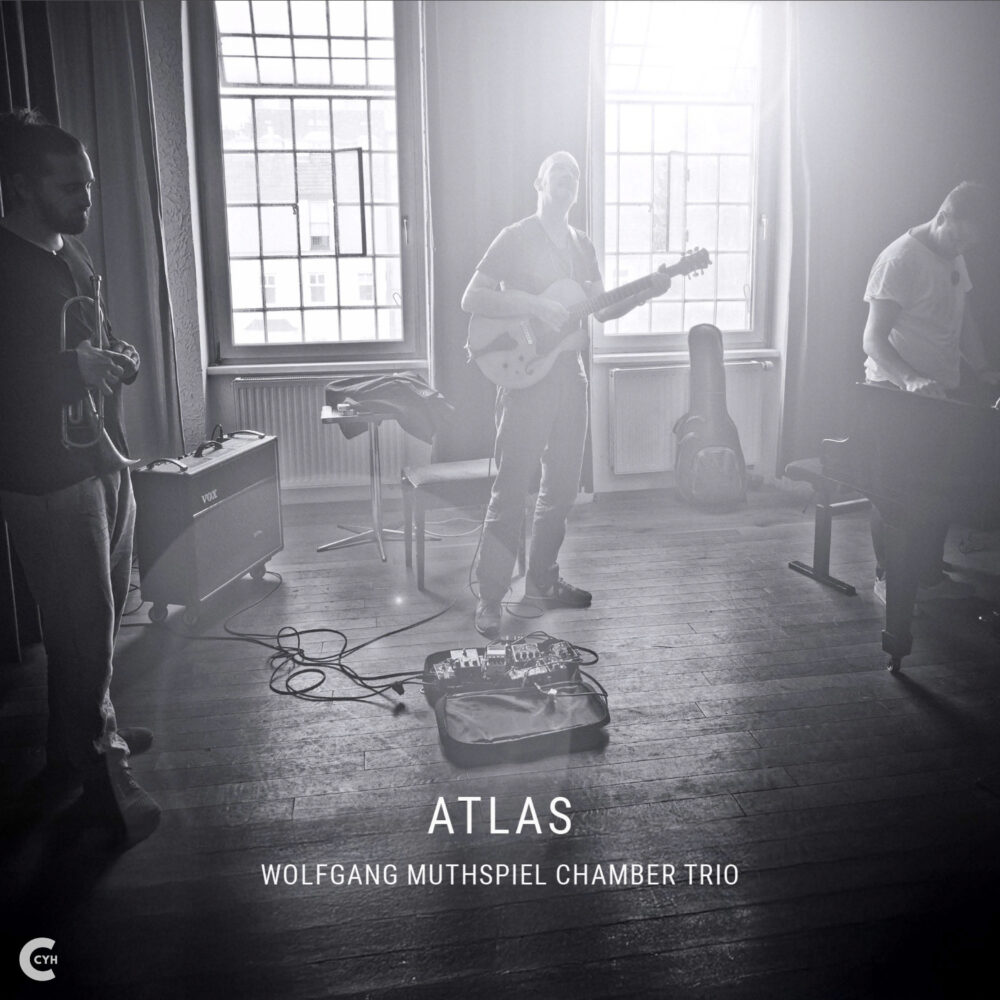
Wolfgang Muthspiel has been plying his creativity at the guitar for a dedicated, long time in nearly a dozen configurations as a leader — everything from solo works to big band extravaganzas to trio settings, especially trio settings. There’s his work with the MGT trio (with Slava Grigoryan and Ralph Towner), another with Larry Grenadier and Brian Blade, then the work he did with Brad Mehldau and Ambrose Akinmusire and the Autria String Trio (with Benjamin Schmid and Florian Eggner. All of them satisfying. But just as satisfying is the new Wolfgang Muthspiel Chamber Trio recording, Atlas. In describing the group on his website, Muthspiel says the goal of the group “is to create an interactive, polyphonic musical network that embraces the intimacy and transparency of chamber music formations without sacrificing rhythmic power or a sense of playful improvisation.” It’s fascinating what this combination of Muthspiel on guitars, Mario Rom on trumpet and Colin Vallon on piano can do. This isn’t what one might think of as a chamber group. They dispense with the pomp and politeness of classical music to focus on sound, improvisation and creativity. Take, for instance, the album’s fourth cut, “Lionel,” an obvious ode to Lionel Loueke, another trio collaborator (with Linda May Han Oh on the album Confluence.) The tune opens with Muthspiel rhythmically scraping the strings and using the guitar’s body as a percussion instrument to introduce a heartbeat before Rom and Vallon come in with the melody. There’s one foot in etude-land and another in modern jazz improvisation and just a touch of the flavor of mother Africa. Vocals, sweet and simple, come into the sound palette, and then at about the 6 minute mark the beauty is interrupted by a furious lash of electric guitar theatrics in a way that catches the listener off guard, but makes perfect sense. The playing on this album is beautiful. Muthspiel’s acoustic guitar work on songs like “Gaucho Shubert,” the opening track,” just glisten. With overdubs, pure flights of technical precision and in-the-moment soloing, there’s so much to like on this recording. And massive thanks to the team that recorded, mixed and mastered this work. The sound is as impeccable as the musicianship.
By Ed Enright
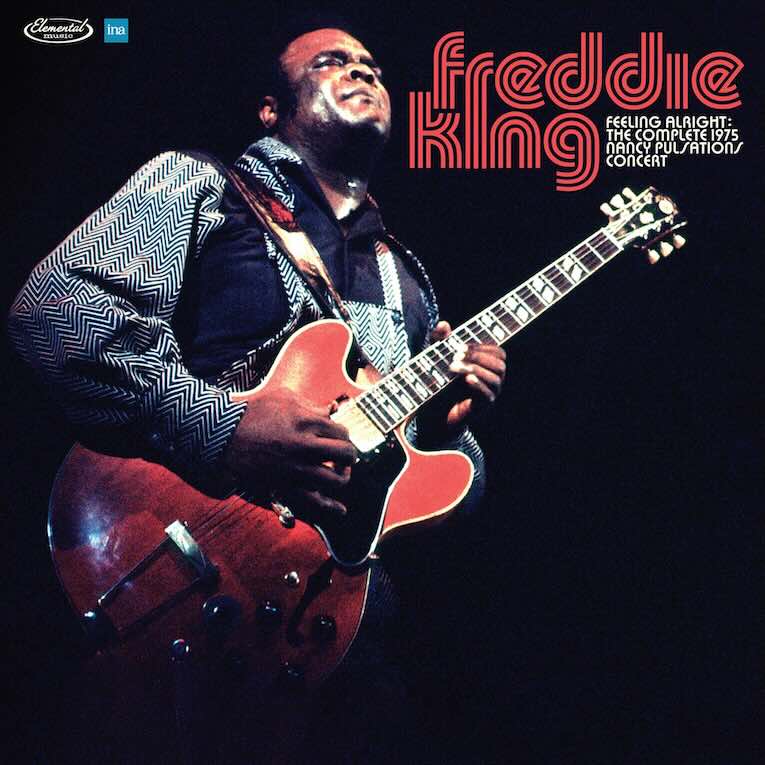
We’re super fortunate that this three-LP vinyl set consisting of previously unreleased material recorded live at the 1975 Nancy Jazz Pulsations Festival in France was released earlier this month as a limited-edition Record Store Day “First.” Freddie King was in peak form and at the height of his popularity when the blues guitar giant and his crack band played to a huge, enthusiastic crowd at one of Europe’s major music festivals at a time when audiences raised on rock ’n’ roll began widely embracing those pioneering artists who were closely connected to the music’s traditional roots. Thanks to album producer and archivist Zev Feldman, who sourced the recordings from the French Radio and Television Broadcasting Office, we now have a great-sounding live document of The Texas Cannonball — something that hasn’t been very forthcoming in the past — performing a generous 16-song mix of his best-known instrumentals (including “Hide Away and “Sen-Sa-Shun”), essential blues standards (“Got My Mojo Working,” “Messin’ With The Kid” and “Stormy Monday,” to name a few) and covers of the late-’60s rock radio hits “Goin’ Down” (by southern soul-rocker Don Nix) and “Feelin’ Alright” (by Traffic’s Dave Mason). Supporting King’s stinging guitar lines and commanding vocals are simpatico touring band members Alvin Hemphill (organ), Lewis Stephens (piano), Ed Lively (second guitar), Benny Turner (bass) and Calep Emphrey (drums), a tight unit if there ever was one. The expertly paced program ranges in mood from calming blue-sky coolness to stormy rock intensity to see-the-light gospel ecstasy, the music leaving ample room for judicious soloing, stretching and testifying. The notoriously hard-living King died just a year after this performance, at age 42, a sobering bit of blues history that makes this deluxe package all the more valuable for today’s listeners and collectors. Also available in CD format, it makes a great companion piece to the two-LP set B.B. King In France: Live At The 1977 Nancy Jazz Pulsations Festival, produced by Feldman and released as a Record Store Day “First” in November 2024.
By Michael J. West
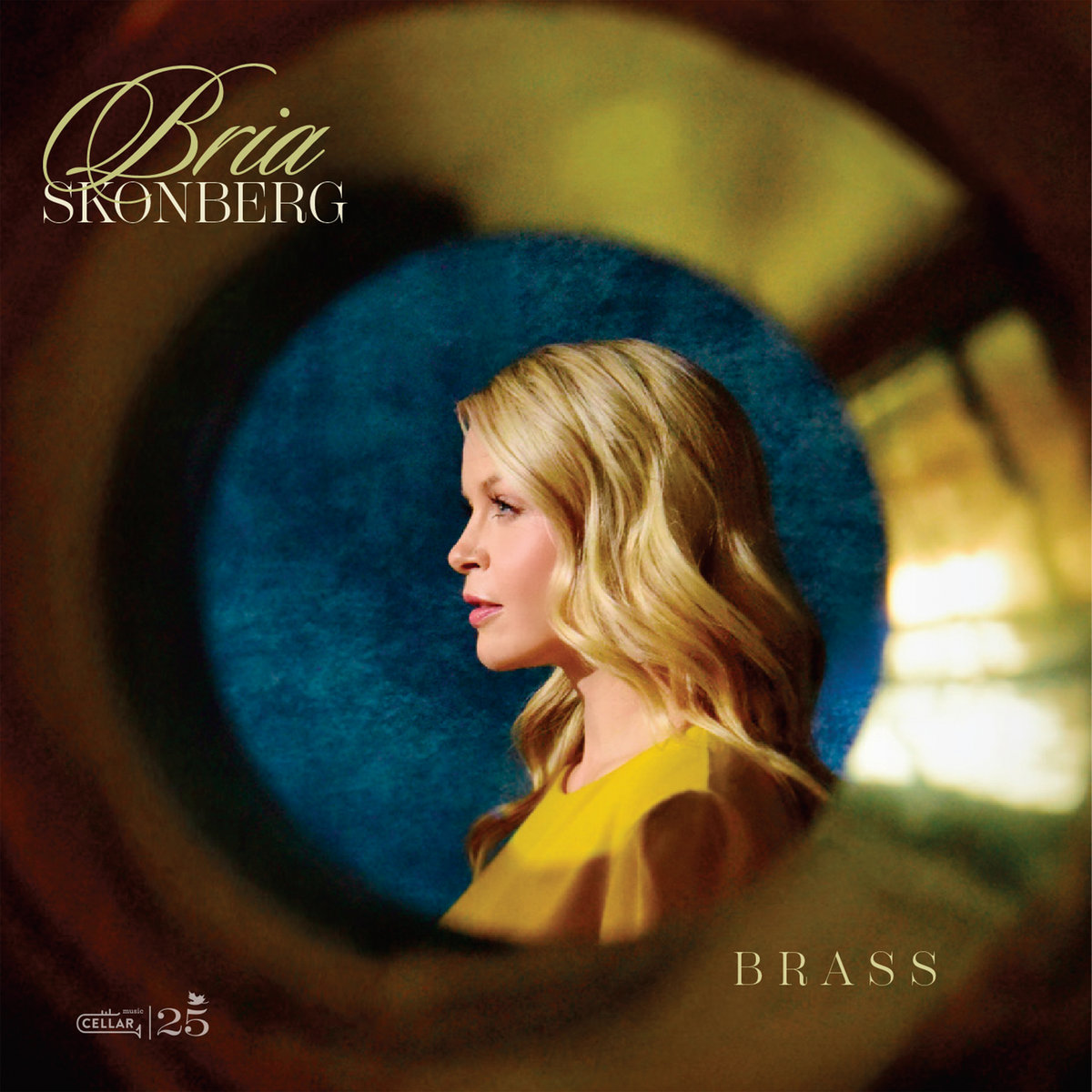
Bria Skonberg is often asked whether she’s a trumpeter or vocalist first — a question that becomes irrelevant when you see how much fun she has doing both on stage. On Brass, she’s firmly a trumpeter first. Indeed, there’s only one vocal on the whole album, on the closing medley “Comin’ Home Baby/You’d Be So Nice To Come Home To.” (She plays the former and sings the latter.) The rest lives up to the album’s plainspoken title, with Skonberg demonstrating her considerable accomplishment on the horn.She’s certainly developed a unique voice, one that combines the dry-champagne tone of Miles Davis (though with a smidge more vibrato) with a healthy cache of brio and technique. The technique is most evident when she uses mutes, as in her boisterous plunger growl on Jelly Roll Morton’s “New Orleans Bump” and remarkably high-spirited Harmon on “Between The Devil And The Deep Blue Sea” (where she slips in some deliciously upturned trills that feel like a calling card). The brio is apparent everywhere — from the jump-blues trumpet battle (with guest Kellin Hanas) on “Brotherhood Of Man” to the ballad “Somewhere Out There” (from the 1986 animated film An American Tail). Skonberg does not improvise here, handling the written melody and leaving pianist Luther Allison to solo, but she doesn’t need to. Her sweet delivery and subtle blues colors make her statement.
Hot jazz — trad and swing — remain Skonberg’s stock-in-trade; “Somewhere Out There” could easily be transposed to a trumpet feature in a big band set. But there’s some modernism here as well: The leader’s own “Of Liberty” is the prime example, resting on sophisticated harmonies and rhythmic details that give Allison, bassist Eric Wheeler and drummer Darrian Douglas a great showcase. There are also shades of Sonny Rollins (including a paraphrase from “St. Thomas”) in the calypso opener “Markham Sunrise.” It’s a hell of a lot of ground to cover, and Skonberg gets it all in without even seeming to break a sweat. DB
By Frank Alkyer
There’s something about the soulfulness of Shabaka Hutchings, who now goes simply by Shabaka, that stirs emotion and summons the spirit. It’s been that way with his various bands (Sons of Kemet, Melt Yourself Down, The Comet Is Coming, the Ancestors) as well as his solo projects (Afrikan Culture and Perceive Its Beauty, Acknowledge Its Grace). So now comes a truly solo project, Of The Earth, one where Shabaka composes, produces and plays every instrument on the recording, which he released on his own record label. It’s spellbinding. The multi-instrumentalist took an 18-month break from performing on tenor saxophone, long known as his main instrument, to pursue his interest in flute. But here on Of The Earth, he returns to saxophone, employing it as just one of many instruments in his artistic palette along with flutes, drum machines and assorted electronics pulled from a portable audio setup he has been traveling with on the road. He pulls it all together into a sound bath that would make Pharoah and Coltrane smile. “A Future Untold” offers a dripping plea from his saxophone over a wash of chimes and electronic soundscapes. With “Those Of The Sky,” Shabaka brings in a chorus of overdubbed flutes and reeds with infectious, slow-groove beat-making. On “Go Astray,” Shabaka raps, his voice processed, poised and driving over an industrial-age, metallic beat. He offers a more inward-looking spoken word on the album’s closing number, “Lowered Eyes.” In between, there are mind-blowing nods to Mother Africa with “Dance In Praise,” “Ol’ Time African Gods” and “Marwa The Mountain.” The way he uses the sound of flutes to soothe, his saxophone to shred and beats to drive on “Stand Firm” is fascinating. As a whole, it seems as though Shabaka has channeled the elders and pulled them into the future. Bottom line, Of The Earth offers a rare, beautiful listen from a modern master of the art form.