
By Michael J. West
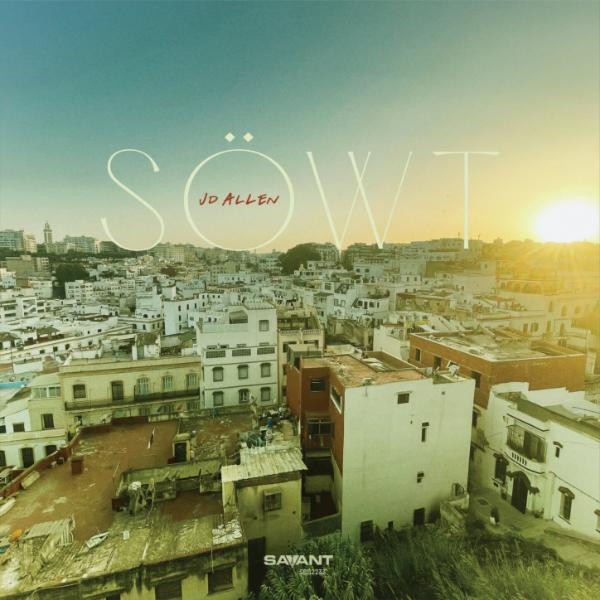
Even as determined as he is not to repeat himself, Söwt is like nothing else in tenor saxophonist JD Allen’s album-per-year catalog. Even using lush chordal accompaniment, as with pianist Brandon McClure on last year’s Love Letters (The Ballad Sessions), Allen has reserved for himself a spacious approach where he can pursue his melodic and harmonic fancies. This one, recorded in Morocco, dispenses with that for the trancelike drones of the Gnawan musical tradition. The results couldn’t be more wonderful.
Allen leads an international quintet including French pianist Leonardo Montana, Cuban drummer Ruy Adrian López-Nussa and Moroccan bassist Hamza Souissi and guembri player Yazid El Alaoui. However, it’s El Alaoui, the Gnawan, who sets the tone with his one-chord ostinatos on each song. Souissi and López-Nussa maintain a low simmer alongside him, though both are more improvisational (particularly the drummer, who continually finds new syncopations and textures inside the groove). It’s Montana and Allen who do the building on that foundation — and generating friction with it.
Said friction comes in ways subtle and not. In the former case, there’s the opener “Kin,” on which Allen’s solo comprises short, jagged phrases that he places just barely out of step from El Alaoui and López-Nussa’s four-bar riffs. Later, on “Solid,” with Souissi more prominent in the rhythm section, Allen’s improvised phrases are in step, but just outside the harmony instead. The title track finds Montana playing an even neater trick. He raises the temperature enough that he threatens to boil over; he doesn’t, but riles López-Nussa into doing so instead. On the not-so-subtle side, Allen plays long, slow, noirish figures over a weirdly harried rhythm section on “Found,” Montana responding with thick, oddly shaped chords. If it’s a battle of moods, Allen’s slinkiness wins — but it’s the battle itself that’s compelling.
“Found” notwithstanding, the Gnawa meditations are the defining feature of this music, not least because of softly muttered chant-singing from El Alaoui (with an uncanny resemblance to singer Damo Suzuki of the classic German band Can). They usually manage to overtake — beautifully so on the captivating “Moussayé,” where stormy playing on both sax and piano isn’t enough to drown out the gorgeous repeating figure on the guembri. Things are just as compelling when Allen and Montana put aside the tensions and go with the flow, as on the lyrical “Lil Lullaby.” It would be out of character for Allen to tackle this concept again, but, oh, how I hope he does.
By Frank Alkyer
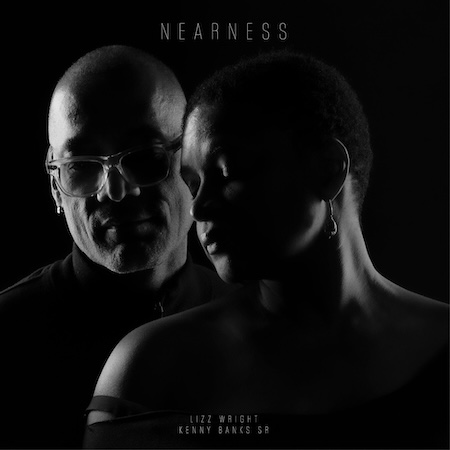
There are few things on planet Earth more beautiful than the voice of Lizz Wright. Her alto demands your ears. Her tone and phrasing melt your soul. So, what could be more perfect than an assembly of standards, spirituals and originals featuring just the voice of Ms. Wright and the soulfully brilliant pianism of Kenny Banks Jr.? Nothing. From the first strains of “The Nearness Of You,” it’s time to grab a comfortable chair, close your eyes and let Wright and Banks take you away. “Nearness” becomes a prayer at an achingly slow tempo that hangs every syllable, lyric and stanza on a gentle breeze. When Mr. Banks slides over to the Hammond B-3 for the spiritual “Soon I Will Be Done,” the duo takes us to a Sunday morning sermon, testifying: “Amen.” Throughout Nearness, Banks and Wright weave an intimate cocoon of spirituality with wonderful takes on “Hold On,” “Amazing Grace” “How I Got Over” and, especially, “Deep River.” On the latter, Wright crosses over into an almost operatic vocal that is absolutely stunning. Somewhere Mahalia Jackson is smiling. When not taking us to church, the duo sends a bit of a love letter as highlighted by the title tune, “All The Things You Are” and “Just You, Just Me” as well as the terrific originals “Hold Me” and “Circling,” the closing number done a cappella. Ms. Wright and Mr. Banks beautifully offer calm, confidence and hope in a chaotic world. Nearness is a perfect balm for difficult times, and a treasure.
By Ed Enright
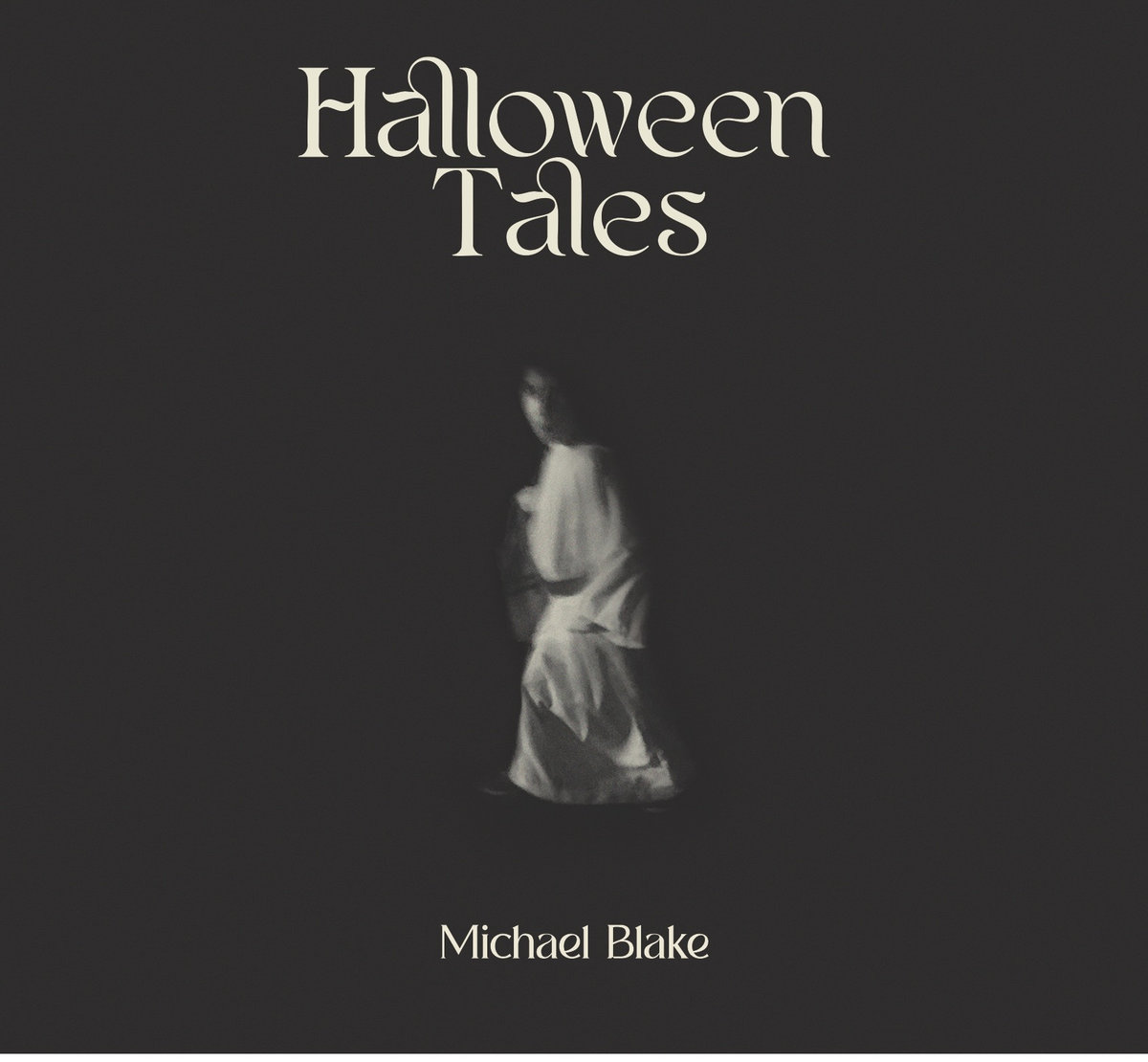
The most frightening moments of Halloween Tales unfold on the haunting first track, which finds the goresome foursome of saxophonist Michael Blake, pianist Gary Versace, bassist Ben Allison and drummer Michael Sarin scaring teenaged babysitters witless with their rendition of the haunting main theme to the 1979 movie Halloween. You can’t help but feel a little unsettled as bell-like tolls of doom signal the onset of All Hallow’s Eve and the boys set out trick-or-treating in the dodgy part of the neighborhood where the most gleefully devilish jazz cats dwell. First stop is “Stalking Monster,” the second movement of Duke Ellington’s 1955 symphonic jazz suite Night Creature; after some heavy, slow, syncopated stalking from Versace at extreme ends of the keyboard, this minor-key swing groove is as easygoing as it is unsuspecting, even as the titular monster’s multiphonic roars can occasionally be heard emanating from Blake’s otherwise subdued tenor. The much less foreboding and more optimistic “Great Pumpkin Waltz” (by Vince Guaraldi), with Blake playing dark-timbred tones on soprano, is classic 1966 Charlie Brown music — an swinging autumn stroll in 3/4 through the fields with childhood pals and pets. “Transylvanian Lullaby,” from the 1974 movie Young Frankenstein, is slow-walking and hauntingly beautiful, conjuring the first tentative steps of the film’s newly “born” quasi-human abomination; if you’ve seen the picture (with music composed by John Morris) you won’t be able to keep from laughing at the memory of those classic comedic scenes with character actor Peter Boyle. The gang heads back to Ellington’s house on “Anatomy Of A Murder (Main Theme)” from the triple-Grammy-winning 1959 film of the same name; it’s a minor blues in 12/8 that serves as a soulful study in cinematic suspense. An outing with this lineup of familiar jazz cats wouldn’t be complete without a songbook standard; they play Cy Coleman’s “Witchcraft” much witchier and breathier than Frank Sinatra’s 1957 hit version. Before heading home for the night with their Halloween haul, the merry pranksters conjure up a just-for-fun original, Blake’s “The Creep,” which crawls, then runs, then slows again to a spooky, cautious stroll following a killer bass solo, ending on an unresolved note that just might leave you glancing back over your shoulder once or twice.
By Michael J. West
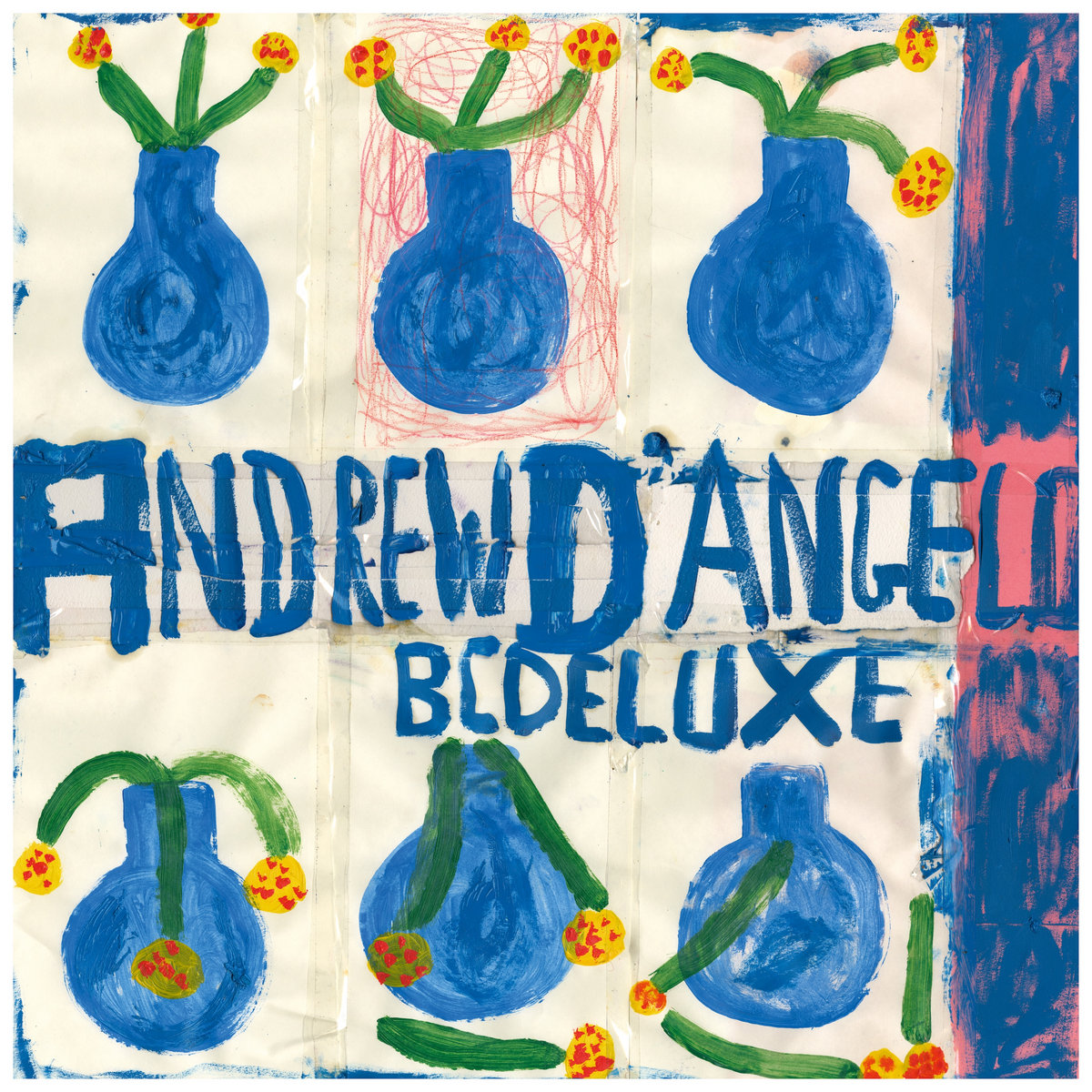
I wanted to make a crack about how BCDELUXE is “the solo bass clarinet album the masses have been clamoring for,” but, by God, the masses should have been clamoring for it. You’d swear it was a demonstration disc on what the instrument was capable of, if D’Angelo didn’t have — and nail — such high artistic ambitions.
This can’t be called an unaccompanied bass clarinet album, because D’Angelo’s axe accompanies itself, via overdubs of differing timbres and textures. “Blues Lightening” offers three versions of D’Angelo, with soft-edged smoothness on the bottom and coarser, more aggressive tones in the foreground (though at some points the triple voices blend together), and it swings like hell. “Sonification” puts the breathy drones up front, with the higher, more melodic D’Angelo further back and drenched in reverb; the effect, not unlike that of medieval polyphony in an old stone church, is beautiful.
D’Angelo doesn’t need the multitracking. He swings without it on the brief interlude “Dingsbums” and achieves a folksier gait on another quickie, “Referendum.” Yet it’s hard to argue with the results when he does double or treble himself. “PK 3809” is exquisite, a romantic lullaby with an organ-like pedal point and delicate lyrical strains. The masterpiece of the session, however, is the closing “Light Language” (at nine-and-a-half minutes, almost twice the length of the second-longest track). The long drone tones are the highest voicing, creating a Bill Frisell-like atmosphere, with the low end being soft to the point of inaudibility at times and the middle tones carrying the melodies. At least, that’s the default setting; the three voices interweave, sometimes in harmony and sometimes in counterpoint; they play calls and responses, and they leave each other space to comment. Loveland Records owner Jakob Bro, who once roomed with D’Angelo and heard him practicing solo bass clarinet, long knew what the rest of us can now attest: All by himself, D’Angelo is both a virtuoso and a visionary. –Michael J. West
By Frank Alkyer
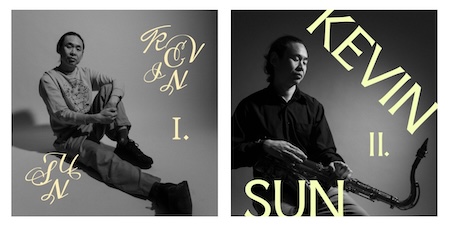
Kevin Sun is one of the most talented saxophonists and composers on the jazz scene today. Inspired, individualistic and smart, he brings forth music that entertains and intrigues. His work is never a straight line. And his influences? Well, let’s just say they are very, very varied! He may take inspiration from a jazz legend or a video game, a wizard of electronic music or a visionary of television music scoring. But along the way, he makes music his way for his own label and follows wherever the muse takes him.
For his latest two releases, Kevin Sun I. and Kevin Sun II., the tenor saxophonist proves the point. On I., he lays out a studio-driven set of eight songs that were workshopped over some 18 months at the Lowlands Bar in Brooklyn, New York, with guitarist Max Light, bassist Walter Stinson and drummer Jon Starks. The album features great musicianship and a very cool production edge. On II., the whole thing was cut in one afternoon in Minneapolis after a tour with Stinson, pianist Christian Li and drummer Kayvon Gordon. Two very different settings, groups and goals, but one successful accomplishment: some fascinating music.
Kevin Sun I. charges out of the gate with “Go In,” a rapid-fire blitz of melody over John Coltrane’s “Countdown.” It makes you wonder if this is how Trane might have sounded in 2026. “Souls Of Fire (A Moment’s Peace, From Dark Souls)” is a slow build with electronics backing Light’s melodic guitar work. This reviewer knows nothing about the video role-playing game Dark Souls, except now I know it has a really cool soundtrack. Sun and company choose creating atmosphere over blistering runs of notes. Nothing extra is added, just what is needed. And it’s lovely. On “Between Night And Day,” Sun offers achingly slow, long tones over a bed of electronic washes to beautiful effect. In the liner notes, he says that the bed was actually a studio trick he learned from pianist Christian Li. He recorded the music backwards, then played it in reverse “to create an otherworldly, Twin Peaks effect.” Mission accomplished! With “Riot In Lagos,” Sun tricks out the Ryuichi Sakamoto tune by overlaying takes to give this raucous explosion a “double quartet” feel.
With Kevin Sun II., the artist strips away all of that production, choosing to document his touring band at the time in an old-school, one- or two-take, no-edits, one-afternoon session at the end of the tour. It kicks off with “Unformed, Shrouded By Fog (Souls Prologue),” a film noir soundscape, make that a game noir soundscape. Sun dedicates the tune to Lim Pik-Sen, the Malaysian-British actress who passed away in 2025 and whose voice narrated the Dark Souls role-playing game trilogy. “Souls Of The Mist (From Demon Souls)” is another Dark Souls-inspired creation that finds the quartet in a quiet, slow groove. Sun’s tenor swings plaintive, searching; Christian Li’s piano, fluid and soothing with just the right touches of beauty and sorrow. Stinson and Gordon glide through the groove with grace and elegance. With “Laura Palmer’s Theme,” there’s something in the air, this is the second recent reading that’s hit DownBeat of the music written by Angelo Badalamenti for David Lynch’s defining television drama Twin Peaks (the other by pianist Jamie Saft on Oh, Angelo). Talk about film noir. This tune just drips with tragedy and dusk. Sun said he wrote this arrangement after watching the first two seasons of the show back in 2013 and revisited it now that both Badalamenti and Lynch have joined the ancestors. Sun has a true admiration for the ancestors. For me, “Belong, Sonny” is the crown jewel of these two recordings, a beautiful love letter to two tenor giants who have passed: Benny Golson and Sonny Rollins. It’s a tribute that bops with full-on tenor worship and a title serving a dual purpose. Yes, it mentions Sonny, but the letters can be rearranged to spell out Benny Golson. Beyond that, Sun draws his inspiration for the tune from Golson’s composition “Stablemates.” It’s both fitting and exhilarating with all four members of the band delivering amazing artistry. Sun offers himself as a tenorist who’s fully aware of his own gifts, but also knows the shoulders he stands upon.
By Ed Enright
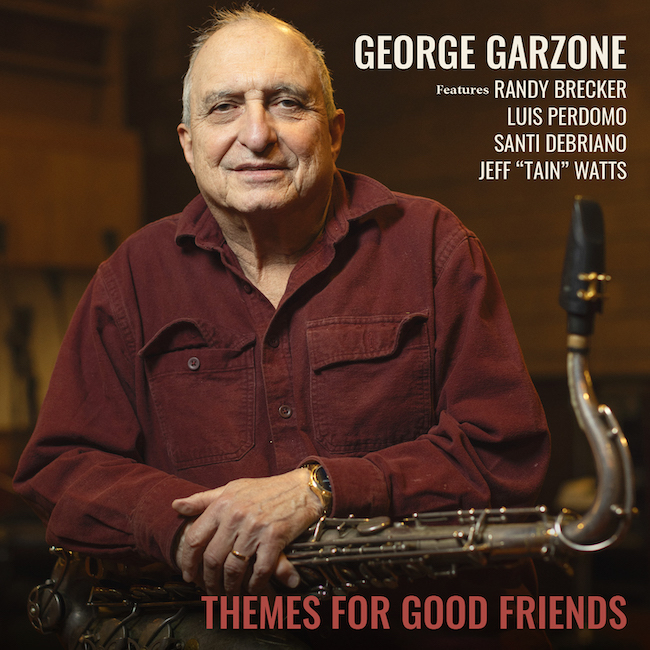
It’s the way George Garzone and his all-star quintet play that makes this studio recording feel so much like a live blow. It’s the soul-stirring conviction heard in their approach to the three originals on this eight-song, straightahead jazz program that makes them sound as warm and familiar as old standards. And it’s the exploratory manner in which the Boston-tough, Berklee-smart tenor saxophonist and his co-conspirators — trumpeter Randy Brecker, pianist Luis Perdomo, bassist Santi Debriano and drummer Jeff “Tain” Watts — reinvent the program’s four standards (and one contrafact) that makes them so worth listening to again. Themes For Good Friends showcases Garzone’s enduring — and highly influential — voice after more than 50 years in the music. Indeed, he continues to play with the same harmonic sophistication, pure tenor tone and deliberate approach to improvisation that have defined him all along. Themes For Good Friends also serves as a celebration of musical relationships forged over a lifetime. Each musician is a bandleader and improviser in their own right; together they create a unified ensemble built on decades of friendship and collaboration. Opening the album is John Coltrane’s “Theme For Ernie” performed as a lyrical duet between Garzone and Perdomo. Archie Shepp’s “U-Jaama” follows, with Watts anchoring the full ensemble before launching into a commanding solo and Debriano providing a rhythmic foundation that allows the music to swing effortlessly. “It Will Happen To You,” built upon the framework of Jimmy Van Heusen’s “It Could Happen To You,” demonstrates Garzone’s wit as an arranger, as the track transforms familiar material into a joyful modern swing vehicle; Brecker delivers a trumpet performance filled with warmth and invention, while Perdomo contributes an exuberant piano solo before the fun concludes with a spirited exchange between Debriano and Watts. Debriano’s composition “Ripty-Boom” provides one of the album’s more expansive performances, with every member stretching freely. Garzone’s “To Michael Brecker” finds him joining the late saxophonist’s trumpet-playing brother in a single melodic statement that becomes a moving tribute to one of jazz’s most beloved voices. Garzone and Watts’ duet deconstruction of “Giant Steps,” an adventure in twisty improvisation that reveals the familiar Coltrane melody only in its closing moments, is one of the bolder statements in this delectable, highly accessible program of hard-swinging hard-bop and heart-wrenching balladry. It passes the “listen to this album over and over all day” test with flying colors.