Sep 3, 2026 10:44 AM
In Memoriam: Cassandra Wilson, 1955–2026
Cassandra Wilson, a singer, songwriter and producer who was one of the most acclaimed and successful jazz vocalists of…


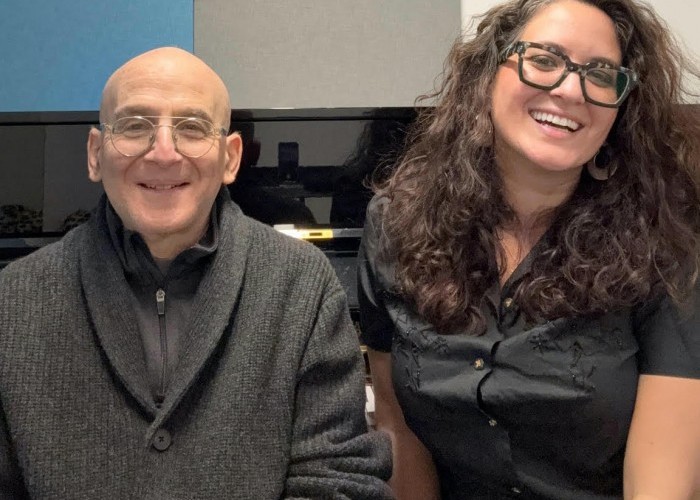
Blindfold Test proctor Ted Panken, left, with the Grammy-winning Nicole Zuraitis.
(Photo: Nicole Zuraitis)After earning the 2024 Best Jazz Vocal Album Grammy for her seventh album, How Love Begins (La Reserve), comprising 12 of her original songs, Nicole Zuraitis was nominated for another pair in 2025 for Live At Vic’s Las Vegas and All Stars Lead To You–Live. In December, Zuraitis took her first-ever Blindfold Test.
Carmen McRae
“Spring Can Really Hang You Up The Most” (Bittersweet, Focus, 1964) McRae, vocal; Norman Simmons, piano; Mundell Lowe, guitar; Victor Sproles, bass; Curtis Boyd, drums.
Carmen McRae. Spectacular. She phrases so beautifully. Her voice has so much character. It’s inimitable. It has a horn-like quality — and also a spoken tone aspect — that I love. I was laughing during the key change in the coda to “my condition must be chronic” because it felt like the band almost missed it, and she was singing a little harder, maybe because she was irritated. I’ve noticed that she sang with more technique on her early albums, and took more risks as she got older. This feels like peak Carmen, similar to when she did The Real Ambassadors.
Alexa Tarantino
“Moon Song” (The Roar And The Whisper, Blue Engine, 2025) Tarantino, flute; Cécile McLorin Salvant, vocal, composer; Steven Feifke, piano; Philip Norris, bass; Mark Whitfield Jr., drums.
Cécile. Her voice is a beautiful instrument, and she uses its full facility, seamlessly. When I was learning, jazz was embracing the straight tone and instrumental sound of the voice. When she came on the scene, I was excited to hear her use a full vibrato. It’s interesting to hear her use it in the upper register, which is pretty theatrical. Lately, I feel I’m always hearing Kate Bush in her — a fluttery, creepy, haunting sound. The song is beautiful. I can’t place it. ... I love the voice-flute duo up front. Who plays flute like that? [afterwards] I’ve known Alexa since she attended Litchfield Jazz Camp.
Samara Joy
“Reincarnation Of A Lovebird” (Portrait, Verve, 2025) Joy, vocal; Jason Charos, trumpet; Kendrick McAlister, tenor saxophone; Dave Mason, alto saxophone; Donovan Austin, trombone; Connor Rohrer, piano; Paul Sikilvie, bass; Evan Sherman, drums.
Samara Joy. She also uses her full instrument. It’s exhilarating to hear someone who loves to sing and loves the study of pedagogy. Her voice is unmistakable. I hear the influences of Sarah Vaughan and Ella, especially in the trills, and also how she drops the larynx and then lifts it up into straight tone. She’s chosen to write lyrics and work with young players and arrangers, and it’s exciting to watch her evolve while in the limelight. That speaks to her strength of character.
Sarah Vaughan
“The Nearness Of You” (Live In Japan, Mainstream, 1973) Vaughan, vocal, piano; John Gianelli, bass; Jimmy Cobb, drums.
Sarah Vaughan, playing for herself. An accompanist would use the damper and voicing differently. What she played wasn’t simple; just what was necessary. She was so harmonically creative, reharming brilliantly and leading herself, going back and forth like a school of fish. I also love how she takes her time and relishes the sound of her amazing voice.
Doug Wamble
“If I’m Evil” (Blues In The Present Tense, Halcyonic, 2022) Wamble, guitar, vocal; “Prometheus Jenkina” a.k.a. Branford Marsalis, tenor saxophone; Eric Revis, bass; Jeff Watts, drums.
Doug Wamble. I know the sound of his guitar and voice — his natural soul. He has something to say, and he’s not afraid to say it. When we were both in rotation at the 55 Bar, I was always blown away by his rapport with the band, and also his understatement. In the same set, he’d go from sounding like Nat “King” Cole to sounding like B.B. King. He’s a deep musician. [afterwards] What a band!
Ekep Nkwele/Vuyo Sotashe
“Skylark” (Emmet’s Place, 2024) Nkwele, Sotashe, vocals; Emmett Cohen, piano; Yasushi Nakamura, bass; Kyle Poole, drums.
That’s from Emmett’s Place. You can tell it’s live because the two microphones sounded different. Emmett is a very playful pianist. You hear the singers rooting for each other, spurring each other’s momentum. One voice sounds highly influenced by Betty Carter, swinging her face off and fearlessly leaning in — I heard Abbey Lincoln in there, too. There’s playfulness and super-heavy swing. Must be one of the Lincoln Center kids. The other voice is a stunning instrument with contralto qualities, in the pocket, more rooted, with a warm quality that feels like a hug. You hear so many influences, it’s hard to tell who it’s coming from. There’s a yin and yang. You’ll have to tell me. [afterwards] Ekep is so killing. She’s going to be the next star.
Shirley Horn
“Everything Must Change” (May The Music Never End, Verve, 2003) Horn, vocal; George Mesterhazy, piano; Ed Howard, bass; Steve Williams, drums.
Whenever I need to feel a lyric, I look at Shirley Horn because she sings for the story, not showmanship. You can hear her life as she sings the lyrics, but also speaks them, almost like poetry. It’s a really hip arrangement, I think in 11/4, and then they break into a swing section and keep it in 4 until the end. That’s why I love jazz. There are no rules.
Betty Carter
“All Or Nothing At All” (Feed The Fire, Verve, 1991) Carter, vocal; Dave Holland, bass.
This is a swinging-ass bass player! Is it Christian? Then it’s one of Christian’s influences who played with Betty Carter. You could sing that bass solo. That’s how musical it was. Dark and lyrical. That’s another reminder to take your time, but only if you have something to say. And Betty Carter always has something to say. I love that song, but I thought she was brave to do it duo, because the bridge back into the “A” section is a tricky jump — you hear her struggling to find the center of the pitch on the way out. She sings like an instrument and her voice is unique. There is no other. DB
The “Blindfold Test” is a listening test that challenges the featured artist to discuss and identify the music and musicians who performed on selected recordings. The artist is then asked to rate each tune using a 5-star system. No information is given to the artist prior to the test.
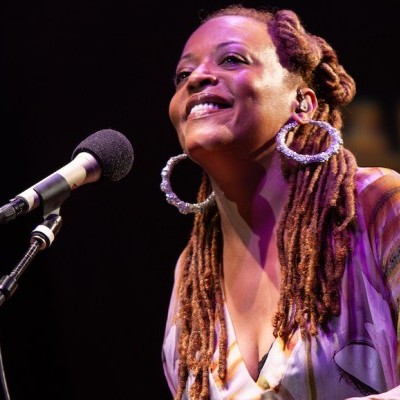
Wilson’s ability to connect to audiences helped her to win two Grammy awards and multiple other accolades. She was named an NEA Jazz Master in 2022.
Sep 3, 2026 10:44 AM
Cassandra Wilson, a singer, songwriter and producer who was one of the most acclaimed and successful jazz vocalists of…
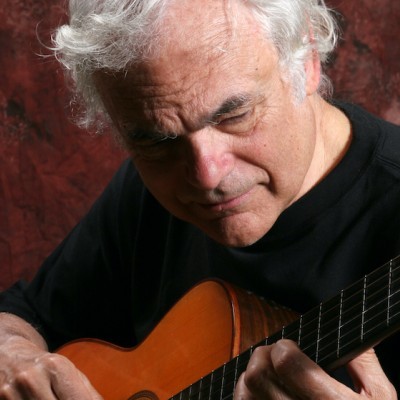
Bertoncini was a specialist and advocate for the nylon-string acoustic guitar, turning down high-profile opportunities that were unsuited to the sound and techniques that he used with that instrument.
Sep 1, 2026 11:06 AM
Gene Bertoncini, an esteemed jazz guitarist, composer, arranger and educator, died Aug. 29 at the Lillian Booth Actors…
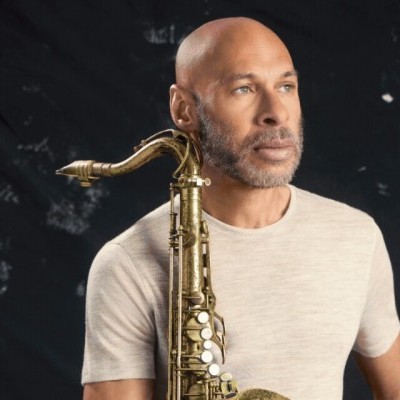
A solo concert by saxophonist Joshua Redman will close the first night of the Hyde Park Jazz Festival on Sept. 26.
Sep 22, 2026 12:26 PM
The Hyde Park Jazz Festival will take place for the 20th time on the final weekend of September 2026. Beginning half…
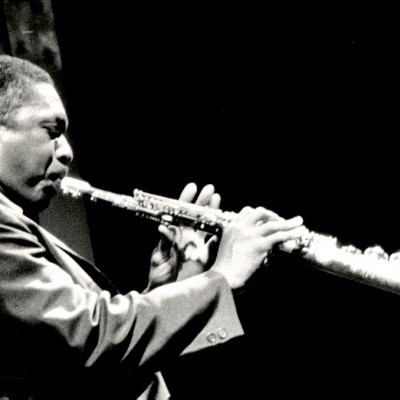
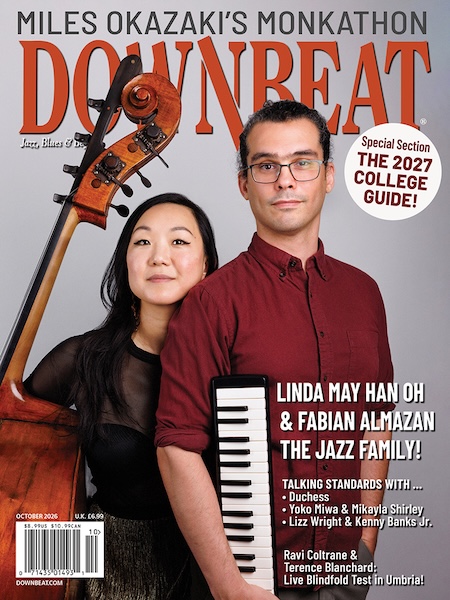
“It was just that suddenly … I could hear it,” Ravi Coltrane said of an epiphany he experienced during his late teens regarding his father’s music. “And it was almost like a calling, like something saying, ‘Hey, man, come on. It’s time to get serious.’ And the first time you really tune in and dial in and focus like that, it can be very life-changing.”
Sep 22, 2026 1:39 PM
Editor’s Note: Tomorrow, Sept. 23, is the 100th anniversary of John Coltrane’s birth. In honor of the tenor and…
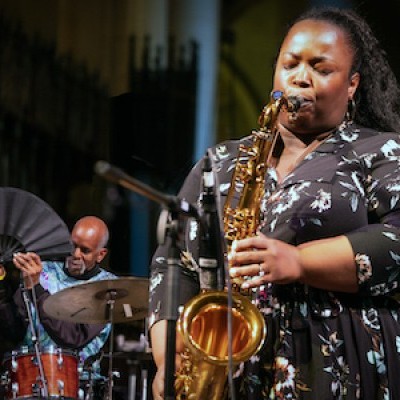
Camille Thurman took to the stage alongside bassist Kenny Davis and drummer Tommy Campbell for a rendition of Johnny Mercer’s “I’m An Old Cowhand” that recalled Rollins’ epochal 1957 trio outing Way Out West.
Oct 6, 2026 1:33 PM
As emcee Mark Ruffin noted at the commencement of an epic tribute to saxophonist Sonny Rollins at the Cathedral of…