Sep 3, 2026 10:44 AM
In Memoriam: Cassandra Wilson, 1955–2026
Cassandra Wilson, a singer, songwriter and producer who was one of the most acclaimed and successful jazz vocalists of…


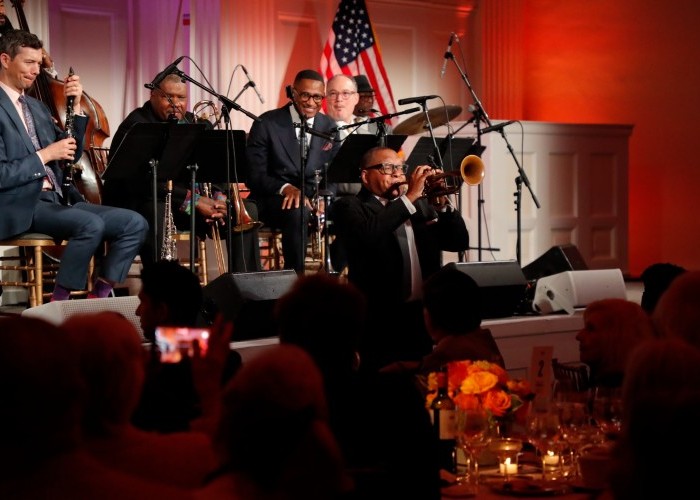
“The greatest honor for me as a trumpet player is to have learned enough to know how great Louis Armstrong actually was,” said foundation president Wynton Marsalis, who spoke and performed at the gala.
(Photo: Astrid Stawiarz/Getty Images (Courtesy of Louis Armstrong House Museum))On June 18, exactly 100 years after Louis Armstrong’s Hot Five accompanied Butterbeans and Susie in a Chicago studio to cut the insinuating “He Likes It Slow,” the Louis Armstrong House Museum — a three-building facility that includes the house in the Corona neighborhood of Queens that Louis Armstrong owned, the home of his next-door neighbor and the recently opened Louis Armstrong Center directly across the street — held its annual gala.
A full house of donors, supporters, board members and musicians — among them four students learning the trumpet in the Louis Armstrong House’s educational program, and the evening’s honoree, Wynton Marsalis, president of the Louis Armstrong Educational Foundation — were on hand. After cocktails, hors d’oeuvres and dinner, there were speeches and testimonials. A representative of chief corporate donor Morgan Stanley spoke movingly about what Armstrong meant to her. A Queens College professor read a poem dedicated to Marsalis in rhymed couplets in the manner of 18th century poet Alexander Pope. Regina Bain, the impressive executive director of Louis Armstrong House, discussed the organization’s growth since the Armstrong Center opened in 2023, and emphasized the importance of its core mission to preserve and propagate the legacy of Armstrong and the 60,000-item archive that his widow, Lucille Armstrong, bequeathed to posterity.
Trumpeter Bruce Harris, director of programs at Armstrong House and the evening’s musical director, discussed the archives with DownBeat before the proceedings. “There’s an energy in these archives, when you’re in the house, holding his horn or going through his books,” Harris said. “The archives have his letters, his drawings, his practice tapes — everything. We have a residency program called Armstrong Now where artists of multiple disciplines spend time in the house with the archives and create new works. That’s one way that we bring Armstrong’s legacy into the present day.”
Another way to celebrate that legacy was via the pan-generational band of master Armstrong practitioners that Harris had assembled for the occasion (Harris and Jon-Erik Kellso, trumpets; Evan Arntzen, clarinet; Wycliffe Gordon, trombone; Ricky Riccardi, piano; Russell Hall, bass; Herlin Riley, drums) to play “Struttin’ With Some Barbecue,” “Heebie Jeebies” and “West End Blues,” culled from the 44 records that Armstrong made with two different versions of the Hot Five between 1926 and 1928. Propelled by Riley’s big beat, they dove into “Struttin’” (1927) with ebullient polyphony, Gordon’s swooping growls contrasting with Arntzen’s smears. Harris and Kellso each played their variant on Armstrong’s century-old solo. Riccardi — much more widely known as the author of an exhaustively researched, highly readable three-volume Armstrong biography than as a pianist — functioned, as he put it, more like Lil Hardin than Earl Hines. Russell Hall, as throughout the set, faithfully held down the bottom while complementing and intuiting each soloist.
Ricardi introduced “Heebie Jeebies” (1926) as “the song that put the Hot Fives on the map” (featuring a lineup of Armstrong on cornet, Kid Ory on trombone, Johnny Dodds on clarinet, Lil Armstrong on piano and Johnny St. Cyr on banjo). Gordon and Riley, whose personal journeys as performers of Armstrong’s music began with Marsalis’ own presentation of Hot Five and Hot Seven repertoire in the early days of Jazz at Lincoln Center, each offered their own variation on Armstrong’s famous scat chorus, setting up Harris’ and Kellso’s clarion trumpet variations refractions and an intense, humorous Gordon solo delivered with guttural tone and his unique sense of melody.
The two trumpeters shared Armstrong’s legendarily chops-busting opening cadenza to “West End Blues” (1928) and nailed it. As Hall and Riley locked in at an ever-so-slow drag tempo, Gordon showed his greatness with a solo that could serve as a master class on how to play a blues, then followed Armstrong’s century-old example with a wordless vocal variation.
Harris introduced Samara Joy, tasked with singing Mitchell Parish’s lyric to Hoagy Carmichael’s “Stardust,” which she recorded on one of her early albums. Now, as then, her version was transcendent, living up to the bar Armstrong set in 1931 with his truly revolutionary delivery of the lyric, followed by a trumpet solo that carried the force of a Caruso aria.
It was time to present Marsalis his award, and a series of warm emcomia ensued. Harris told an anecdote he’d related earlier about coming to Marsalis’ apartment for a lesson in 1996, when he was in high school. “Wynton said, ‘Let’s play some blues,’” Harris said. “I played my Clifford Brown and Lee Morgan stuff. Wynton stopped. He said, ‘Go check out some Louis Armstrong.’ I left. I picked up the Hot Five and Hot Seven recordings and bought the transcriptions. I’ve been in love with Pops ever since.’”
During that conversation, Harris discussed the high degree of difficulty of executing the “West End Blues” cadenza, and emulating Armstrong’s style. “Playing the high notes is a job in itself, but when Armstrong played them, he sung those notes. You’ve got to play it strong, with soul, with feeling, and have it be very pointed. That’s not an easy thing to do.”
DownBeat also spoke with Kellso, whom Harris described as a “top-10” Armstrong interpreter. “A lot of people play figures and phrases that come directly from Armstrong who don’t even know it comes from him,” he said. “He was always ahead of the times. During the 1920s he influenced everybody to find a looser, swinging way of playing. People who were his friends always told me what a warm and generous guy he was. I think that personality comes through in his voice, and how he loosened and personalized the melodies the same way he did with the trumpet.”
After Harris’ testimonial, Wycliffe Gordon and Herlin Riley, who played the Hot Five and Hot Seven repertoire on numerous occasions during their long tenures with the Wynton Marsalis Septet and the Lincoln Center Jazz Orchestra, spoke warmly about Marsalis’ impact on their careers. Gordon called it “the greatest experience of my life.” Riley’s remarks emphasized Marsalis’ formidable work ethic, and his personal generosity when Hurricane Katrina upended his life shortly after he’d left the Lincoln Center Jazz Orchestra, and again last year, when Marsalis included him with the orchestra on a September-October sojourn to West Africa. Earlier, both masters spoke to me of Armstrong’s impact.
“I listened to recordings of Armstrong’s music all the time when I was in high school and college, but I didn’t have a chance to practically apply that music until I was with Wynton’s band,” Gordon told DownBeat earlier. “I started to understand the tradition of polyphony when I started playing with Wynton, Herlin Riley, Reginald Veal, Don Vappie, Doctor Michael White, Freddie Lonzo. We played Jelly Roll Morton, King Oliver, a lot of traditional music. We learned the repertoire so we could get away from it, and apply new traditions that came after Pops. Learning his trumpet solos was one of the greatest challenges I faced. I loved it because I learned that everybody has their own voice. Duke Ellington said it best: Better to be your number-one than someone else’s number-two.”
For Riley, Armstrong has been a larger-than-life figure since childhood, via his grandfather, Frank Lastie, who raised Riley (b.1958) during his childhood and teens. Born in 1902, Lastie was placed in the Waifs Home For Boys in 1913. There he played drums in the school band, whose members included a 12-year-old Armstrong, who famously developed his trumpet skills that year under the ministrations of the school’s band director Peter Davis. “My grandfather passed on his skills to me at the kitchen table using butter knives,” said Riley, who spent much of his childhood and teens living with his grandparents. “He never played secular music, but he played in church. He told me that time is a beautiful thing when you play this music. It doesn’t require a lot of chops or innovation or moving around the drums. That takes quite a bit of discipline, because you automatically want to play everything that you play. Louis was so relaxed and confident within himself that even at the fastest tempos he didn’t chase the rhythm like Charlie Parker did, playing 16th and 32nd notes. He used the rhythm as a foundation and played over it, built on top of that — it’s so melodic and so spiritually enriched.
“As a kid, I always wished that I could play with Louis Armstrong, and experience first-hand what he brought to the music. But, of course, we’re born in the times we’re born in, and we can’t go back. I consider him an agent of joy. He brought joy wherever he went. When you look at his videos or listen to his music, you walk away from it smiling. It makes you feel good. That’s a very special quality.”
Then Marsalis spoke. He addressed Riley and Gordon, recalling road tales from the first half of the 1990s with the Wynton Marsalis Septet, his laboratory for conceptualizing, workshopping and refining the “all jazz is modern” concept that became his mantra. He contrasted the democratic, egalitarian principles that Armstrong, who refused “to divide people by color,” embodied throughout his glorious career, with the “fool” who had received 70 million votes in 2024. He related several anecdotes that illustrated “the universal love and depth of feeling” that Armstrong received as he toured the globe during the last two decades of his life.
Then Marsalis discussed Armstrong’s extraordinary musicianship. “The greatest honor for me as a trumpet player is to have learned enough to know how great Louis Armstrong actually was,” he said. “It’s not possible to make you understand the sophistication of his playing — the accuracy of it, the depth of it, the feeling in it, how many people he influenced, his technical capabilities, the different traditions he could play in. When I was in my early 20s, I was invited to watch tapes of Pops playing on TV shows in small towns in Eastern Europe. You knew he didn’t know a lot of the songs. But after three hours, we looked at each other and said, ‘Did you notice, the man has not even missed a single harmony yet?’ Do you know how difficult it is to be that accurate with your playing? He almost never missed a note, and was able to improvise that clearly and correctly and accurately on the harmonic progressions of the songs, with that depth of feeling. It’s not something you can believe was humanly possible.”
He segued to his final chorus, comprising two stories that Dizzy Gillespie told him. “Dizzy remembered that he asked Armstrong one day, ‘Pops, why are you always looking up when you play? What are you looking for?’ He said, ‘Pops told me, ‘I don’t know, brother, but I always find it.’ Then Dizzy told me why he moved around the corner from Louis Armstrong’s house in the 1950s. He said, ‘A guy like that, man, I would call his house every chance I could because I knew something like that would never happen in the world again. And I wanted to get as much of it as I could.’”
Then Marsalis retrieved his trumpet, strolled along the bandstand, began to blow on “Bourbon Street Parade” by Paul Barbarin, Armstrong’s drummer at the cusp of the ’30s, and commenced a second line. DB
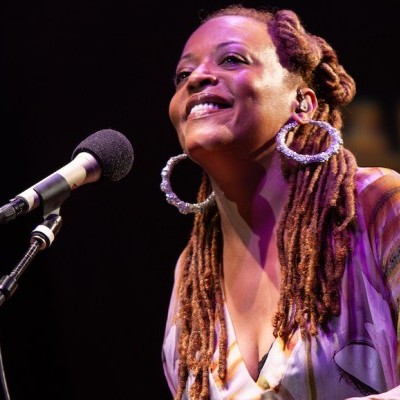
Wilson’s ability to connect to audiences helped her to win two Grammy awards and multiple other accolades. She was named an NEA Jazz Master in 2022.
Sep 3, 2026 10:44 AM
Cassandra Wilson, a singer, songwriter and producer who was one of the most acclaimed and successful jazz vocalists of…
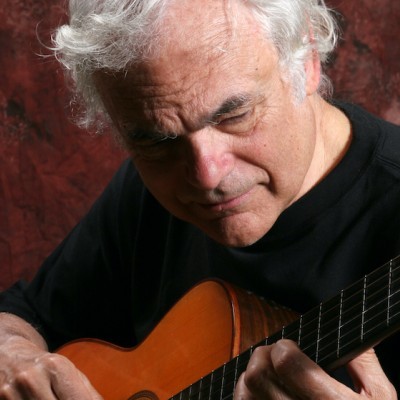
Bertoncini was a specialist and advocate for the nylon-string acoustic guitar, turning down high-profile opportunities that were unsuited to the sound and techniques that he used with that instrument.
Sep 1, 2026 11:06 AM
Gene Bertoncini, an esteemed jazz guitarist, composer, arranger and educator, died Aug. 29 at the Lillian Booth Actors…
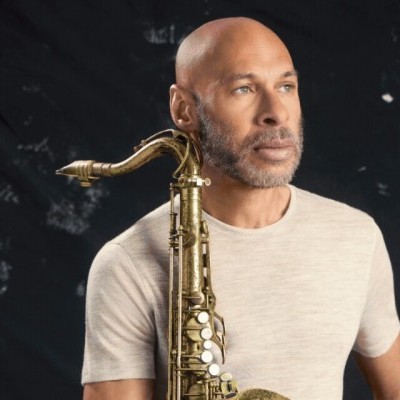
A solo concert by saxophonist Joshua Redman will close the first night of the Hyde Park Jazz Festival on Sept. 26.
Sep 22, 2026 12:26 PM
The Hyde Park Jazz Festival will take place for the 20th time on the final weekend of September 2026. Beginning half…
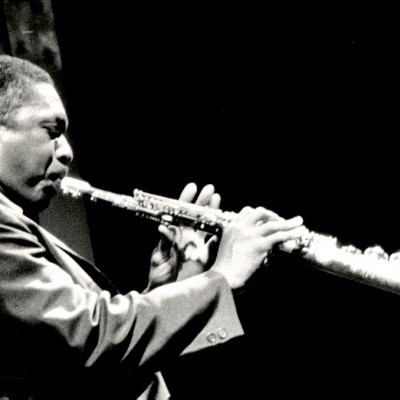
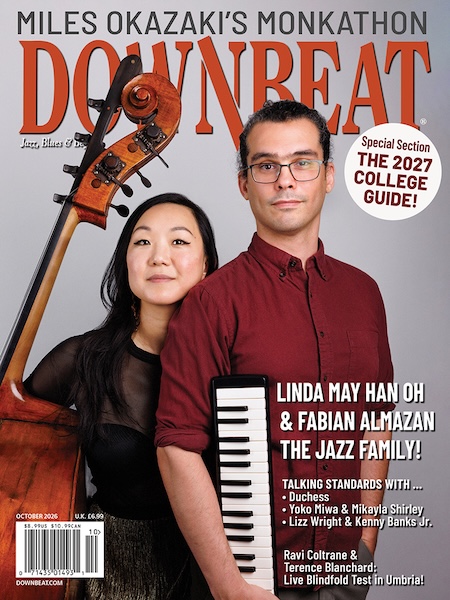
“It was just that suddenly … I could hear it,” Ravi Coltrane said of an epiphany he experienced during his late teens regarding his father’s music. “And it was almost like a calling, like something saying, ‘Hey, man, come on. It’s time to get serious.’ And the first time you really tune in and dial in and focus like that, it can be very life-changing.”
Sep 22, 2026 1:39 PM
Editor’s Note: Tomorrow, Sept. 23, is the 100th anniversary of John Coltrane’s birth. In honor of the tenor and…
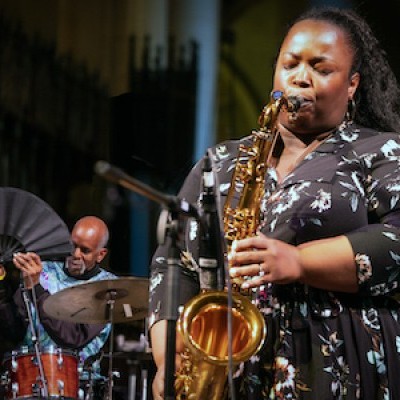
Camille Thurman took to the stage alongside bassist Kenny Davis and drummer Tommy Campbell for a rendition of Johnny Mercer’s “I’m An Old Cowhand” that recalled Rollins’ epochal 1957 trio outing Way Out West.
Oct 6, 2026 1:33 PM
As emcee Mark Ruffin noted at the commencement of an epic tribute to saxophonist Sonny Rollins at the Cathedral of…