Sep 3, 2026 10:44 AM
In Memoriam: Cassandra Wilson, 1955–2026
Cassandra Wilson, a singer, songwriter and producer who was one of the most acclaimed and successful jazz vocalists of…


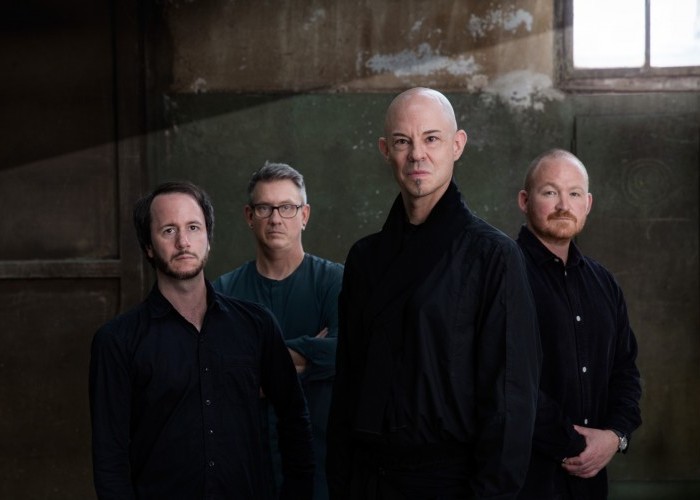
“We thought it’s important that Ronin has a new statement,” said Nik Bärtsch of his band’s latest album, Spin. “The sound is differently produced, so it reflects more of who we are.”
(Photo: Christian Senti)Nik Bärtsch cuts an imposing figure on stage. He’s unmistakable with his soul patch, shaven head and black attire. The Zurich-based pianist and composer’s distinctive look matches his free-spirited music.
In October at the Enjoy Jazz Festival in Heidelberg, Germany, Bärtsch and his Ronin quartet delivered a triumphant concert that defied expectations. Genres blended, tempos shifted. Gentle piano single-note rhythms led to extemporized passages sending the energy to skyrocketing levels that then plunged into rock-powered explosions. That’s the fuel of the leader’s work of controlled intensity. He said after the show, “It’s interesting that music is not necessarily only a linear narrative phenomenon. We perceive it almost like a remembrance architecture.”
Call it polymetric jazz or ritual rock fusion or kinetic groove, Bärtsch’s music spans an array of possibilities. At Enjoy, in one piece the pianist dreamed lightly on the keys, played inside the box with a flutter of strings while being joined by his master sidekicks: Sha on alto saxophone and bass clarinet, Jeremias Keller on electric bass and Kasper Rast on drums and percussion. What’s remarkable is how all four members contributed to the rhythm-driven music. Bärtsch set up a piano motif that each member played off of. Even Sha on the horns patterned a twist. They played like a community delivering such pieces as “Modul 66,” where a post-rock attitude moved through odd-meter funk into a structural harmony that drove the “spin” of the piece.
Most of the concert’s music came from Nik Bärtsch’s Ronin’s recent album Spin — its ninth electro-acoustic album of stimulating, shapeshifting jazz that conjures up a mystical, mercurial freedom. It’s released on his Ronin Rhythm Records. The tunes are based on linear counterpoint cycles, distilled metric weaves and reinventions of written beats improvised on to create a surprising creative cycle. As Bärtsch wrote in his 2021 book Listening Music Movement Mind (Lars Müller Publishers), “Jazz cultivates the gap between interpretation and improvisation, combined with new forms of playing, new instruments and sounds, swing and groove and such aesthetic and stylistic elements as hipness and an underground image. …Jazz is more like a practice and attitude than a style with commandments and prohibitions.”
In other words, expect the unorthodoxy. Bärtsch’s explorations in his multifaceted world include his performance space for modular music in his Zurich home, his personal experience of the Japanese tradition of crafted art, his 2022 Europe tour collaboration with Laurie Anderson and his residency at the Massachusetts Institute of Technology in modern technology on studying the influence of movement on making music.
Prior to interviewing Bärtsch in Heidelberg, I wrote pianist Tania Giannouli, who has been performing cross-continent piano duo dates with him, to recommend material for discussion.“Nik is such an interesting personality and his areas of interests are literally vast, from music to politics and martial arts and philosophy,” she repled. “I would just go with the flow of the discussion.”
At the festival’s headquarters the day after the Ronin show, Bärtsch reflected on this year’s “knowing” theme. “I find it related to knowing experience, collecting knowledge through doing, and to working together in a community,” he said. “By being dedicated, you discover the way to freedom by finding your voice. It is an interesting motto, especially for this festival that tries to bring together different musical genres, but mainly with the spirit of jazz. That responsibility and dedication is, for me, an important heritage. One newspaper in Switzerland once wrote about me that I was a scientist of groove because I’m dedicated to groove, to patterns, to things like a scientist studying it — not in this cold idea of a scientist, but in this warm, curious dedication to finding new solutions and new perspectives on groove music.”
Groove plays a major role in Bärtsch’s music life. When he was young kid, he gravitated to the beat-heavy music on the radio. “It didn’t matter what genre, I started to drum on all sorts of stuff like ashtrays and pots in the kitchen,” he said. “I read once from a famous composer that the groove is belonging to the community. It’s not the invention of someone. Groove means we have it, we share it. It’s an energy that’s also community energy.”
When Bärtsch was growing up in Switzerland in the mid-’70s, he wasn’t allowed to study the drums in school. He was told he had to learn violin or piano. He was 7. But he was so determined that his mother looked for a drum teacher. “She found an American drum teacher Sal Celi,” he said. “He was an amazing guy. He was a very good central teacher. We just played. When I was 9, I discovered the piano. I saw a piano player playing boogie-woogie. I ran home to my mother and said I want to learn this. This music is what I feel.”
While most piano teachers in Switzerland were classically trained, once again his mother found the perfect teacher, Hanspeter Reiman, who worked with Bärtsch for eight years. “At first I learned simple boogies then complex boogie figures for the left hand,” he said, “After that we went into Gershwin’s music, standards, Latin music and even Chick Corea. He taught me to listen and watch and use my rhythmic balances and patterns. So through discipline, I just played and was fascinated. That’s how it started. So with my good friend drummer Kaspar Rast, we formed a band working with odd-meter groove music. We were inspired by fusion, funk and Brazilian music. It was an experimental education. I didn’t start studying classical music until I was 16.”
Bärtsch and Rast attended the jam sessions at Bazillus Club, an underground space that was founded in 1969 by Beat Kennel. “We had jam sessions when we were very young, and there were all sorts of people playing,” he said. ”We had a kind of a weird urban mix of groove music. And the interesting thing was that this guy who was running the club wanted the jam session to be cultivated in terms of groove. He didn’t want too many freaky things, too many solos. He wanted to have a collective of rhythm. That was, for me, a really important time because it was the jungle, it was open, it was no school. We could learn from these older, amazing players. Coming out of that as a late teenager and then going into my own music, the groove always had a huge function.”
That led Bärtsch to different combinations of styles. He was informed by Steve Reich’s minimal music as well as any kind of music that had rhythmic energy. Funk was special, especially James Brown and the Meters. But Prince was most important. “When I was a teenager in the ’80s, Prince was an essential figure for us also in terms of band play,” he said. “He always had good bands, and he was influenced by all the great groove musicians. He had his own place, and he always did these jams after the sessions. So I have dozens of old bootlegged videos from that time.”
Founded in 2001, Ronin has been Bärtsch’s working band for several years after leadership of his more expansive acoustic group Mobile that also featured Sha and Rast. He stripped the band down to a zen-funk quartet that attracted ECM Records Manfred Eicher, who released several of the group’s albums. Spin is Ronin in evolution.
“We work constantly on the pieces, even the pieces we already recorded,” he said. “We do new arrangements. I listen to them again and again, composing new pieces and finding new interesting interpretations of cycles, rhythms, overlapping patterns. ‘Modul 35’ is a key tune from our history. It was on our first album for ECM in 2006 with a new interpretation for our live record in 2012. This version is totally new. The way we played, you also hear what the band as an organism learned about the piece. Over the years we started to understand them better, and they became our standards.”
While Bärtsch has a commitment from ECM for another record, he decided to set Spin into delivery first on his own label. “We thought it’s important that Ronin has a new statement,” he said. “We were touring more in the States also, and we were ready with the new repertoire. The sound is differently produced, so it reflects more of who we are. So far we are totally surprised by how well-received the record is from the traditional fans of the band as well as attracting young people who are there for new contemporary groove music.”
He paused and added, “We also reach a lot of rock players, especially people who like bands. In the U.S. almost every town has an interesting band, and of course that’s what Ronin is.” Of note, when Ronin played at the Big Easy Festival in 2024, they were a major “uplifting” hit. One notation said: “Ronin seemed like high priests of minimalism and the mystic.”
Much of Ronin’s module growth comes from the Exil club he co-founded 20 years ago. It was formed out of artistic necessity soon after his inspiring 2003 visit to Japan. “For a musician and artist in Switzerland, as a small kind of neutral country in the middle of Europe, very often you go away, maybe to Paris or London or Berlin or New York,” he said. “But I wanted to go somewhere where nobody goes. I had developed an interest in Japan as a teenager in books, films, in music, especially Noh and modern composers. I got a support prize for young musicians in Zurich, and with that money, I went with my wife to Japan. Since we already did Aikido, we trained with martial arts there. I was connected to a Swiss musicologist who was teaching in Osaka at the music faculty university. He showed me a lot of musical history, musical performances from Japan, from the different fields. It influenced me a lot in terms of the tradition of crafted art — the dedication, patience and long development. I learned that mastery happens out of training and dedication. That speaks very close to me.”
On his return from Japan, Bartsch set Exil into motion. “It was self-help in a lot of ways because Switzerland is so small that you do not have so many possibilities to play,” he said. “It’s not in the European Union where every country has different languages, different magazines. So it was difficult for a young new band to regularly play and create enough gigs for a working band. So I founded this kind of home-based training where we meet every Monday.”
It’s been a massive investment, designing the club and installing a high-class P.A. and lighting system. “This gave us the possibility to really focus on the band development,” he said. “We have a regular gig, we have a working band, we have a continuity, we have perspective.” In addition, Exil serves as the home base for the weekly Montags series of workshops and concerts that are livestreamed.
With the increase of creative visibility recognized throughout Europe, Bärtsch has often worked closely with event producers to develop new possibilities. He works closely with Enjoy Jazz Festival’s producer Rainier Kern, who hosted a public talk with him.
A few years ago, he had an invitation from another German festival that was based on lyrics and singing. “I love great singers like Chantelle Lee and Cassandra Wilson who influence me a lot, but my music is instrumental,” he said. “With Ronin we made a conscious decision to avoid vocalists because we want to go more to the instrumental groove pattern. But this guy said, don’t you ever want to play with a singer? And I said, I’m not so much into singers except that I love Laurie Anderson’s music because the show is important, she’s talking to the people. I listened to a lot of her records in the ’80s and ’90s, so it influenced me. She’s not just a regular singer.”
The festival producer asked Anderson if she would be interested, so she formed a unique trio of Bärtsch and Norwegian guitarist Eivind Aarset. They played different songs from different times, even some classical music with a modern take. So successful was the initial performance, Anderson brought the trio back together in 2016 for a performance at the Brighton Festival in England, where she was serving as music director.
Over the years, Bärtsch has written close to 70 modular pieces (the moduls). In addition, he has composed and performed on a variety of projects, including collaborating with the Mannheimer Schlagwerk percussion ensemble formed at the State University of Music and Performing Arts in Mannheim in southwest German. He wrote and performed music such as “Seven Eleven” for the 2021 album The Numbers Are Dancing.
In addition to his recording and touring, a week before his Enjoy show he was in residency at the Massachusetts Institute of Technology in Boston. He had performed there before, doing duo works with koto/shamisen player Sumie Kaneko.
This time he was the subject of research about the movement of making music, specifically on the piano. The researchers put wires and sensors on his body to measure the movement in relation to tension. Bärtsch played several pieces with different aspects of piano playing, such as slowing down the tempo and increasing the tempo to show the effects on his arms, wrists and spine.
“I found it very inspiring at MIT,” he said. “We were in the media lab where they were working on the new instruments, but also looking at the relationship of improvisation with computer support. In the lab were all these scientific fields working so closely together. One guy was doing research on a virus, the other on a new instrument. An older guy was doing research about AI in music in terms of improvisation. And they were all hanging out together in the laboratory. So there was a lot of crosstalk. The whole setup was a huge mix of scientific and artistic minds. And they really wanted to go into music and the relationship to what they were doing.“
In all of his adventures over the years, a key takeaway was how limited he found the piano to be and how he can free it. “One of the challenges is that the piano cannot bend the note,” Bärtsch said. “But in the way I play piano and put objects inside, I can do it. I’m prepared, and I start with doing it for the instrument in a good way to explore these fields and also in blending, of course, with the other instruments. That’s what I bring to Ronin to refresh old moduls and to create new ones. It makes our weekly Exil sessions exciting.” DB
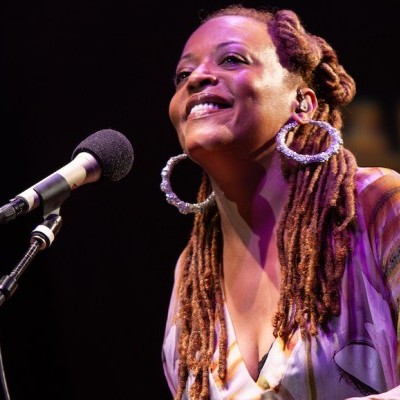
Wilson’s ability to connect to audiences helped her to win two Grammy awards and multiple other accolades. She was named an NEA Jazz Master in 2022.
Sep 3, 2026 10:44 AM
Cassandra Wilson, a singer, songwriter and producer who was one of the most acclaimed and successful jazz vocalists of…
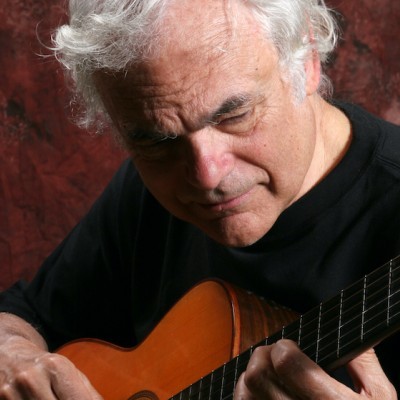
Bertoncini was a specialist and advocate for the nylon-string acoustic guitar, turning down high-profile opportunities that were unsuited to the sound and techniques that he used with that instrument.
Sep 1, 2026 11:06 AM
Gene Bertoncini, an esteemed jazz guitarist, composer, arranger and educator, died Aug. 29 at the Lillian Booth Actors…
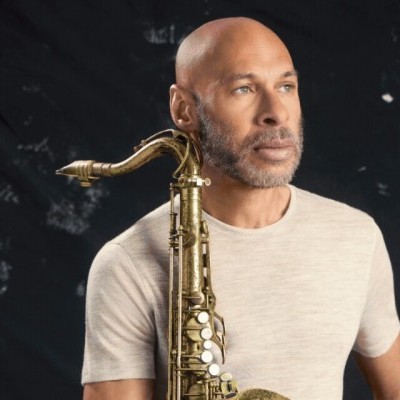
A solo concert by saxophonist Joshua Redman will close the first night of the Hyde Park Jazz Festival on Sept. 26.
Sep 22, 2026 12:26 PM
The Hyde Park Jazz Festival will take place for the 20th time on the final weekend of September 2026. Beginning half…
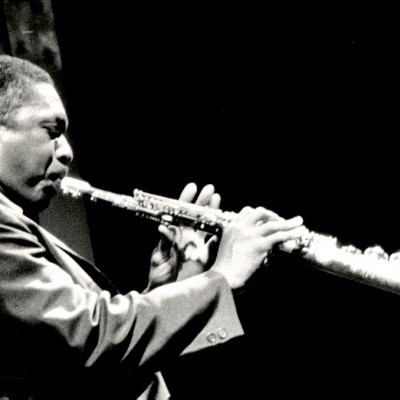
“It was just that suddenly … I could hear it,” Ravi Coltrane said of an epiphany he experienced during his late teens regarding his father’s music. “And it was almost like a calling, like something saying, ‘Hey, man, come on. It’s time to get serious.’ And the first time you really tune in and dial in and focus like that, it can be very life-changing.”
Sep 22, 2026 1:39 PM
Editor’s Note: Tomorrow, Sept. 23, is the 100th anniversary of John Coltrane’s birth. In honor of the tenor and…
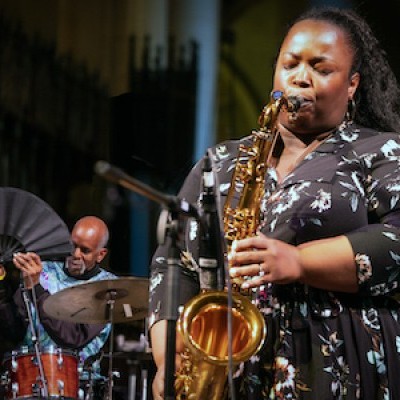
Camille Thurman took to the stage alongside bassist Kenny Davis and drummer Tommy Campbell for a rendition of Johnny Mercer’s “I’m An Old Cowhand” that recalled Rollins’ epochal 1957 trio outing Way Out West.
Oct 6, 2026 1:33 PM
As emcee Mark Ruffin noted at the commencement of an epic tribute to saxophonist Sonny Rollins at the Cathedral of…