Sep 3, 2026 10:44 AM
In Memoriam: Cassandra Wilson, 1955–2026
Cassandra Wilson, a singer, songwriter and producer who was one of the most acclaimed and successful jazz vocalists of…


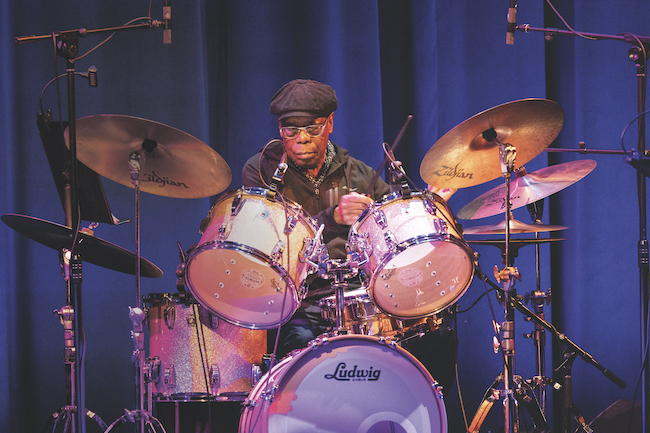
“I play what I want and what I like,” said Andrew Cyrille. “I use my knowledge artistically and professionally.”
(Photo: Mark Sheldon)Midway through August, a few days after concluding a week at the Village Vanguard with the quartet that Andrew Cyrille convened in 2019 for his third ECM album, The News, Bill Frisell distilled the rarefied experience of playing with the 85-year-old drum grandmaster. “Andrew tries to make everyone sound good,” said Frisell. “He creates an environment of trust where everyone watches out for each other. There’s an element of ‘What in the world is going to happen next?’ It’s about making something happen. People generalize that he’s ‘far-out,’ ‘abstract,’ ‘ethereal.’ Listen for a second. Everything Andrew does comes from a beat that reaches deep down into the center of the earth.”
Throughout the first set on night two, Cyrille addressed each circumstance with the decisive finesse of a tennis champion, instantly intuiting the respective intentions of Frisell, pianist David Virelles and bassist Ben Street as they spun out stories, recalibrating dynamics and rhythmic shapes, volleying back crisply executed responses to every salvo, keeping the postulations fresh with an enormous lexicon of beats and timbres.
“Every gig or project or recording feels cooperative,” Frisell said, referencing not only The News, but also its two ECM predecessors — The Declaration Of Musical Independence (a 2014 quartet album with Street and analog synth-electronics improviser Richard Teitelbaum) and a 2018 trio date with Wadada Leo Smith titled Lebroba — and Breaking The Shell (Red Hook), a timbrally extravagant 2024 encounter with Kit Downes.
Street opined that Cyrille’s “magical control of his imagination” and “clarity of utterance and space” mirror the qualities that animate his favorite poets. “I know how hard they worked on their finished product, and here’s Andrew seemingly doing it in real time,” said Street. They met in 2010, while recording Open Opus (ILK), the first of three trio albums with Danish pianist Søren Kjærgaard — on which, Street recalled, Cyrille rendered the complexly scored charts “like he’d played it for years.”
Two years later, at Street’s instigation, Virelles paired Cyrille with batá wizard Roman Diaz on his much-praised Continuum, spurring a memorable week at the Village Vanguard. “I recognize West African diasporic elements in everything Andrew does,” Virelles said. “Playing with him is a portal to the sensibility of another era. You hear all the nuances of timbre. You feel the depth of touch. You hear his ability to make micro-adjustments of phrasing and dynamics. You experience all the attributes of a consummate master, but also all the history.”
Born in 1939, Cyrille began his drum journey soon after World War II when he joined a drum and bugle corps at St. Peter Claver elementary school, around the corner from his Bedford-Stuyvesant home. His mentors, high-level local pros Willie Jones — who gigged with Lester Young and Thelonious Monk — and Lenny McBrowne taught him the intricacies of the drumset. He and his best friend, who became Max Roach’s brother-in-law in 1949, practiced on the maestro’s drums as tweens.
By 16, he was earning pocket money playing mambos, calypsos and shuffles at local dances and social functions with a trio that included guitarist Eric Gale.
In 1958, worn down from juggling a freshman chemistry major’s courseload with nocturnal musical pursuits, Cyrille opted for music, matriculating to Juilliard as an orchestral percussion student. He sidemanned in Brooklyn with eminent beboppers Duke Jordan and Cecil Payne, assembled ad hoc combos in which Freddie Hubbard and John Handy made their first New York appearances, went on the road with blues singer Nellie Lutcher and tenor hero Illinois Jacquet and played with the trios of pianists Roland Hanna (a Juilliard classmate) and Mary Lou Williams.
Also in 1958, Cyrille played for the first time, informally, with Cecil Taylor. They remained in touch as Cyrille expanded his horizons. The son of Haitian immigrants, he’d absorbed West African rhythms, having heard local drummers on a 1947 visit to his uncles near Port au Prince, and later in Brooklyn when master drummer Alphonse Cimber played for dances at his mother’s social club.
During the early 1960s he exponentially increased his West African vocabulary in drum ensembles with Nigerian master Babatunde Olatunji; later in the decade, he joined the Believers, an operatically trained vocal group that performed spirituals, gospel and urban blues with an African drum choir.
In February 1961, Cyrille made his debut recording with boundary-pushing vibraphonist Walt Dickerson; two weeks later, he swung a relaxed standards date with Coleman Hawkins. In 1964, he joined Taylor for an 11-year run that included his informed participation on the pathbreaking albums Unit Structures and Conquistador, both on Blue Note.
During his post-Taylor half-century, Cyrille has embodied the discipline and exhilaration of speculative improvising and form-building through the consistent artistry, creativity and professionalism he brings to multiple jazz and jazz-adjacent contexts. He’s recorded erudite drum conversations with fellow ’60s path-breakers Milford Graves and Rashied Ali, and in the drum ensemble Pieces of Time with Graves, Kenny Clarke and Famoudou Don Moye. Several solo records — from 1969 (What About?) to 2022 (Music Delivery/Percussion) — showcase his orchestral concept of the drum set. He’s done tabula rasa duos with a cohort of elite outcats and engaged in more structured encounters with Anthony Braxton, Marilyn Crispell and Teitelbaum. He’s impeccably executed and interpreted the complex scores of Muhal Richard Abrams, John Carter and Cyrille’s Trio 3 partners Oliver Lake and Reggie Workman, and propelled the ensembles of David Murray, Eric Revis and Aruan Ortiz, the Santiago de Cuba-born pianist whose stately, atonal compositions on Inside Rhythmic Falls (Intakt) proceed to Cyrille’s and bata master Mauricio Herrera’s synchronized, spirit-raising beat undercurrent.
Teaching in formal and informal contexts is another important component of Cyrille’s career mosaic. “You’ve always encouraged creativity and individuality, never disparaging,” Nasheet Waits told him last June at the beginning of a four-hour Zoom encounter that also included fellow Cyrille fan and student Matt Wilson and this writer. Waits expressed regret for not paying closer attention as a teenager, when he opened his father’s (Freddie Waits) studio for Cyrille’s lessons and rehearsals. “I first saw you play drums on the Art Linkletter Show as your father stood next to you,” Cyrille told Waits. “You had the same smile as now. I’d visit your parents, while you and your brother ran around. You look exactly like your mother. There was always a drumset.”
Wilson was living in Boston when he approached Cyrille, whose records he’d absorbed, for a lesson at the Regatta Bar. “When I arrived, you were sitting at the drums, reading USA Today,” he told Cyrille. You wore a little earplug with a metronome, and kept a steady pulse on the bass drum. I walked into the most beautiful sound. It wasn’t an exercise. I’ll never forget the concepts we discussed.”
The conversation has been edited for space and clarity.
Nasheet Waits: Eric Revis articulated something I also feel — you approach the music from the inside out. You get to the core and give it exactly what it needs, unobtrusively and supportively, with a certain forward motion. You gave me — and a lot of other drummers — courage to achieve swing without necessarily playing tang-tangtadang-tangtadang.
Andrew Cyrille: Playing from the inside-out is exactly how I think about the drums when I’m playing with different concepts. I was able to get to so many different places not just because of all of the people I’d played with before Cecil Taylor, but because when I got to Cecil, I could go anyplace I wanted. Cecil always said, “This is our music.” Anyone I play with, I listen. Then I try to make the music as much mine as it is theirs.
Once, I heard Max play so much stuff during a set at Smalls Paradise in Harlem, I told him, “Damn, Max, you played everything. There’s nothing left.” He said, “Oh, yes, there is. There’s a universe out there. Go look, and find some stuff.” Philly Joe Jones said, “You’ve got to find your own signature. Do what you need to do to make your contribution.” That’s always been in my head. To keep this music alive, you have to find out where it came from and what you want to do with it now for the people who are here, because Now is the only time we have.
Waits: What was the origin of your relationship with Philly Joe Jones, and what did he show you?
Cyrille: Joe opened a lot of doors for me. Max never showed us anything specific, and I was looking for someone to help me understand the language of this music and make music with it. I saw Joe at a concert with Miles Davis where he swirled the brushes like cooking in a pot. “Where’d he get that?! I’ve got to meet this guy.” I don’t remember exactly how we connected, but when I was 17, 18, 19, Joe borrowed my drums to make his gigs and sessions. He brought me to Bud Powell’s Time Waits date with him and Sam Jones in 1958. My tongue was hanging out, wishing I could do what he was doing on my drums.
I’d go to Joe’s house, where he showed me things with the brushes, and compositions with rudiments — play a four-stroke here, then a seven-stroke here and then an 11, then repeat it, and so on. Sometimes we’d ride the A-train, going to do whatever business he had to do, and he’d show me stuff on the rattan woven seats, with people watching us. He’d say he was giving me a lesson. He never charged me for it either. Maybe it was because he was using my drums! Once, at a gig in Brooklyn with Lee Morgan and Cannonball, he wanted to go out and do whatever when the next set came on. “Let the kid play.” I’m getting all this information from these powerhouses; they’d turn around, nod their heads and say, “Yeah!” — that kind of thing, though I was still learning.
One night, I was hoping Joe would let me play a gig with Donald Byrd and Lou Donaldson, but he didn’t. I was angry when I went to his house the next afternoon. He was tired. He got his clothes together, and we started walking down the street with his lady, who said, “What’s wrong with him, Joe?” He said, “Shit. He’s so mad because I wouldn’t let him play — and his bones ain’t even developed yet.” But then Joe would tell me, “I want you to be my protégé.” I told him, “I don’t want to be your protégé, man. I want my own voice. I don’t want to be like you.” Down the line, one night I was driving someplace with him and G.T. Hogan, and Joe said, “He thinks he’s the only one who’s got his philosophy.” He was referring to me telling him that I didn’t want to play like him. Even though I played a lot of stuff that he played. I won’t lie!”
Waits: That tradition of letting younger musicians or other musicians sit in doesn’t happen too often now. Definitely not as you’re describing it, an almost extension of pedagogy.
Cyrille: Partly it’s because of how the music has expanded. A lot of pieces are not in AABA form that most of us can swing with, but compositions that are too complicated for cats to come up and sit in. Muhal Richard Abrams gives you a score where suddenly there’s a 1/4 beat, then you go to 11, or 3/2, or whatever it is. You’ve got to know how to count those meters. Even with Trio 3, so much was going on in some of Reggie’s and Oliver’s pieces that you had to follow it on the page to get from one place to the next. The notes don’t play the music. You play the notes, so you’ve got to learn how to interpret. Joe told me: “You got to know how to read; if you can’t read; you won’t be able to play.” That got into my head.
Ted Panken: How did your Juilliard experience impact the way you thought about the drums?
Cyrille: Our music comes out of Africa and also out of Europe. We’ve inherited both cultures. At Juilliard, for example, I learned how to sight-sing using solfege. When I look at a composition, I might be able to sing the pitches I see from learning that. I played etudes with Morris Goldenberg, my percussion teacher. I still have them. I use that information when I’m playing compositions by Bill Frisell, David Virelles and Ben Street. All the things I learned at Juilliard helped me in the American experience — let me put it that way — which we all are part of.
Playing for dancers at the June Taylor School at 56th and Broadway taught me a lot about playing solo drums. A lot of great dancers came through there. I could play anything as long as they could count and dance to it and feel good. You could see the music moving through the air. After playing for dancers for two hours, you can play a drum solo that long just by imitating them. Once I went from June Taylor to a rehearsal with Cecil at Hartnett School of Music. He asked me, “How do you hear rhythm?” I said, “I hear it through the dance.” He said, “Yeah, I’m into dance also.”
He was really into dance. In a sense, that’s how we got together. He said, “This is our music.” He never said, “Don’t do this.” So I had to think about what I could contribute to what they were playing to help make the whole the sum total of its parts. When we recorded Unit Structures, I decided I could play a relative kind of mambo on the beginning. The rest of it, I used all I’d learned according to how they were playing. I had a ball. Sometimes on these concerts we’d play an hour-and-a-half. The more we played, the stronger I’d get.
Matt Wilson: How did Mary Lou Williams and Philly Joe Jones respond to hearing you do this pioneering music with Cecil?
Cyrille: You’ve got to be true to yourself, and not be bothered if Mary Lou said, “If you play a certain way, you’re not going to get certain gigs.” I tell my students, “If everybody loves you, then you’d have a problem.” You kiss somebody’s butt on one side, they say, “Hey, no, you kissed it too hard; kiss it on the other side.”
A bass player told me Mary Lou was looking for a drummer. I walked in the door, my chest all stuck out. “I go to Juilliard.” She looked at me and said, “Don’t you come in here with that shit now.” Pow! She talked about swing. I asked her, “How can I start playing the ride cymbal a little different from the way it has been played?” She said, “Well, if you do that, you won’t get any gigs. Some cats can’t use that. You have to be able to swing with what’s happening with the music.” It wasn’t that her ear was totally out of what was going on. Mary Lou loved Jimmy Lyons. She brought me to hear Eric Dolphy, who she said played in the cracks. Mary Lou was a good person. She was a converted Catholic. She had written “St. Martin de Porres” — an African saint — for the Pope. She was into converting people she felt needed to be resuscitated, and also to clean up the scene.
Waits: You might be the drummer who has worked and recorded the most with other drummers. What has inspired that?
Cyrille: Africa — and, of course, Europe, too. In the drum and bugle corps I was playing with Scottish drummers, these police guys, playing dotted-eighth licks. There’s a lot of musical connections between Africa and what is played in Europe. They have some of the same scales, and a lot of European cultures have a marching element. In several countries, the Swiss Guard plays signals for military instructions from the drums, what are called rudiments, which are nothing but sticking patterns used by Westerners to make up rhythms for people who either dance or march to them. As a result of the Europeans playing those rhythms, Africans learned them. The Africans then gave the feeling that they wanted to give to the rudiments or the scales that they learned from the Europeans. Voilà or voici — jazz.
Milford and I got together because we both were heavy into African drumming. I came out of the Marcy projects in Brooklyn; Milford came out of the Jamaica projects in Queens. We played a lot of similar dances. After I started playing with Cecil, Giuseppe Logan brought his recording with Milford to the composition class I was taking at Hartnett. I thought to myself that I was doing this stuff with Cecil, and I felt sincere about it. At the same time, Milford was playing with Albert Ayler, and he said that the first thing he heard was the calypso. He also played tablas, and introduced me to his teacher, who I studied with. Milford set up his trapset to get those sounds. Everything he was doing entered the crucible of how he played the drums.
After we did Dialogue Of The Drums, I started thinking about getting an imprimatur, which means a stamp of approval, from one of the elders. I had met Kenny Clarke in Paris when I was there with Cecil in 1969. He told me he’d moved to Paris and stayed because of the racism here. He taught me a lot. In 1984, I decided to ask him to come to New York to play and make a record with me, Milford, and Famoudou Don Moye. I asked each person to write a piece, which is why I called it Pieces Of Time. When I phoned “Klook” — I called him “Mr. Clarke” — he said he’d come over to do it because the money was good. He was going to stay with Milt Jackson, who lived in Teaneck, New Jersey. I was living in Little Ferry, New Jersey. We met at my studio to explore what he wanted to play. He looked at me, his back straightened up, and he said, “I’m going to play this thing called ‘Laurent’ for my son.” Klook played it. Then he looked at me. “Can you do that?” In a sense, he was saying, “Can you deal with me?” I got it. I had him.
Later, we went to a club where Max Roach was playing with his group. When we came in, Max saw him. “Klook, what are you doing here?” Klook said, “Well, l’m working for him.” Max smiled. I just crumbled. I got the imprimatur from the king of bebop. Max came, in a sense, after Klook. I called Max “The Emperor” because Max played many different kinds of music with different people, even Cecil later on — and, of course, M’Boom. Max was into that. Klook did his thing, too. But he did it from the bebop perspective.
Wilson: Max Roach, Mary Lou Williams and Coleman Hawkins are three of the most forward-thinking people of jazz history. They embraced so much music within their lifetime. You seem to have embraced that spirit of open-mindedness and always seeking a new adventure.
Cyrille: You know what? Even today, with all those people I’ve played with, it’s an adventure. To be honest with you, I’ve been fired. People said, “You can play drums, but you can’t play for me.” That happens. Sometimes you go home with tears in your eyes. But you’ve got to get back up.
Waits: Some people, if they get fired, decide to try to adopt a different attitude or approach.
Cyrille: But, see, Nasheet, that’s how they want to live their lives. When I met Cecil, he was doing what he was doing, and he allowed me to do what I wanted. That also gave me strength. There wasn’t much money for our early gigs, but Cecil knew what he wanted, and by the late 1960s he paid me more than anyone else.
I was working with different bands or groups like The Believers, but when it was time to work with Cecil I’d get somebody to sub. Apart from the money, it was the idea I could give this music my all, and he would take it. So would Jimmy Lyons and Sam Rivers. Cecil said, “I can introduce you to Europe.” This cat took me to Spain, first class. I got a painting from Miró. Moving through Europe, I saw things I’d never seen before. He gave me the greatest opportunities in life through this music, even though all the other people Matt mentioned also inspired me, as did a lot of those African cats when I was playing with Babatunde.
Wilson: I think Declaration Of Musical Independence is one of the greatest records of the last 10 years. It’s generational. I love it and also Lebroba. They’re sonically interesting. You welcome people to be who they are. You’ve done for a generation of musicians — David Virelles and Ben Street, for example — what Cecil and Mary Lou Williams did for you. At your age, to still do that and be so youthful is inspiring.
Cyrille: But you see, they also feed me. I get a reward from giving to them, because they give back to me. It keeps me alive. You and Nasheet keep me alive. When I did my first record for ECM, I decided, “I’m going to do what I want.” That’s why I called it Declaration Of Musical Independence. In 1979, I played with Richard, Anthony Davi and George Lewis on a very good record by Leroy Jenkins called Space Minds, New World, Survival Of America, and in 1981, we did a duo concert — just electronics and organic drums — that was later released as Double Clutch. See, Richard never played “jazz.” He was improvising music with electronics. We played what we heard, like having a conversation.
Panken: Playing with the band documented on The News seems like a great opportunity to interpret, at a very high-level, repertoire from the different areas you’ve explored during your career.
Cyrille: They’re gifted, very creative players. In 2013, after Paul Motian passed away, Sun Chung called me for an ECM record with Ben Monder and Pete Rende [Amorphae]. After that, Sun wanted to do a date with Frisell and Teitelbaum and Ben Street. I did it because it was a good band and everybody wanted to play. Everyone brought in music. Later, I told Ben I wanted someone who is open and can play the blues, and we simultaneously named David.
I play what I want and what I like. I use my knowledge artistically and professionally. If my students need to listen to what the drummer plays on “Desafinado,” I can play a bossa nova. If it’s something open, like what I did with Cecil or Kidd Jordan or Charles Gayle, I do that, too. I enjoy doing both. I’m happy. That means I have peace and a sense of well-being in the music at this point in my life. DB
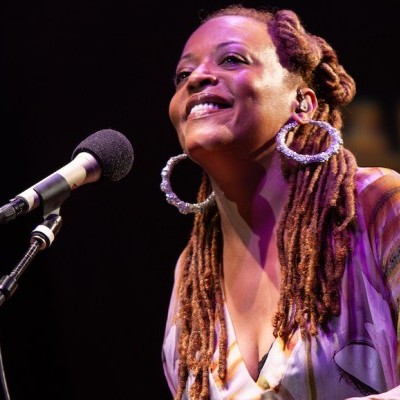
Wilson’s ability to connect to audiences helped her to win two Grammy awards and multiple other accolades. She was named an NEA Jazz Master in 2022.
Sep 3, 2026 10:44 AM
Cassandra Wilson, a singer, songwriter and producer who was one of the most acclaimed and successful jazz vocalists of…
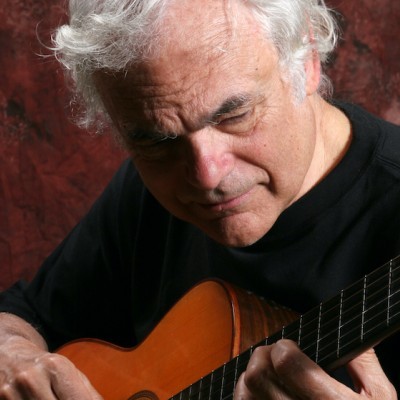
Bertoncini was a specialist and advocate for the nylon-string acoustic guitar, turning down high-profile opportunities that were unsuited to the sound and techniques that he used with that instrument.
Sep 1, 2026 11:06 AM
Gene Bertoncini, an esteemed jazz guitarist, composer, arranger and educator, died Aug. 29 at the Lillian Booth Actors…
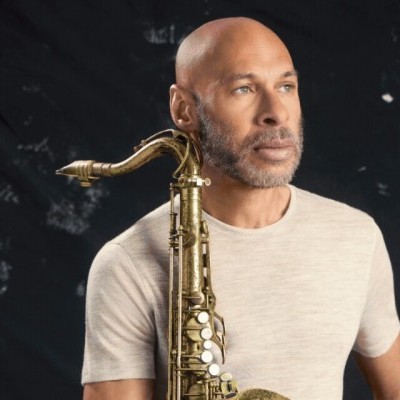
A solo concert by saxophonist Joshua Redman will close the first night of the Hyde Park Jazz Festival on Sept. 26.
Sep 22, 2026 12:26 PM
The Hyde Park Jazz Festival will take place for the 20th time on the final weekend of September 2026. Beginning half…
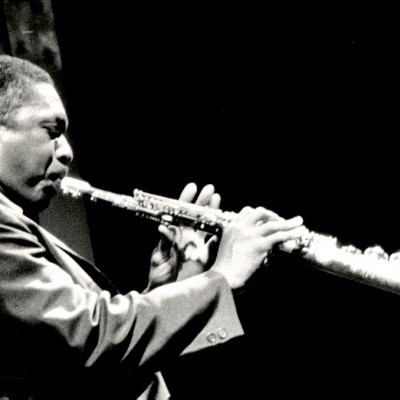
“It was just that suddenly … I could hear it,” Ravi Coltrane said of an epiphany he experienced during his late teens regarding his father’s music. “And it was almost like a calling, like something saying, ‘Hey, man, come on. It’s time to get serious.’ And the first time you really tune in and dial in and focus like that, it can be very life-changing.”
Sep 22, 2026 1:39 PM
Editor’s Note: Tomorrow, Sept. 23, is the 100th anniversary of John Coltrane’s birth. In honor of the tenor and…
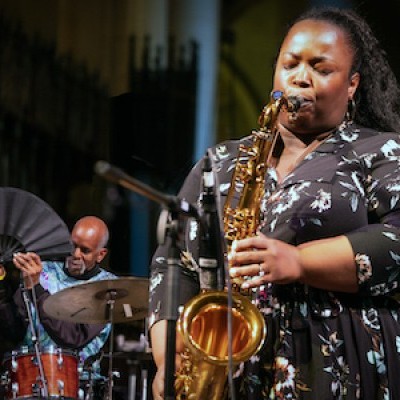
Camille Thurman took to the stage alongside bassist Kenny Davis and drummer Tommy Campbell for a rendition of Johnny Mercer’s “I’m An Old Cowhand” that recalled Rollins’ epochal 1957 trio outing Way Out West.
Oct 6, 2026 1:33 PM
As emcee Mark Ruffin noted at the commencement of an epic tribute to saxophonist Sonny Rollins at the Cathedral of…