Sep 3, 2026 10:44 AM
In Memoriam: Cassandra Wilson, 1955–2026
Cassandra Wilson, a singer, songwriter and producer who was one of the most acclaimed and successful jazz vocalists of…


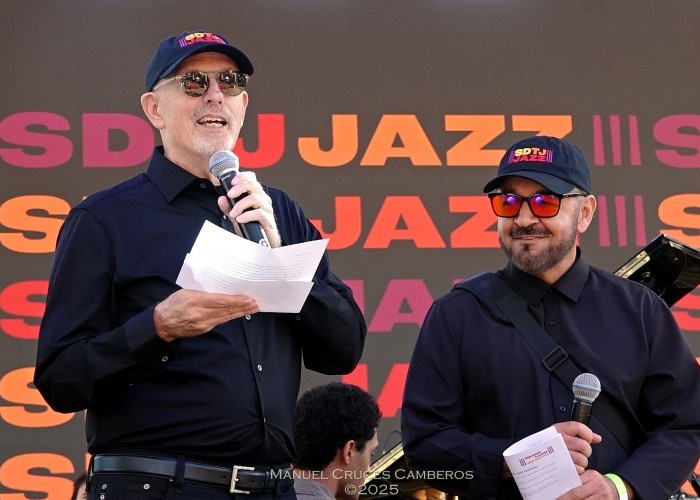
Daniel Atkinson, left, founder of the San Diego Tijuana International Jazz Festival, and Julián Plascencia, his fest partner in Tijuana.
(Photo: Manuel Cruces Camberos)When “international” is used in the name of a jazz festival, it’s typically to indicate the geographic origins of the talent being presented. But in the case of the three-city San Diego Tijuana International Jazz Festival (SDTJ Jazz), it’s also indicative of geography.
“I think that being on the border is probably the most interesting thing about San Diego,” declared Daniel Atkinson, SDTJ Jazz founder and executive director. “There are other interesting things, but I think that positions us in a very different way even from a place like Los Angeles.”
Launched in 2024, the annual SDTJ Jazz is held the first full weekend in October with one day in downtown San Diego; another day in Tijuana, Mexico; and a third one in Escondido. The San Diego and Tijuana concerts are outdoors and free, while the performances in Escondido are a mix of free outdoor shows and ticketed indoor performances. Artists can be booked for single or multiple days.
“Escondido is 40 miles north of the border, and downtown San Diego is about 15 miles north of it. So we’re using the geography to serve different audience bases,” Atkinson explained. “We’re taking advantage of the impassibility of the border because 95% of the people who attend the Tijuana show are from Tijuana. But it’s not as though we’re saying to the U.S. audience, ‘People, don’t come.’ We’re just saying, ‘Come to where you’re comfortable.’
“The hall in Escondido is actually, in many ways, the nicest in the region for its size,” he added. “It has great acoustics, it’s comfortable, and it’s a classic hall design that has four tiers with an orchestra section and three different balcony levels. Plus, they’ve just got everything there. They have huge green room facilities and rehearsal spaces. And there’s a whole set of outdoor spaces that we can use this year.”
When talking about the Quartyard, a space in downtown San Diego, Atkinson described its inviting atmosphere and appeal to younger audiences.
Scheduled for Oct. 1–4, the 2026 SDTJ Jazz lineup was still being finalized at press time. But Atkinson, a veteran producer of concerts and albums and a longtime educator, was happy to discuss its first two iterations as well as new offerings for the third.
We certainly made huge strides with the second year,” he said. “I really feel like last year was tight, and it had a kind of a diversity that I’m proud of having put together.
“But you set a bar, and then you have to rise to that bar.”
Two of last year’s triumphant bookings were vocalists Gabrielle Cavassa, who was still best known for her work in saxophonist Joshua Redman’s band, and Lucía, who was headlining her first West Coast dates. “That was utterly fluky,” he admitted. Yet each was wholly fitting.
“The same agent, Chris Mees, represents both of them. And he told me that Gabrielle is from Escondido,” Atkinson said. “That was very fun, because friends and family galore came out for her. And I think they really hadn’t had a chance to hear her since high school.”
Lucía, on the other hand, was already on Atkinson’s radar. “One of my colleagues in Tijuana runs a son jarocha festival that takes place right at the border wall,” he said. “And Lucía’s father is an eminent son jarocha musician and a significant improviser. So Jorge, my friend in Tijuana, told me, ‘You’ve got to check out this young woman. Because not only is she a great jazz musician, she comes from this lineage of son jarocha.’” Lucía and Atkinson had spoken via video nearly a half-decade prior to her performing in Tijuana, and he was happy to bring that connection full circle.
Cavassa and Lucía were also consecutive Sarah Vaughan International Jazz Competition winners in 2022 and 2023, respectively. “They could not have been more different in terms of approach to the music,” he noted. “Then again, being a jazz vocalist can mean a lot of different things.
“Something that we tried to do last year that for various reasons didn’t come together is to have a day of film screenings that we will do in coordination with the San Diego Latino Film Festival,” he said. “It will be on the middle day, the Friday, when we don’t really have concerts running. We haven’t worked out the details yet, but we’re hoping to replicate the film screenings in Tijuana at their cultural center, because they have a very nice film program there, too.”
A unique feature of the festival is the Binational Youth Ensemble. Boasting an equal number of high school musicians from each side of the border, the eight- to ten-piece band performs in both Tijuana and San Diego.
“They get together and work up a repertoire and play it together. And it always amazes me,” Atkinson reflected. “There are always kids who speak the other side’s language, so we don’t have to translate for them. There’s a young bass player from here, Collier Keitany, who speaks Spanish beautifully, and he announces to the crowd in Tijuana and vice versa with Eduardo Hernández, a drummer from Ensenada.”
SDTJ Jazz’s early October scheduling is related to the weather (“It’s temperate and dry,” Atkinson pointed out) and surrounding activities: “The state government of Baja California has an arts agency called the Secretaría de Cultura, and every October is performing arts month there. So we are leading off essentially a whole month worth of different types of performing arts activity that takes place all over the state, not just in Tijuana.
“People outside of this area think of San Diego as the beach and the zoo and that we’re kind of the land of the Lotus Eaters. And then Tijuana is extremely poorly understood,” he concluded. “I’ve been presenting jazz in San Diego for almost 40 years now, and this festival upends people’s expectations by providing the opportunity for serious musicians on both sides of the border to play a variety serious music.” DB
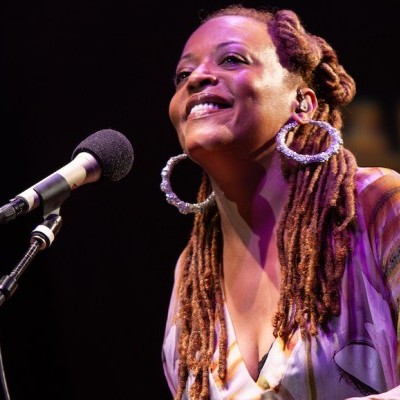
Wilson’s ability to connect to audiences helped her to win two Grammy awards and multiple other accolades. She was named an NEA Jazz Master in 2022.
Sep 3, 2026 10:44 AM
Cassandra Wilson, a singer, songwriter and producer who was one of the most acclaimed and successful jazz vocalists of…
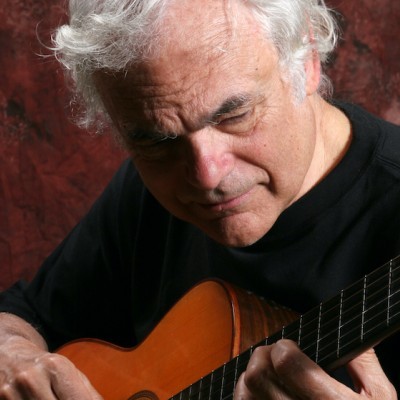
Bertoncini was a specialist and advocate for the nylon-string acoustic guitar, turning down high-profile opportunities that were unsuited to the sound and techniques that he used with that instrument.
Sep 1, 2026 11:06 AM
Gene Bertoncini, an esteemed jazz guitarist, composer, arranger and educator, died Aug. 29 at the Lillian Booth Actors…
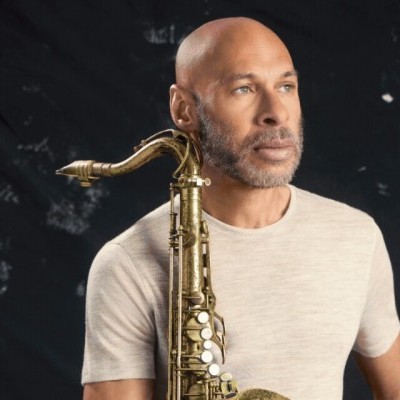
A solo concert by saxophonist Joshua Redman will close the first night of the Hyde Park Jazz Festival on Sept. 26.
Sep 22, 2026 12:26 PM
The Hyde Park Jazz Festival will take place for the 20th time on the final weekend of September 2026. Beginning half…
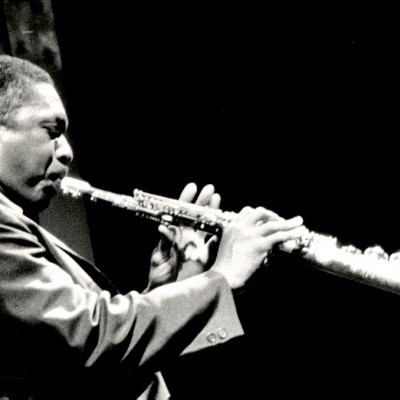
“It was just that suddenly … I could hear it,” Ravi Coltrane said of an epiphany he experienced during his late teens regarding his father’s music. “And it was almost like a calling, like something saying, ‘Hey, man, come on. It’s time to get serious.’ And the first time you really tune in and dial in and focus like that, it can be very life-changing.”
Sep 22, 2026 1:39 PM
Editor’s Note: Tomorrow, Sept. 23, is the 100th anniversary of John Coltrane’s birth. In honor of the tenor and…
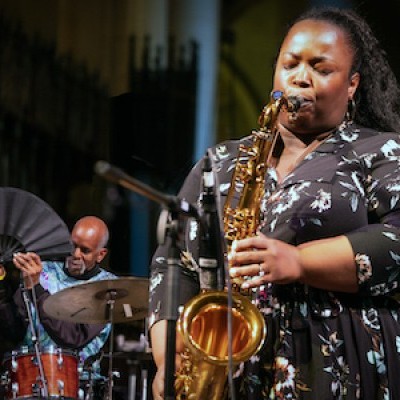
Camille Thurman took to the stage alongside bassist Kenny Davis and drummer Tommy Campbell for a rendition of Johnny Mercer’s “I’m An Old Cowhand” that recalled Rollins’ epochal 1957 trio outing Way Out West.
Oct 6, 2026 1:33 PM
As emcee Mark Ruffin noted at the commencement of an epic tribute to saxophonist Sonny Rollins at the Cathedral of…