Sep 3, 2026 10:44 AM
In Memoriam: Cassandra Wilson, 1955–2026
Cassandra Wilson, a singer, songwriter and producer who was one of the most acclaimed and successful jazz vocalists of…


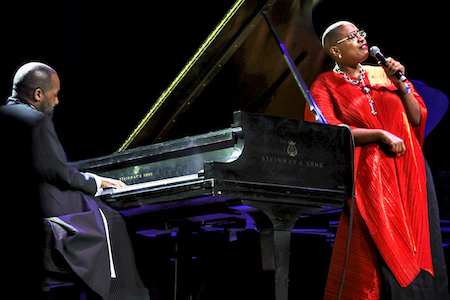
Cécile McLorin Salvant busts out Jelly Roll Morton’s “The Murder Ballad” at Big Ears, here with pianist Sullivan Fortner.
(Photo: Michael Jackson)There’s pluralism, then there’s PLURALISM! — and then there’s Big Ears. Thurston Moore, who participated in this year’s iteration of the annual music fest, recently called it a “wonderland.” I’ll buy that. We don’t need to go too deep into the radical scope established by founder Ashley Capps and his creative squad. For more than a decade now, the breadth of their programming has spoken for itself, becoming well known and making even the most zealous music heads quake in their boots when it comes time to choose a trajectory through the four days of offerings that swamp Knoxville, Tennessee, each spring.
Ukrainian vocalists or Brooklyn percussionists? South Asian ragas or Northumbrian art-folk? String quartets or solo saxophone? Bastardized surf-rock or Korean zither recitals? Minimalism or expressionism? Glassblowing or cinema? Monk played on guitar or Moondog orchestrated? Virtuoso opera singers or virtuoso mandolin players? Black metal string skronk or dreamy pedal steel guitars?
This time ’round the quandaries were as perplexing as the curation was inspired. Many fans see only a portion of the offerings (more than 250 this year), and the most ambitious are found zig-zagging from venue to venue with a determined stride. Maybe that’s how Big Ears is best addressed, small bites at a time, moments savored. In celebration of that notion and acknowledgement of 2026 being the fest’s 13th edition, here are 13 key shows I caught. Oh, make that 14 — I threw in an extra because I’m already looking forward to next year’s bash.
CHES SMITH’S CLONE ROW: The Standard, Thursday, March 26
More often than not, when the clamor of an ensemble winds down to allow for a bass solo, the music’s animation wanes. Nick Dunston was already cooking hard before Smith’s three-strings-and-percussion outfit let him sally forth to carve some pluck ’n’ rumble on his own. Thing is, it only took 30 seconds or so to realize, though operating alone, the bassist kicked the band’s bustle to the next level. Frenetic slides, a down-low roar, slapping and tickling, gargantuan kerrangs, silence banished at every juncture. The look on Dunston’s face was as fierce as the flashing of his fingers. When Smith dropped his drums back in, he wasn’t picking up slack, he was playing catch with a leopard.
BRIGGAN KRAUSS: First Presbyterian Chapel, Saturday, March 28
The Sex Mob reed player has been performing solo for years, and the times I’ve caught him alone have been entrancing and revealing. Here, the intimate chapel of wooden pews and a comparatively low ceiling became a partner in Krauss’ soundscaping gambits, and by shifting through a variety of volume levels on his alto he milked the chamber’s reverberation assets with a composer’s vision. The balance between strident long tones and sensual multiphonics kept listeners from slouching and Krauss from settling into any particular zip code for too long (though this well-designed recital was far from “skittish”). Amended occasionally by the “towel mute” Krauss keeps handy to extend his textural palette, the compositional squall that marked most of the set had a steady fervor.
MASADA I: Bijou Theater, Friday, March 27
John Zorn’s creative kingdom was repped by more than 10 shows at Big Ears 13, and one of its cornerstones was his original Masada quartet of Dave Douglas, Greg Cohen and Joey Baron reuniting to kick off the fun. It’s been a minute since they last shared a stage, but the rapport was palpable as the foursome swarmed together for an hour’s worth of hand-in-glove interplay that moved from fractious elation to somber reflection. (Re)proving a vital affinity, the brass and reeds dovetailed with the bass and drums, generating power and celebrating parity. Zorn’s signature animation found him overtly pointing to each soloist as the music steadily shifted, a catalyst move that was half invitation, half command. When he urged Baron to dominate a colossal closing feature, the drummer’s virtuosic splashes conjured thoughts of Chick Webb’s jubilantly theatrical approach, raising the roof while bringing down the house.
RICHARD THOMPSON: Tennessee Theater, Saturday, March 28
Thompson’s obviously a mind-boggling guitarist, but evidently he’s also a helluva drummer. I’ve heard him play acoustic versions of “Valerie” several times, but only during this Knoxville show did it feel like the song’s hopped-up groove was presenting itself in the form of controlled mania. It was all about his thumb and the downstroke, aka a runaway train, a Basie rhythm section, a Tommy Ramone speed-slam and, surely, the performance’s artistic center (regardless of how witty those lyrics about a sexy spendthrift are). Those wild upper-register guitar solos that usually make Thompson’s fans faint no longer claimed center stage.
JOYFUL NOISE PLAYERS: Pretentious Beer Company, Saturday, March 28
There was a Golden Gate Park vibe in the air as the spring temps and weekend sunshine beamed down on the backyard of the Old City brewery. The JNP troupe, featuring Wendy Eisenberg, Shahzad Ismaily, Greg Saunier, Booker Stardrum, Patrick Shiroishi, Kishi Bashi, Tall Tall Trees and other pals, made hay at an impromptu gig last year and decided to have at it again. Sometimes when you read the word “organic” in terms of improvisation, it means springing from who-knows-where. Let’s stick with that definition for this one. Watching musicians cast about in a democracy can be frustrating for an audience — consensus ain’t easy and the torpor of noodling is always lurking in the shadows. But this collective sculpted their five or six episodes into a molten suite that had something engaging to say at every twist and turn — like a loosey-goosey Soft Machine if they came up in the Haight. Cheapest instrument: a couple of condo molding boards clacked together by Stardrum. Best switcheroo: Ismaily playing TTT’s banjo.
CÉCILE McLORIN SALVANT: Tennessee Theater, Sunday, March 29
Curate your presentation correctly and scholarship starts to fuel your entertainment. The virtuosic vocalist has this notion down pat, perhaps one of the reasons she busts out Jelly Roll Morton’s “The Murder Ballad” every now and then. Its lusty street vernacular executed with an A-list actor’s articulation, her spin on the extended blues was riddled with overt sexual references that can make audiences blush. But Salvant doesn’t mind pressing our buttons as long as some historical truths or modern suspicions are rattled in the process, and the voice-and-piano excursion through Morton’s jailhouse opus achieved both goals. Secret weapon: having Sullivan Fortner’s 12-fingered piano trundling sustain the 20-minute groove with an ingenious mix of James Booker anxiety and Memphis Slim bounce.
JEFFREY LEWIS & THE VOLTAGE: Barley’s, Friday, March 27
I dashed in and dashed out the barroom as it was in full beer-fueled swing, but had enough luck to find the gloriously slack singer-songwriter/illustrator in an amped-up mode, just starting the eight-minute trek through his cornerstone cautionary tale, “The Last Time I Did Acid I Went Insane.” His psychedelic speedbumps are many. Bad life choices, spiral-staircase infinity, punching cats in the head, reading your pal’s mind, seeing stars under a rug, embracing nothingness. Lewis wrapped it up by sharing the meaning of life with the crowd, but rather than spill the beans here, I’m gonna let you find out for yourself when you catch one of his very fun shows.
DOYEON KIM: Black Box, Sunday, March 29
Intention can supercharge the impact of an artistic statement, especially in intimate settings. The level of focus, theatrical aplomb and zest for drama delivered by the vocalist/string player during her improvised duet with guitarist Rafiq Bhatia was simply breathtaking. It wasn’t the supple way she frailed her gayageum, the trad, multi-stringed zither from her Korean homeland. It wasn’t the operatic caws that leapt from her throat, or the swift poetic lines she spieled that goosed the music’s density. It wasn’t the bold resolve she used when clanging a ritual gong to signal a shift in the action. It was a combination of all three, enhanced by a profound communication level with her partner that upended any and all things ordinary and kept listeners on the edge of their seats. By trusting in the value of her mission and applying herself in a deeply authoritative manner, Kim introduced us to a world of historically cognizant abstractions.
NELS CLINE’S “LOVERS”: Tennessee Theater, Saturday, March 28
Missed the secret pop-up duet with Julian Lage, but caught the guitarist jumping onstage with Steven Bernstein’s Millennial Territory Orchestra to decorate the outro section of Sly’s “Stand” (the “STAND!-na-na-na-na-na-na-na-nah-nananana” part) with his singular funkified skronk. The real capper was the “extended” version of his eerie opus “Lovers,” with the Knoxville Jazz Orchestra enhancing the rich soundscape of Cline’s vision and Michael Leonhart’s arrangements. The entire span was plush and ominous, but the most chilling passage took place during Jimmy Giuffre’s distressingly plaintive “Cry, Want,” where stark phrases drifted from the leader’s axe to the orchestra’s heart to concoct a forlorn fantasia.
MILES OKAZAKI THE COMPLETE MONK: First Presbyterian Chapel, Saturday, March 28
Multitasking is a typical part of a musician’s agenda, but the way the Brooklyn guitarist embraces the role of a rhythm section when essaying the maestro’s canon is truly marvelous. In 2018, Okazaki cut Thelonious Monk’s entire songbook in a solo setting that revealed as much about the string player’s insights as the pianist’s genius. At Big Ears he rolled out this tuneful tsunami in an evening’s worth of four discrete shows. His instrument’s dry tone was utterly compelling, allowing the beauty of Monk’s melodies to resonate clearly. But the wisdom of his own extrapolations was just as evident — and playful. Momentarily including a samba inflection, it sounded like “San Francisco Holiday” was leaving the Bay Area en route to Bahia. And when it came to “Monk’s Dream,” Okazaki had enough frolic to soundtrack a kindergarten.
TIM BERNE: Regas Square, Friday, March 27
If there was a tiny space in the definition of “hurtling” that allowed room for elements of “poise” to sneak in, defining the saxophonist’s conception of motion would be a bit easier. His unit of Tom Rainey, Gregg Belisle-Chi and (often) John Hébert has been honing an ever-growing book in Brooklyn for years, and much of its attraction is due to the addictive kinetics Berne writes into his pieces (see Yikes Too). The Knoxville audience bore witness to that urgency, visibly appreciating the kind of coordination that can only be honed on the bandstand. The boss’ serpentine melodies, the guitarist’s keen rejoinders, the bassist’s provocative motifs and, especially, the drummer’s sage percussion dynamics, all united to further the music’s enormous personality.
HARRIET TUBMAN & GEORGIA ANNE MULDROW: Jackson Terminal, Saturday, March 28
Repping their new Pi Recordings collab, Electrical Field Of Love, the ferocious trio and fab singer were full of communion fervor. Melvin Gibbs, Brandon Ross and J.T. Lewis are all about constructing a wall of spectral sonics that feigns density but lets plenty of ideas in. Ms. M amplifies that process, bringing cultural scholarship and entertainment elan to the mix. Together they’d just delivered an hour of dubadelic Blackrawk, maximal AF. Then Ross sneaked into the lithe intro of Bob Marley’s forever-chilling “Redemption Song.” After he sang the first verse and chorus, in what seemed an unplanned choice, Ross nodded to Muldrow to jump in with the second. Visibly moved by the largesse, she smiled lovingly, mentioned his generosity off-mic and swung into action. Strong lesson: We all need to share a little more around here.
DARIUS JONES TRIO: Black Box, Saturday, March 28
Whether heard as prayer, protest or plea, the live reading of “No More My Lord,” from Jones’ The Legend of e’Boi (The Hypervigilant Eye), was the most passionate sprawl of sound I encountered all weekend. The leader explained its roots as a 1948 Allan Lomax/Parchman Farm artifact, sung by prisoner Henry Jimpson Wallace. Then he, bassist Chris Lightcap and drummer Gerald Cleaver launched into a vehement excursion that nimbly amended its character every few minutes, allowing a wealth of emotions spill out. Making room for devotion, distress, decorum and delirium, the trio worked an explosive drone that revealed the depth of their unity and their commitment to artful alliance.
MARC RIBOT’S SHREK: Bijou Theater, Thursday, March 26
It might have been a minute since the guitarist addressed the cantankerous classiques from his earth-shaking ’90s outfit, but this century’s model — Mary Halvorson, Sebastian Steinberg, Chad Taylor, Ches Smith — snuggled right into the tunes’ centers while tearing at their seams. The zenith was “Pulse,” the gnarly ping-pong exchange from 1999’s Yo! I Killed Your God that found the two guitarists slamming sonic dirtballs at each other while the others egged ’em on. Bonus points for Steinberg’s limber bass antics. DB
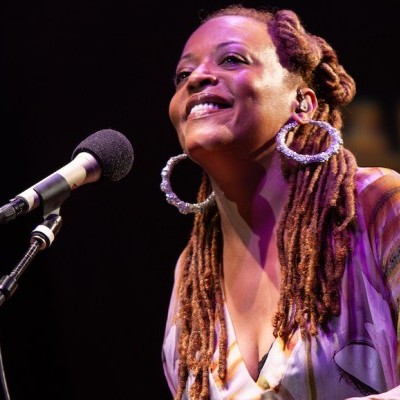
Wilson’s ability to connect to audiences helped her to win two Grammy awards and multiple other accolades. She was named an NEA Jazz Master in 2022.
Sep 3, 2026 10:44 AM
Cassandra Wilson, a singer, songwriter and producer who was one of the most acclaimed and successful jazz vocalists of…
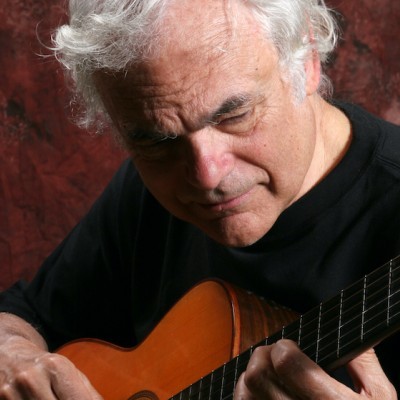
Bertoncini was a specialist and advocate for the nylon-string acoustic guitar, turning down high-profile opportunities that were unsuited to the sound and techniques that he used with that instrument.
Sep 1, 2026 11:06 AM
Gene Bertoncini, an esteemed jazz guitarist, composer, arranger and educator, died Aug. 29 at the Lillian Booth Actors…
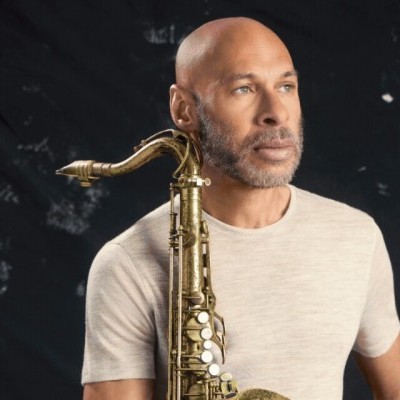
A solo concert by saxophonist Joshua Redman will close the first night of the Hyde Park Jazz Festival on Sept. 26.
Sep 22, 2026 12:26 PM
The Hyde Park Jazz Festival will take place for the 20th time on the final weekend of September 2026. Beginning half…
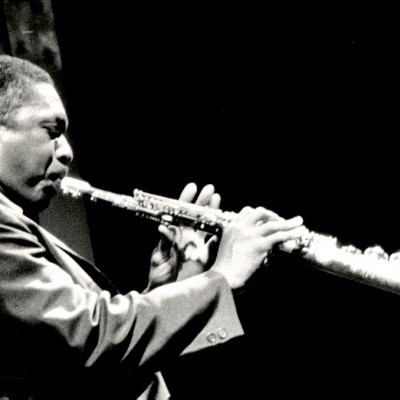
“It was just that suddenly … I could hear it,” Ravi Coltrane said of an epiphany he experienced during his late teens regarding his father’s music. “And it was almost like a calling, like something saying, ‘Hey, man, come on. It’s time to get serious.’ And the first time you really tune in and dial in and focus like that, it can be very life-changing.”
Sep 22, 2026 1:39 PM
Editor’s Note: Tomorrow, Sept. 23, is the 100th anniversary of John Coltrane’s birth. In honor of the tenor and…
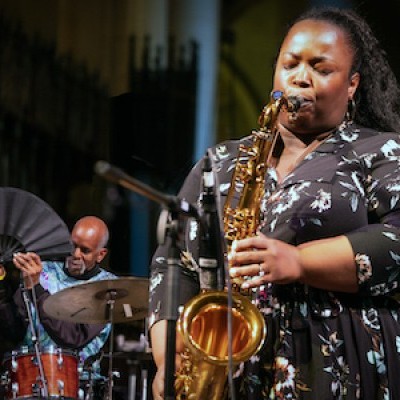
Camille Thurman took to the stage alongside bassist Kenny Davis and drummer Tommy Campbell for a rendition of Johnny Mercer’s “I’m An Old Cowhand” that recalled Rollins’ epochal 1957 trio outing Way Out West.
Oct 6, 2026 1:33 PM
As emcee Mark Ruffin noted at the commencement of an epic tribute to saxophonist Sonny Rollins at the Cathedral of…