Sep 22, 2026 12:26 PM
Hyde Park Jazz Fest on Chicago’s South Side to Present 20th Edition
The Hyde Park Jazz Festival will take place for the 20th time on the final weekend of September 2026. Beginning half…


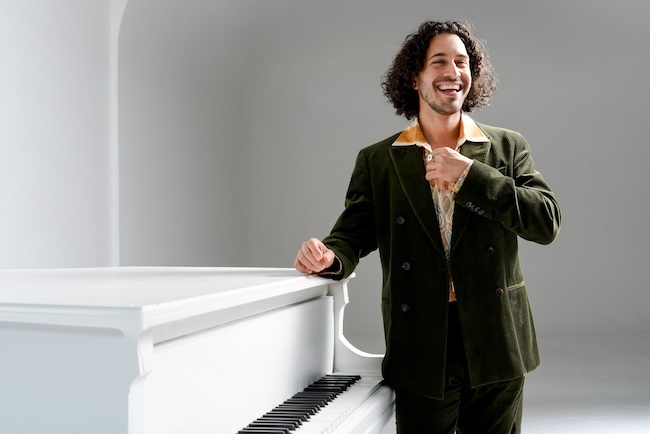
I want to create alternate spaces for the music to exist and thrive," says Emmet Cohen.
(Photo: Kevin Alexander)It’s been a year of tumultuous change for Emmet Cohen—a new Harlem apartment, a new venue for his hugely popular Live from Emmet’s Place webcast, a new album, a packed international touring schedule.
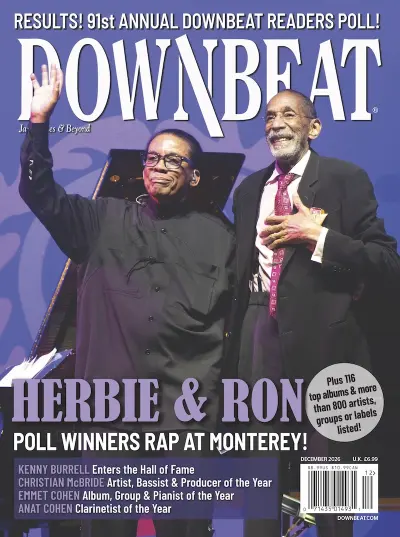
And now, a sweep of three major categories in the 2026 DownBeat Readers Poll: Pianist of the Year for the second year in a row; Album of the Year for Universal Truth (Mack Avenue); and Jazz Group of the Year for The Emmet Cohen Trio.
He has worked hard to get here. Never content to achieve virtuoso status as a pianist and wait for recognition to arrive, he has become a model of jazz entrepreneurship in the 21st century.
The ambitious 36-year-old pianist, bandleader and educator is in constant motion, this year alone hosting The Jazz Cruise; producing the now-monthly Emmet’s Place livestream from its new home at New York’s Power Station recording studio; conducting master classes at schools and universities; leading tour groups to Cuba and Sicily for musical collaborations; playing weeks at New York’s Smoke and Birdland and residencies at major jazz festivals; and touring North America, Europe and Japan.
Asked whether he has a theory about why he and his trio have become so popular with jazz fans and fellow musicians, he mused about the principles he tries to maintain: “community, consistency, a diverse set of projects and love,” for both the music and the audiences.
“I think it’s all about the community,” he told DownBeat via video from his new home. “The people that I’m fortunate enough to play with exhibit … I’m just gonna call it love. I find people to play with who are like-minded and share a similar passion for playing and sharing this music. There’s an element of love these people exhibit. Joe [Farnsworth] and I will stay out there until the very last person has said ‘Hi,’ no matter what country we’re in.”
The “consistency” is the grueling pace he maintains through a variety of ventures. “There’s hardly a second of downtime in my schedule. Concerts, master classes, residencies, the American Piano Competition [which named Cohen its Artistic Partner for the 2027 competition], artist-in-residence at the D.C. Jazz Festival and, next year, artist-in-residence at Columbia Neuroscience [the university’s Zuckerman Institute]. Also, Penn State University asked me to design a course for them similar to the one I hosted earlier this year,” he said, referring to a six-week online course he taught called “Breaking Through,” offering personalized practice and career advice to a small group of musicians.
Cohen is well practiced at turning adversity into opportunity. Faced with the sudden disappearance of gigs as a result of the pandemic in 2020, he established Live from Emmet’s Place in his Harlem apartment, building it into the most popular regular online jazz concert series in the world, with tens of millions of views on YouTube and Facebook. Six years later, when the residents of his apartment house forced him to stop the weekly webcasts after years of noise complaints, he initially despaired.
“When we first found out we had to move from my apartment, my world crumbled a bit. I was distraught. I thought: We built this thing. It belonged in this apartment. And these people in the building were prohibiting me from doing it. How would we ever be able to recreate the magic somewhere else?”
Then Berklee School of Music, the operator of the Power Station, offered to host Emmet’s Place. Cohen knew the vibe would never be the same as it had been in his cozy apartment, where the musicians were “like, one arm’s length from the fridge and from each other. … I realized we’d have to sacrifice some intimacy in order to grow. But now I think we have the possibility to do things in a more professional manner.”
The new operation combines Cohen’s production team with that of the Power Station, separate audio feeds for the webcast and the studio recording, an overhead camera for the piano and far more space for both the musicians and the audience. A livestream in September featured Bryan Carter’s Jazz at Pride big band, six vocalists and a nine-piece string section. Cohen has also been able to attract “several artists who never made it to the apartment,” including Joshua Redman, Ron Carter and Chris Potter, all of whom appeared this year on the webcast.
The award for Jazz Group of the Year is especially significant for Cohen. The personnel of his trio are variable, drawing on a stable of close friends and collaborators, all of whom know the tunes and the spontaneous way in which he likes to work on stage.
“We have an expansive repertoire,” he said. “You can hear five sets over the course of a week at Birdland and never hear a song repeated. We combine repertoire and stylistic choices from over a 100-year span of jazz. I’ve learned that what defines a group is a mutual understanding of the concept and the repertoire.
“It’s been a great blessing to be able to welcome a number of different musicians on each instrument but still provide a similar outcome that maintains the personality of the group itself. I think about [bassists] Russell Hall, Yasushi Nakamura, Philip Norris, Reuben Rogers and Joey Rainieri. And I think about [drummers] Joe Farnsworth, Kyle Poole, Evan Sherman, Joe Saylor and Bryan Carter. I can mix and match any of those musicians and still feel like I’m comfortable enough to express myself in a format that I call the Emmet Cohen Trio—I think that’s a magical thing! So often [in jazz] people leave a group, and that’s the dissolution of the group.”
That hasn’t happened with the trio, he said, “because I’ve spent a lot of time and energy making sure that the group is not based on individuals as much as it is on a conceptual and spiritual approach, and having similar values in the music. There is a level of joy and freedom when you show up. We might not have a set list, but the individual musicians are going to be able to do something personal, and it’s going to swing as hard as possible. And it’s going to be rooted in a base of about 100 or so arrangements that they all know.”
Cohen spent much of 2026 touring a show devoted to material by John Coltrane and Miles Davis in their centennial years, with an expanded quintet: drummer Farnsworth and bassists Yasushi Nakamura or Reuben Rogers filling out the rhythm section; Jeremy Pelt on trumpet and Tivon Pennicott on tenor saxophone. The group (with Nakamura) recorded some of the arrangements on Universal Truth (Cohen named it after the idea Coltrane sought to express through his music) with guest appearances by jazz masters Ron Carter and George Coleman. . The seven musicians on the album represent three generations in jazz. Bridging those generations has become a hallmark of Cohen’s musical career.
This fall, the label re-released the album in a deluxe edition including new material (a previously unreleased track of “Luck Be A Lady,” featuring Patrick Bartley on alto saxophone, and a live version of the album’s centerpiece, Cohen’s original “Universal Truth” suite, recorded at Smoke in Manhattan.
Cohen’s unsure why this album, his 13th as a leader, has resonated so well with the public. Was it the Miles and Trane theme? The expanded ensemble? The inclusion of classic material (like Davis and Bud Powell’s “Budo” and Coltrane’s “Blue Trane”)? The guest appearances? Or was it just the right album at the right time?
“God, I don’t know,” he laughed. “I think that it brought together a lot of the … hopes and dreams I have about music into one project. It has the generational connectivity that I’m so passionate about. Yet this is the first album that I’ve played with these jazz masters where it hasn’t been about honoring the jazz master. … It was more about integrating them into the vision that I have now. The idea was to get together and just play with the masters, Ron and George; my contemporaries, like Tivon and Yasushi; and some of the most important musicians in their prime, like Jeremy and Joe.
“Yes, we wanted to honor Miles, we wanted to honor Coltrane, we wanted to honor Jimmy Heath [whose classic ‘Gingerbread Boy’ is featured], but we weren’t going to make it about that. They would just be in our minds and our hearts. We were gonna try to do our thing and keep it personal.”
Cohen’s schedule for 2027 includes more of everything—monthly livestreamed concerts, visits to schools around the country and special travel programs for his eager fanbase, including planned visits to Ireland and California’s Napa Valley.
“The livestreams are still the center of our artistic ecosystem,” he said. “I want to create alternate places for the music to exist and thrive, whether we’re playing for school assemblies, taking people to Ireland or studying music from other cultures and incorporating that into what we do.”
In all these projects, Cohen’s goal is “to continue to be a connector of all types. And, hopefully, inspire people with our music to ask questions about themselves, their lives and, ultimately, get closer to whatever their universal truth might be.” DB
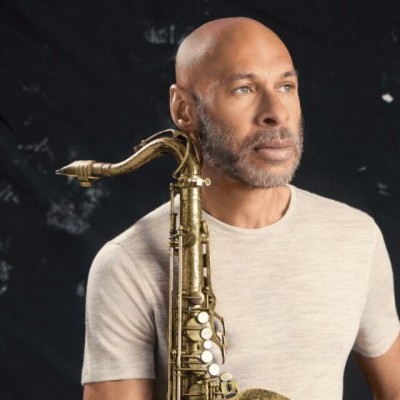
A solo concert by saxophonist Joshua Redman will close the first night of the Hyde Park Jazz Festival on Sept. 26.
Sep 22, 2026 12:26 PM
The Hyde Park Jazz Festival will take place for the 20th time on the final weekend of September 2026. Beginning half…
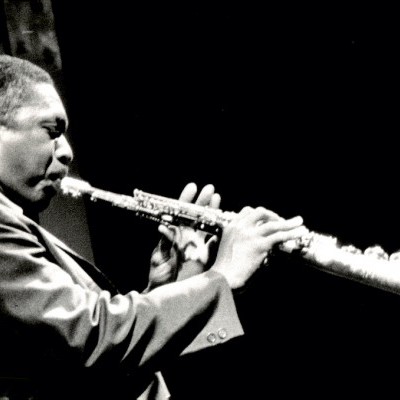
“It was just that suddenly … I could hear it,” Ravi Coltrane said of an epiphany he experienced during his late teens regarding his father’s music. “And it was almost like a calling, like something saying, ‘Hey, man, come on. It’s time to get serious.’ And the first time you really tune in and dial in and focus like that, it can be very life-changing.”
Sep 22, 2026 1:39 PM
Editor’s Note: Tomorrow, Sept. 23, is the 100th anniversary of John Coltrane’s birth. In honor of the tenor and…
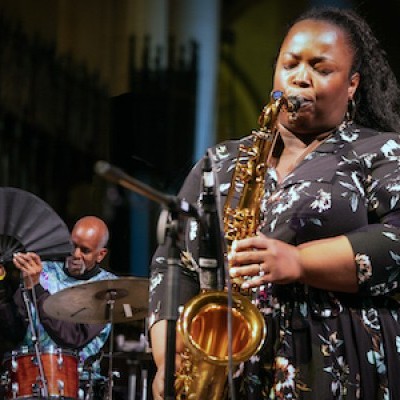
Camille Thurman took to the stage alongside bassist Kenny Davis and drummer Tommy Campbell for a rendition of Johnny Mercer’s “I’m An Old Cowhand” that recalled Rollins’ epochal 1957 trio outing Way Out West.
Oct 6, 2026 1:33 PM
As emcee Mark Ruffin noted at the commencement of an epic tribute to saxophonist Sonny Rollins at the Cathedral of Saint…
Record producer Bob Thiele’s classic photo that became the cover of John Coltrane’s landmark album A Love Supreme.
Sep 22, 2026 1:36 PM
A tribute to John Coltrane is one thing, but there is much more to the iconic saxophonist’s 100th anniversary…
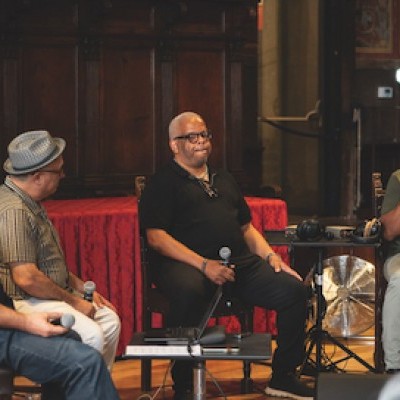
Ravi Coltrane (right) makes a point during a live Blindfold Test at the Umbria Jazz Festival while pianist Greg Burk (far left), journalist Ashley Kahn and trumpeter Terence Blanchard listen.
Oct 20, 2026 12:53 PM
The pairing of Terence Blanchard and Ravi Coltrane was billed as “The Miles/Coltrane Legacy,” a tour celebrating the…