Sep 22, 2026 12:26 PM
Hyde Park Jazz Fest on Chicago’s South Side to Present 20th Edition
The Hyde Park Jazz Festival will take place for the 20th time on the final weekend of September 2026. Beginning half…


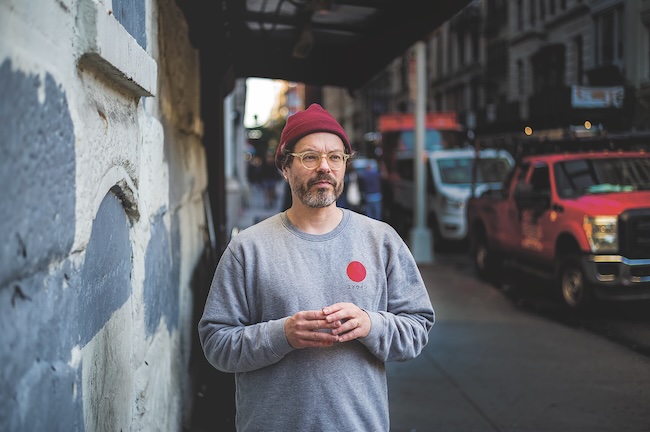
“It’s not about these records being big hits, it’s about documenting things,” Bro says of his Loveland Records label.
(Photo: John Rogers)“After many decades playing guitar, I realized that virtuosity isn’t what I’m looking for,” says Jakob Bro. “You can spend your whole life practicing, and in the jazz world you’re often pigeonholed with your instrument, but I’ve always felt like an alien in that scene. I’m more interested in the many layers of music—what inspires me and what I find interesting. Someone once called me an anti-guitar hero.”
For the past two decades, Danish guitarist and composer Jakob Bro has been redefining the world of improvisational guitar music through silence as much as sound. First coming to prominence in the early 2000s as a sideman with drummer and Keith Jarrett collaborator Paul Motian and with Polish trumpeter Tomasz Stańko, Bro has since released more than 20 albums as a bandleader with a vast range of some of modern jazz’s most distinct artists.
A cursory glance at his official biography lists Bro as currently collaborating with everyone from Joe Lovano to Wadada Leo Smith, Charles Lloyd, Brian Blade, Jorge Rossy, Marilyn Crispell, Mark Turner, Larry Grenadier, Joey Baron, Thomas Morgan, Palle Mikkelborg, Marilyn Mazur, Anders Christensen, Anja Lechner, Jakob Buchanan, Skúli Sverrisson, Arve Henriksen and the Brussels Philharmonic—to name just a few.
Across this diversity of bandmates, ensembles and fellow players, Bro’s skill is in providing ample space for their virtuosity to shine. Rather than dominate settings with his own compositions, Bro’s bands thrive on their egalitarianism, allowing each musician their moment in the spotlight as well as the capacity to create something new as a whole. In 2025 alone, Bro released four albums: the ambient textures of Until I Met You with Japanese percussionist Midori Takada; the minimalist experimentalism of The Montclair Session with trumpeter Wadada Leo Smith, drummer Andrew Cyrille and pianist Marilyn Crispell; the free-jazz-inspired Murasaki with Smith and drummer Marcus Gilmore; and the melodic tenderness of New Morning with his 10-piece large ensemble. Each record plays through discrete atmospheres but is unified in Bro’s spaciousness and subtle propensity for quiet.
“I try to find a reason to create sound because silence is beautiful as it is,” he says over a video call from his Copenhagen home. “When I find someone I love playing with, I want to create different combinations and contrasts, since there’s something fascinating about going into the studio with a variety of people. Paul Motian was my mentor and he was very good at mixing people up and making bands with different players. He created a family of musicians, and it was really inspiring to be a part of. I now constantly think about how I can create settings for the people who move me and inspire me and make them enjoyable both for us and for the listener. I’m so dependent on the people I play with, and I like creating that way.”
Bro’s latest collaborative project is a second album with Takada, From Such A Blue Sky. Recorded during improvised sessions in Tokyo, the resulting six tracks are deeply moving and delicately attuned to the pair’s wordless melodic dialogue. Fingerpicked acoustic guitar interweaves with plaintive piano melody and whispers of shaking bells on “Lullaby For You,” while dark drones and reverberating gongs provide a moody soundscape for Bro’s gentle guitar lines on “Unendable Dream,” dual guitar and marimba melodies coalesce on the lilting, uplifting energy of “Flowering Tree” and shades of electric guitar distortion merge with washes of cymbal hits on the enigmatic “Falling And Fragmentation.” It is a peaceful yet engaging listening experience, one that soothes the listener with its downtempo textures while drawing them in with flashes of difference and compositional debate.
This fruitful collaboration with Takada isn’t just a reflection of Bro’s admiration for her pioneering minimalist compositions but rather symptomatic of a wider shift in his creative life towards Japan. “Eight years ago, when I turned 40, I decided that since I had dedicated my life so far to only music, it was time to try and pick up a new hobby, to learn something from scratch once more,” he says. “I started learning Japanese, and it took me right back to being a kid and the thrill of discovering something new. Studying Japanese ended up giving me a lot of focus in my life. Around the same time, I also decided to reach out to Midori and see if she was interested in a collaboration, and in the years since, she has become an incredibly inspiring person to work with and her music has coalesced with my Japanese study. It’s wonderful to now have the two languages of music and Japanese in my life.”
Finding a mutual affinity for the space between the notes as much as for playing itself, the duo has since struck up an informal agreement to meet in a Tokyo studio each year for a recording date with no fixed expectations or outcomes. “We said that every November we should meet, and it’s a nice experiment to see how we can develop naturally,” Bro says. “We’re definitely going to add to Until I Met You and From Such A Blue Sky to create a trilogy of albums, and then who knows where it will go from there. I want to keep meeting up to record until I die.”
True to his ethos of blending collaborators, Bro is also in the process of making new combinations with Takada and other longstanding bandmates like saxophonist Joe Lovano, Smith and a string quartet. “For a long time I’ve been working on finding a balance between composed material and open material, and slowly I’ve been emerging into this idea where we play concerts and we have no written music at all. In fact, if we went into written music it would break the flow,” he says. “It means I have total freedom to play completely open as well as composing more formally for settings like choir and string quartets. I’m interested in creating and establishing these moments of beauty here and there on record, and then when the concert comes there’s a whole library of music to draw upon.”
With so many projects often being written for, recorded or toured simultaneously, Bro increasingly found it necessary to create a releasing infrastructure that could allow him to head to the studio and put out projects whenever he wanted. While his solo career took off internationally after signing with ECM in 2016 and he consequently released eight albums on the storied label, by 2024 he decided it was time to move operations completely over to his own imprint, Loveland Records.
“I used to put out a few records early on through Loveland but it was very sporadic. Then, when I started to work with ECM, I would record stuff on the side that I didn’t put out. It became difficult because everything was on the shelf and it all began to feel old,” he says. “Music is a companion that follows you throughout your life, and you can hear the development of a person through it. I felt like I had to start taking my label seriously to allow for that documentation to occur. It’s since become an amazing place for total artistic freedom, and I feel like a bit of a rebel because I’m releasing records with people like Charles Lloyd and Joe Lovano, who are both on majors, but it’s great that we can do it and that we ensure conditions are as fair as possible.”
Loveland isn’t just a vehicle for Bro’s own combos; it has also expanded to release other artists from his constellation of collaborators. Recent records include the debut album from bassist Thomas Morgan, Around You Is A Forest, as well as the first solo album in 25 years from ECM artist and composer Palle Mikkelborg, Light, and a forthcoming solo bass clarinet album from Kurt Rosenwinkel collaborator Andrew D’Angelo, BCDELUXE.
“They’re all records that make sense to release on Loveland because it’s music I’m related to,” Bro explains. “I’ve toured for years with Thomas Morgan so it felt right to put out his debut, while I used to live with Andrew D’Angelo when I first went to New York. He was the soundtrack to my everyday life for a long time since I would always hear him practicing the bass clarinet in his room. I also have a dream of releasing a solo album from another dear collaborator and friend of mine, Joey Baron, which I hope we will make happen one day. It’s not about these records being big hits, it’s about documenting things.”
As much as the freeing chaos of Loveland is a departure from longstanding labels like ECM with their codified release schedules, it still harks back to jazz heritage with its unified visual language. Comprising brightly colored pencil drawings, impressionistic figures and textured abstract landscapes, each cover for Loveland’s releases is created by Danish artist Tal R.
“I was inspired by ECM’s covers being instantly recognizable and wanted something similar for Loveland. So I approached Tal, who is a good friend of mine, and he said he’d do 10 for me initially,” Bro says. “He doesn’t want to hear the music beforehand because he has a philosophy that the visuals and the music will always meet. I just give him the title and he brings the music to life in his own imagination. I love what he’s done, and we now have an agreement that he will make 100 covers for us, which means we’re committed to 100 releases on the label.”
Ever-expanding, Loveland isn’t only on a mission to release 100 records. The label has also recently begun holding its own festival in Copenhagen each November and December. With the first official edition in 2025 hosting erstwhile collaborators Lovano, Midori Tadaka, Wadada Leo Smith and Marcus Gilmore alongside local artists like drummer Jakob Hoyer and bassist Anders Christensen, 2026’s event will feature overseas luminaries like Charles Lloyd and Bill Frisell with Danish saxophonist Mette Rasmussen. “What makes the festival unique is the fact that I’m putting all these players in new combinations, so they have to have a lot of trust in me,” Bro says. “It all started as a way to give something back to the Danish music community, and now it’s growing. This year we have a schools program happening where we have 1,300 kids coming in to hear short solo concerts from Bill Frisell and Charles Lloyd, and then I’ll talk to them about creating music, improvising and making sound. It’s all part of Loveland’s mission to spread the music as wide as possible and get kids involved, just as I was.”
Growing up in a household full of music, since Bro’s mother used music to teach children with special educational needs and his father ran an amateur big band, Bro first picked up the trumpet before moving onto the guitar at 10 after becoming enamored with the wild sound of Jimi Hendrix.
“For a long time I actually felt like I chose the wrong instrument. It was such an alien, and I thought maybe something acoustic was better for jazz,” he says. “I think it’s part of the reason why my career is what it is, because I know my instrument can only do certain things. So I want to shine a light on other people in my music instead.”
Despite his tousles with the efficacy of his instrument, it was clear from the start that Bro was prodigiously talented. From 13 he began teaching guitar to older students, and by 15 he was determined to drop out of school so he could focus entirely on his musical studies. Somehow, he made a convincing case to his parents, and they relented. “I basically made my own conservatoire at home where I would wake up at 5:30 a.m. every day and have this incredibly intense schedule of listening, practicing, transcribing and then biking over to sessions with other musicians around town,” he says. “At 17 I became the youngest person to be accepted into The Royal Danish Academy, and I was there for a year until I played during a workshop with Michael Brecker and Danilo Pérez and they told me I had to come to the U.S. Later that summer I also had a chance encounter with Kurt Rosenwinkel, who saw me playing with my trio and he said the same thing. That cemented it for me. I left for the U.S. at 18 and haven’t really looked back since.”
Now 48, Bro has been on a 30-year road to creative self-expression and he shows no signs of slowing down. Alongside his recordings with Takada, he also has plans to start a new trio with Lovano and drummer Brian Blade, as well as the ultimate goal of 100 records on Loveland. “I’m turning 50 soon, and I’m sure that will bring with it a new period of reflection and assessment,” he says. “It’s been a long journey, but all I’m thinking about now is what you can do with what you have to make meaningful art. Now music is purely a pleasurable thing, I’m really trying to just enjoy it.” DB
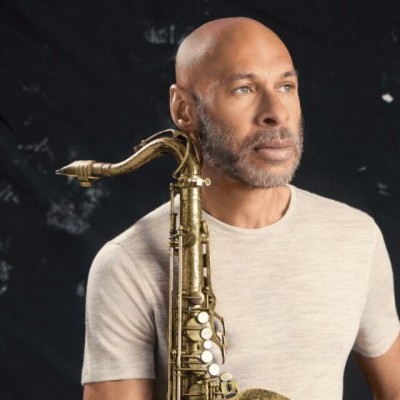
A solo concert by saxophonist Joshua Redman will close the first night of the Hyde Park Jazz Festival on Sept. 26.
Sep 22, 2026 12:26 PM
The Hyde Park Jazz Festival will take place for the 20th time on the final weekend of September 2026. Beginning half…
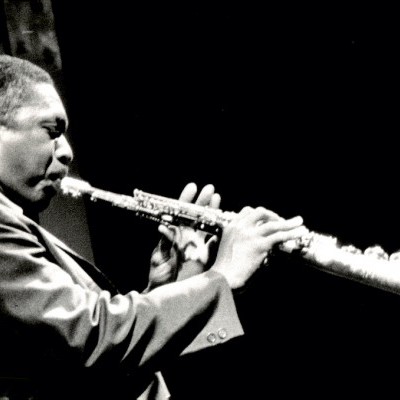
“It was just that suddenly … I could hear it,” Ravi Coltrane said of an epiphany he experienced during his late teens regarding his father’s music. “And it was almost like a calling, like something saying, ‘Hey, man, come on. It’s time to get serious.’ And the first time you really tune in and dial in and focus like that, it can be very life-changing.”
Sep 22, 2026 1:39 PM
Editor’s Note: Tomorrow, Sept. 23, is the 100th anniversary of John Coltrane’s birth. In honor of the tenor and…
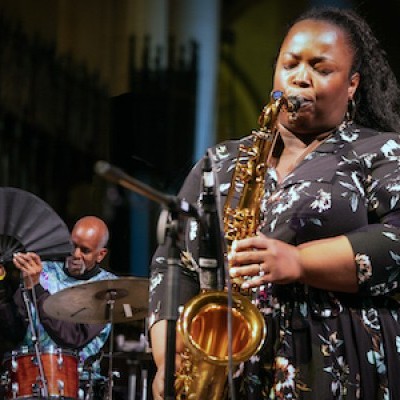
Camille Thurman took to the stage alongside bassist Kenny Davis and drummer Tommy Campbell for a rendition of Johnny Mercer’s “I’m An Old Cowhand” that recalled Rollins’ epochal 1957 trio outing Way Out West.
Oct 6, 2026 1:33 PM
As emcee Mark Ruffin noted at the commencement of an epic tribute to saxophonist Sonny Rollins at the Cathedral of…
Record producer Bob Thiele’s classic photo that became the cover of John Coltrane’s landmark album A Love Supreme.
Sep 22, 2026 1:36 PM
A tribute to John Coltrane is one thing, but there is much more to the iconic saxophonist’s 100th anniversary…
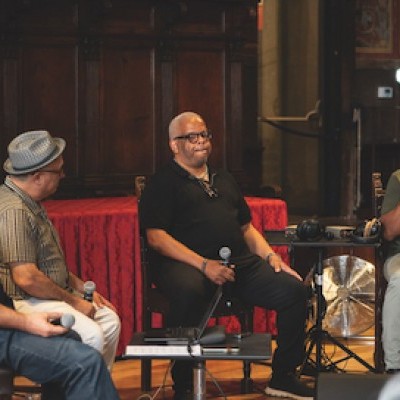
Ravi Coltrane (right) makes a point during a live Blindfold Test at the Umbria Jazz Festival while pianist Greg Burk (far left), journalist Ashley Kahn and trumpeter Terence Blanchard listen.
Oct 20, 2026 12:53 PM
The pairing of Terence Blanchard and Ravi Coltrane was billed as “The Miles/Coltrane Legacy,” a tour celebrating…