Sep 22, 2026 12:26 PM
Hyde Park Jazz Fest on Chicago’s South Side to Present 20th Edition
The Hyde Park Jazz Festival will take place for the 20th time on the final weekend of September 2026. Beginning half…


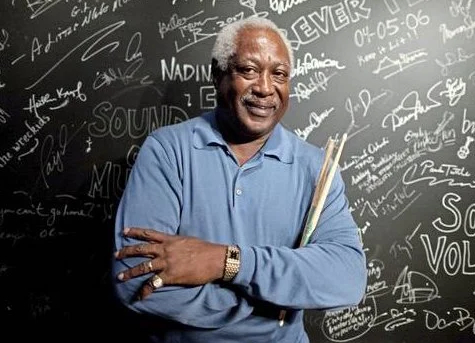
“When you’re playing jazz, you’ve got to listen to the music,” says the Pittsburgh-based drum grandmaster Roger Humphries.
(Photo: Courtesy Roger Humphries)Around 9 p.m. on gala night of the 2026 Pittsburgh Jazz Festival, I was obliged to exit an immensely satisfying concert by Samara Joy and her cohesive septet in the August Wilson Cultural Center’s auditorium to emcee a set by drum grandmaster Roger Humphries. A familiar and beloved figure in Pittsburgh’s hardcore jazz circles for most of his 82 years, Humphries reached the global stage during his 1964–’67 tenure with Horace Silver, during which he developed a creative, still-fresh, swing-meets Afro-Latin beat matrix to propel bandmates Joe Henderson, Carmel Jones, Woody Shaw and J.J. Johnson on albums like Song For My Father, The Cape Verdean Blues and The Jody Grind, thereby stamping his tonal personality in the volatile mix of contemporaneous drum expression then being developed by individualistic, virtuosic generational contemporaries like Tony Williams, Joe Chambers, Jack DeJohnette, Lenny White and Billy Cobham.
After a year or so on the road with Ray Charles, Humphries opted for family over potential stardom, and came off the road in 1969. The world’s loss was Pittsburgh’s gain. For the ensuing 57 years, Humphries has taught and mentored several generations of high-level musicians; performed in the western Pennsylvania/eastern Ohio/northern West Virginia area with acoustic hard-bop and the plugged-in funk groups with personnel culled from Pittsburgh’s first-class musician pool, and recorded them on the well-crafted, self-produced albums Keep, the Faith and Chicken on the Hill With Will; and enjoyed family life with his wife, Regina, a nurse, their four children and 11 grandchildren, and the nine older siblings and numerous cousins—and their progeny—with whom he spent his formative years.
For the entirety of the 90-minute set, Humphries turned back the clock. Barely moving a muscle below his elbows, he sustained his crisp execution from the first note to the last, orchestrating the flow by playing the entire form of tunes like “The Kicker,” “Crisis,” “Nutville” and several other Silver classics as his bandmates soloed, accommodating their individualism by responding to their postulations with the focus and dynamic nuance of a gifted drum practitioner half his age. Humphries further emphasized his individualism by uncorking several cogent, explosive drum solos that had guest trumpeter Sean Jones and bassist Dwayne Dolphin laughing with delight.
A week before the concert, Dolphin, 63, spoke on the phone about Humphries, with whom he’s played regularly since he was 16. “I always enjoyed the level of sophistication Roger plays with,” Dolphin said. “There’s his touch—he never hit the drums as if he was angry with them, but always as a musical instrument, cool, calm and under control. I don’t think I’ve ever played with a drummer with that much control of the beat. I always describe Roger as a cat. You could throw him in the air upside down, he’ll twist and everything, but he’s going to land on his feet no matter what. He’s incredibly musical all the time.
“Tony Williams was like that, too. He absolutely adored Roger. The first time I met Tony, he asked where I was from, and when I said Pittsburgh, the next thing out of his mouth was, ‘How’s Roger Humphries doing?’ Tony was hardcore; he didn’t give it up. He said, ‘That’s a bad brother.’”
“It’s great for Pittsburgh that Roger is there, because he represents so much of the essence of jazz music,” said Jeff Watts, perhaps Humphries’ best-known mentee. “You can hear that he heard everybody, but he has his own way of playing everything—his own funky vibe, his own shuffle. His feel is very gangster, not in a Art Blakey way, but specifically in a Roger Humphries way, aggressive and nasty. There’s happy swinging and polite swinging. He has a nasty swing, and his own way of playing Afro-Latin vibe. I feel his solo vocabulary is unique. He plays the beat like he intends people to dance to it. He has maximum getdown. He knows all the structure, and he functions in the schools as an educator, but at the same time, he’s got that street edge. That’s good for these kids to know. He deals with kids well. I run into his students all over the place, and they all know how to deal. And they know how to be gentlemen, but they’re not like schoolboys, either—they have a little edge, a little swag.”
As Humphries moved from one song to the next, you could hear him extrapolate freshly brewed variations and refractions of the 1950s vocabularies and techniques of Max Roach, Art Blakey and Philly Joe Jones, who befriended Humphries in late adolescence, and invited him to sit in on their late sets at such Black-owned Pittsburgh venues as the Crawford Grill and Hurricane Lounge. “He learned some things from those people, but his gift is unique and God-given—everything he has comes from a different place,” Dolphin said. By way of emphasis, he recalled asking Humphries’ siblings, “How old was Roger when you guys knew he was going to be a professional drummer?” after his mentor tasked him to write the liner notes for Keep the Faith. “They convened and discussed it for about 30 seconds. Then they said, ‘three years old.’”
Humphries was 5 when he made his public debut in 1950, sitting in with alto saxophonist Tab Smith’s Orchestra and vocalist Savannah Churchill. The instigator was his uncle, Frank Humphries, a trumpeter whose 1941 recording of “After You’ve Gone” with Lucky Millinder’s orchestra shows the strong influence of his Pittsburgh friend Roy Eldridge, two years his senior, who in 1927 had recruited Frank’s older brother, saxophonist Hildred Humphries (1910–’96), to join him on the road with a juvenile carnival band in the Rock Dinah show. Perhaps he was motivated to do so after Art Blakey, with whom Frank had played frequently in Pittsburgh during the 1930s, asked Roger’s parents the previous year before to bring Roger on the road as a child act, and was politely rebuffed. At home, Roger occasionally played with them, supplementing almost daily jamming with older brothers Lawrence, a saxophonist, and Norman, a drummer, upon whom Roger modeled himself as he moved into adolescence, internalizing as a first principle the notion that playing the drums, whatever the style, constitutes a conversation with the soloist.
At 14, still in junior high school, Humphries applied that m.o. when Illinois Jacquet invited to sit in one night at the Crawford Grill. Jacquet liked what he heard, and hired him for a quintet engagement on his next trip to Pittsburgh. In 1962, Stanley Turrentine and Shirley Scott—after asking his parents’ permission—took him on the road, to a gig at Los Angeles’ It Club. In 1964, Horace Silver, who was disbanding his Blue Mitchell/Junior Cook/Gene Taylor/Roy Brooks unit, heeded enthusiastic recommendations from both Roach and Blakey, and flew Humphries to New York for a three-day audition. Although Silver put him up at his apartment, there were no guarantees. for the drum chair. Also auditioning were Billy Cobham and Edgar Bateman, who, Humphries recalls, “played so much drums, they scared me; I thought no way in hell would I get the gig.” When Silver informed Humphries that the job was his, he explained: “You were the only one who did what I asked.”
“We all had our conversation with Horace, and for whatever reason, mine was the one that made him want to get back with me,” Humphries says. “When you’re playing jazz, you’ve got to listen to the music. They don’t have to put anything up here for you. I have beautiful memories about Horace and Max and Art Blakey and Philly Joe, and how they treated me. That’s why my thing is about passing it on. A lot people have talent. But we’ve got to pass it on to the next generation.”
“Roger taught me to really, really listen,” Dolphin cosigns. “But his biggest impact on me has been from being around him personally off the bandstand. He tried to teach me about being the best human being I could be and the best musician I could be, which is to play on the highest level.” DB
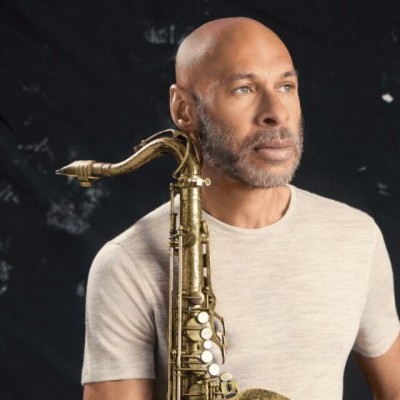
A solo concert by saxophonist Joshua Redman will close the first night of the Hyde Park Jazz Festival on Sept. 26.
Sep 22, 2026 12:26 PM
The Hyde Park Jazz Festival will take place for the 20th time on the final weekend of September 2026. Beginning half…
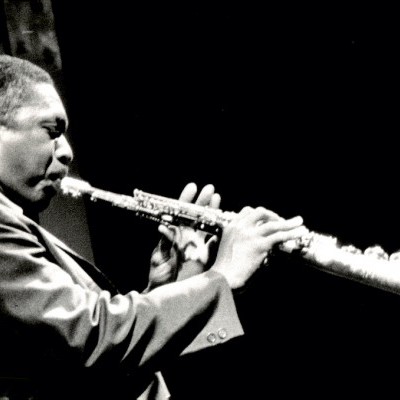
“It was just that suddenly … I could hear it,” Ravi Coltrane said of an epiphany he experienced during his late teens regarding his father’s music. “And it was almost like a calling, like something saying, ‘Hey, man, come on. It’s time to get serious.’ And the first time you really tune in and dial in and focus like that, it can be very life-changing.”
Sep 22, 2026 1:39 PM
Editor’s Note: Tomorrow, Sept. 23, is the 100th anniversary of John Coltrane’s birth. In honor of the tenor and…
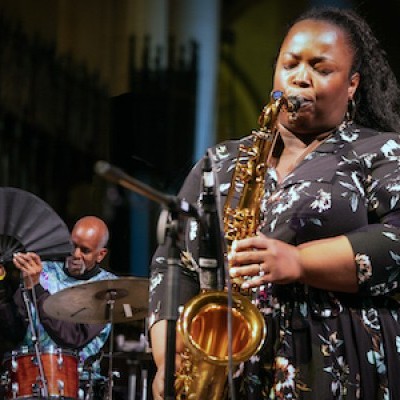
Camille Thurman took to the stage alongside bassist Kenny Davis and drummer Tommy Campbell for a rendition of Johnny Mercer’s “I’m An Old Cowhand” that recalled Rollins’ epochal 1957 trio outing Way Out West.
Oct 6, 2026 1:33 PM
As emcee Mark Ruffin noted at the commencement of an epic tribute to saxophonist Sonny Rollins at the Cathedral of…
Record producer Bob Thiele’s classic photo that became the cover of John Coltrane’s landmark album A Love Supreme.
Sep 22, 2026 1:36 PM
A tribute to John Coltrane is one thing, but there is much more to the iconic saxophonist’s 100th anniversary…
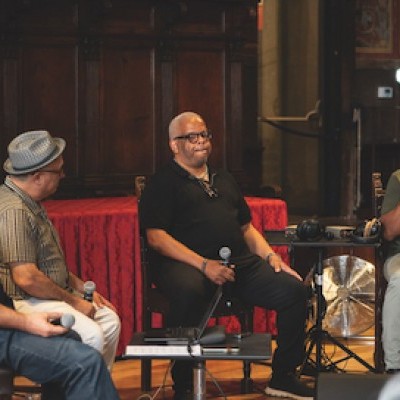
Ravi Coltrane (right) makes a point during a live Blindfold Test at the Umbria Jazz Festival while pianist Greg Burk (far left), journalist Ashley Kahn and trumpeter Terence Blanchard listen.
Oct 20, 2026 12:53 PM
The pairing of Terence Blanchard and Ravi Coltrane was billed as “The Miles/Coltrane Legacy,” a tour celebrating…