Sep 22, 2026 12:26 PM
Hyde Park Jazz Fest on Chicago’s South Side to Present 20th Edition
The Hyde Park Jazz Festival will take place for the 20th time on the final weekend of September 2026. Beginning half…


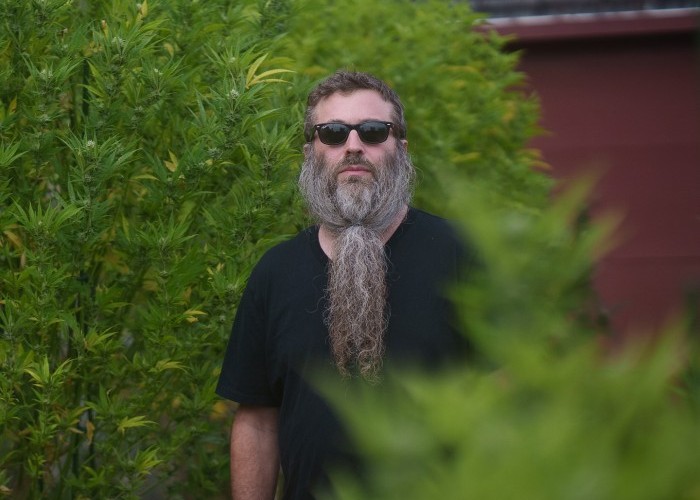
“It’s nice and quiet here, plenty of space to think, super chill,” says Jamie Saft of living in Maine.
(Photo: Alexa Saft)For many years, keyboardist Jamie Saft, born in Queens in 1971, was a fixture of New York’s downtown scene. He played with drummers Bobby Previte and Jerry Granelli, trumpeter Dave Douglas and saxophonist Peter Epstein, as well as many others, and around the turn of the century was drawn into John Zorn’s orbit, serving as a member of Electric Masada and appearing on dozens of other albums and projects.
But then he left the city.
“When we first moved from Brooklyn to the Hudson Valley in 2007 … it was really chill, really quiet, not too many people. And then suddenly it all became gentrified. My neighbors were like David Bowie and Iman, and Daniel Craig and Rachel Weisz. And I was like, what the fuck is this?” he laughs.
Since 2021, he’s been living in a small town in Maine. “It’s nice and quiet here, plenty of space to think, super chill. Life is much easier up here,” he says. “There’s a lot of great musicians and artists sort of hiding out here in Maine. It’s a great place to coast if that’s what you’re looking for. It’s not nearly as pushy and motivated as New York, so sometimes it’s like pushing a boulder up a hill to try and do things here, but quality of life is really high. We’re 10 minutes from the ocean, in the woods, on a river, a really amazing and beautiful place to live.”
Saft isn’t retreating from music, though. He’s got two albums out now that represent different sides of his multifaceted musical personality.
The simply titled Jamie Saft Trio Plays Monk, released in late 2024, features bassist Brad Jones and drummer Hamid Drake. As might be expected with that lineup, it’s a ferociously swinging collection of music. “Hamid’s originally from New Orleans, played with reggae bands, has played every style of music,” Saft explains. “Brad also has this incredibly broad palette … he’s played with Ornette and played in Elvin Jones’ band, but also played with reggae bands. So all three of us approach jazz, but improvising as well, with this broad palette. And all that music is equally important in informing the way we improvise.”
But this isn’t a loose, jam-oriented record by any means. Plays Monk is in fact a beautifully recorded album, played with almost classical restraint. Saft recalls, “We went into this beautiful, really old-school studio in Milano called Real Sound, where they have an 1890s C. Bechstein concert grand, which is a beautiful European piano, very different than a Steinway. If you see Monk videos from Europe, he’s very often playing a C. Bechstein. And they’re just as great as Steinways, but really tonally different. Sort of darker and richer, very orchestral piano in a way.” The performances are all first takes, the sound of the trio working through the music. They don’t take many liberties with form; instead, they honor Thelonious Monk as one of America’s great composers.
“As a pianist, those songs are so specific,” Saft says. “There’s so much information in them that I think a lot of times gets missed in the way people approach them. So I really try to approach them as songs. And we really stuck to the architecture of those songs on this.”
Saft’s latest release is Rhodes Scholar, a digital-only collection of original music for Fender Rhodes electric piano that runs nearly two-and-a-half hours. It’s one of Saft’s favorite instruments; he says, “I bought my first Fender Rhodes for $70 in the late ’80s, which is insane. They’re worth thousands and thousands of dollars now if you can even find a good one.”
The pieces, which almost all run between two-and-a-half and six minutes — the sole exception is the eight-minute “Pleiades” — often have a drifting, gentle quality reminiscent of the early ’70s work of Lonnie Liston Smith, or the devotional music of Alice Coltrane (who preferred a Wurlitzer electric organ). Saft says, “There’s something about the round bell tone, that Fender Rhodes sound, that is just so calming, so warm and enriching that it was something I really just wanted to explore more.”
But it’s not all bliss; Rhodes Scholar is a journey. “I didn’t actually set out to make a solo Fender Rhodes record. I just started working on some music on my Fender Rhodes, and suddenly the exposition of it was really making sense to me,” he says. “So, actually, that record is all in order, how I recorded it. And it’s interesting because it starts out pretty inside, very sort of tonal and quiet and contemplative, and it gets progressively darker and progressively more intense and more detailed. And starts going more out.”
For him, it’s part of a broader exploration of long-form music. “I really also wanted to just create an album where you lost sense of time. And when I listen to it, after a while, I can’t remember how long I’ve been listening to it. And I really love that space. So I just tried to create sort of a more long-form work that explored the different sounds and different tonalities with the Fender Rhodes.”
Saft doesn’t plan on slowing down. He just wants people to maybe consider the possibility of coming to him. “I have a giant studio space. We have a whole building for our studios. My wife has her art studio upstairs, and I have guest rooms for my people to come and stay and make records.” He says it’s just not as important as it once was to be in the same neighborhood as one’s creative peers.
“It’s never going to be the same level as New York. But, frankly, I see all my musician friends on the road, in Europe, more than I see them in New York — we’re all working over there, not really as much in New York. And I still go to the airport, still get to play with my dudes. So we love it. We’re so happy here.” DB
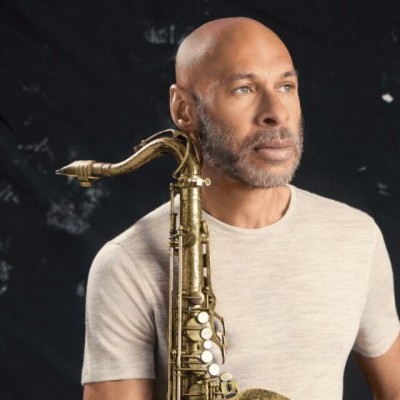
A solo concert by saxophonist Joshua Redman will close the first night of the Hyde Park Jazz Festival on Sept. 26.
Sep 22, 2026 12:26 PM
The Hyde Park Jazz Festival will take place for the 20th time on the final weekend of September 2026. Beginning half…
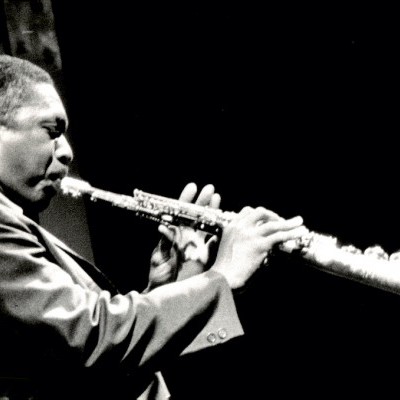
“It was just that suddenly … I could hear it,” Ravi Coltrane said of an epiphany he experienced during his late teens regarding his father’s music. “And it was almost like a calling, like something saying, ‘Hey, man, come on. It’s time to get serious.’ And the first time you really tune in and dial in and focus like that, it can be very life-changing.”
Sep 22, 2026 1:39 PM
Editor’s Note: Tomorrow, Sept. 23, is the 100th anniversary of John Coltrane’s birth. In honor of the tenor and…
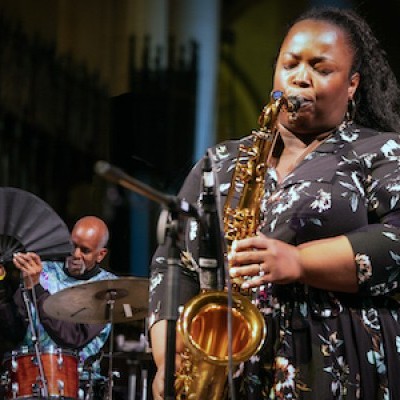
Camille Thurman took to the stage alongside bassist Kenny Davis and drummer Tommy Campbell for a rendition of Johnny Mercer’s “I’m An Old Cowhand” that recalled Rollins’ epochal 1957 trio outing Way Out West.
Oct 6, 2026 1:33 PM
As emcee Mark Ruffin noted at the commencement of an epic tribute to saxophonist Sonny Rollins at the Cathedral of Saint…
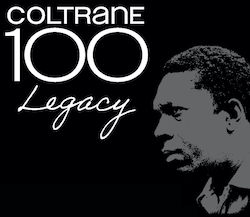
Record producer Bob Thiele’s classic photo that became the cover of John Coltrane’s landmark album A Love Supreme.
Sep 22, 2026 1:36 PM
A tribute to John Coltrane is one thing, but there is much more to the iconic saxophonist’s 100th anniversary…
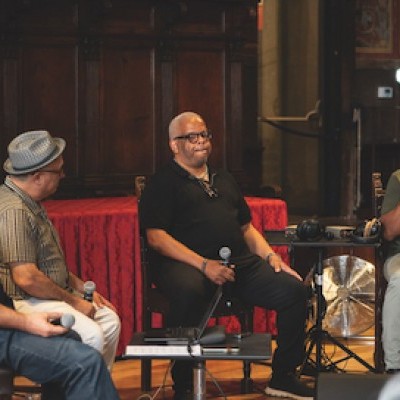
Ravi Coltrane (right) makes a point during a live Blindfold Test at the Umbria Jazz Festival while pianist Greg Burk (far left), journalist Ashley Kahn and trumpeter Terence Blanchard listen.
Oct 20, 2026 12:53 PM
The pairing of Terence Blanchard and Ravi Coltrane was billed as “The Miles/Coltrane Legacy,” a tour celebrating the…