Sep 22, 2026 12:26 PM
Hyde Park Jazz Fest on Chicago’s South Side to Present 20th Edition
The Hyde Park Jazz Festival will take place for the 20th time on the final weekend of September 2026. Beginning half…


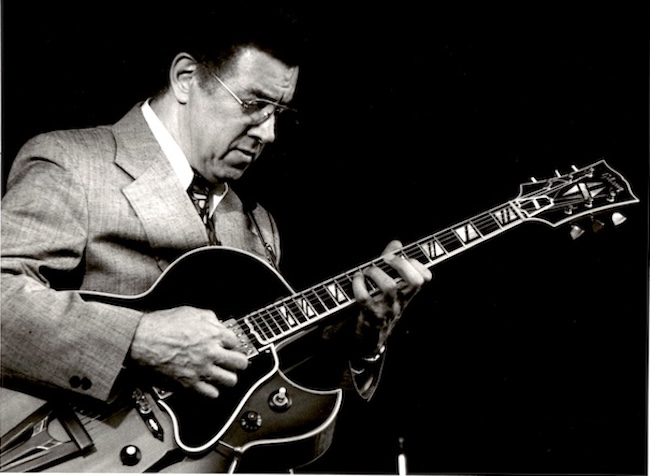
“Trane, Milt jackson, Coleman Hawkins, Count Basie … also Oscar Peterson, the Jones brothers out of Detroit, Dizzy Gillespie, of course,” says Kenny Burrell while name-checking his playing partners.
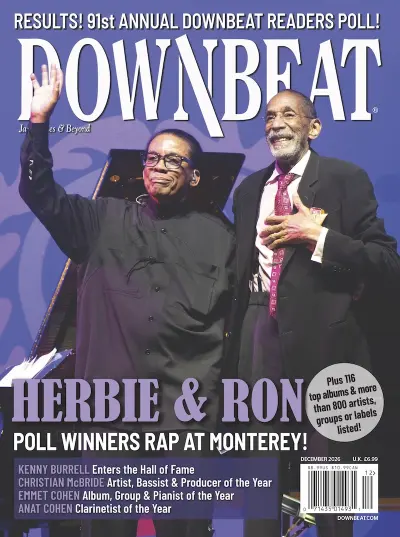
(Photo: Mark Holston)At long last, consummate classy gentleman and guitar legend Kenny Burrell has been inducted into the DownBeat Hall of Fame. And while it could’ve happened 20 or 30 years ago, given his influential body of work over six decades and his distinguished history as an educator (as the founding director of the Jazz Studies program at UCLA), the 95-year-old Detroit native seemed deeply appreciative of the honor in a recent call from his home in Los Angeles.
During a spirited conversation, Mr. Burrell ran down a laundry list of jazz immortals he had played with through his remarkable career. “There’s been so many great players that I’ve worked with,” said the 2005 NEA Jazz Master. “Trane, Milt Jackson, Coleman Hawkins, Count Basie … also Oscar Peterson, the Jones brothers out of Detroit, Dizzy Gillespie, of course. Dizzy was very encouraging to me right away, which is a great help to a young musician.”
He was also quick to list several great vocalists that he worked with, including Billie Holiday, Sarah Vaughan, Ella Fitzgerald, Lena Horne and Betty Carter, as well as Tony Bennett, Frank Sinatra and seminal role model Nat “King” Cole.
In a career spanning 75 years, Burrell played on over 200 sessions as a sideman while recording 100-plus albums as a leader or co-leader, several of which have been forever imbedded in the memory banks of jazz guitar players everywhere, including 1963’s Midnight Blue, 1965’s Guitar Forms, 1958’s Blue Lights (Vol. 1 and Vol. 2) and 1959’s A Night At The Vanguard (a trio date with bassist Richard Davis and drummer Roy Haynes). His tune “Chitlins Con Carne” has become a jazz standard. And his instantly recognizable tone — fat, warm, seductive—has been emulated by over three generations of guitarists.
Duke Ellington, whom Burrell revered and paid tribute to on 1975’s Ellington Is Forever, once called him “my favorite guitar player.” And Jimi Hendrix once declared, “Kenny Burrell, that’s the sound I’m looking for.”
It seems everyone loves Kenny Burrell, especially his protégés Rodney Jones and Bobby Broom, sidemen in Burrell’s The Jazz Guitar Band project from the mid-1980s. They both traveled internationally with their mentor, appearing in concerts in Europe, Canada and at the Blue Note in Osaka, Japan. Their two nights at the Village Vanguard on Oct. 24 and 25, 1986, were documented and subsequently released in two volumes on 1987’s Generations and 1988’s Pieces Of Blue And The Blues.
It’s no coincidence that so many of Burrell’s album titles have had the word “Blue” or “Blues” in them. Along with being profoundly influenced by jazz guitar greats like Charlie Christian, Django Reinhardt and Oscar Moore (the latter two he actually met in person), Burrell was also affected to the core by T-Bone Walker and B.B. King. As he wrote in the liner notes for his 1968 Verve album, Blues–The Common Ground, “The blues isn’t just a matter of a particular musical structure, a rigid harmonic form—it’s a feeling one gets from certain music. Also the way one expresses those feelings. The blues is T-Bone Walker, The Staple Singers, John Coltrane, The Rolling Stones or Buffalo Springfield. One can detect a blues flavor in a flamenco tune. It is part of one powerful force with many channels and that force is the soul of man.”
In mentioning B.B. King and T-Bone Walker as primal influences, Burrell chuckled and exclaimed with the enthusiasm of a cheerleader at a blues pep rally, “Oh, that’s right! Yeah, on the natural side!”
Born in Detroit on July 31, 1931, Kenny Burrell was the youngest of six siblings. Inspired by Charlie Christian, he picked up the guitar at age 12, began playing in a high school band at age 15 and by 1948, at age 17, became an active part of the local Detroit jazz scene, working in a trio at the Club Sudan (with fellow teenagers Tommy Flanagan on piano and Alvin Jackson on bass) that was modeled on Nat “King” Cole’s famous trio.
Burrell’s first time in the studio came on March 1, 1951, when Dizzy Gillespie hired the 19-year-old guitarist to record with John Coltrane, Milt Jackson, Percy Heath and drummer Carl Donnell “Kansas” Fields on three tracks for his Dee Gee label—“Birks’ Works,” “Tin Tin Deo” and “We Love To Boogie” (subsequently released on the two Savoy compilations, 1956’s The Champ and 1957’s School Days).
After graduating from Wayne State University in 1955, he toured for six months with the Oscar Peterson Trio before moving to New York, where he performed in Broadway pit bands and on pop and R&B studio sessions while also working in jazz venues like The Five Spot, the Village Vanguard and Birdland and appearing on jazz recordings.
Along with a string of monumental Blue Note recordings like 1956’s Introducing Kenny Burrell (with Paul Chambers, Tommy Flanagan and Kenny Clarke), 1957’s Kenny Burrell (with Flanagan, Frank Foster, Oscar Pettiford and Shadow Wilson) and 1963’s Midnight Blue (with Stanley Turrentine, Major Holley, Bill English and Ray Barretto), Burrell also recorded frequently with B-3 organ great Jimmy Smith. “He was a character, man!” Burrell chuckled, reflecting on the Incredible Jimmy Smith, as Blue Note billed him during his tenure with the label from 1956 to 1963.
Smith and Burrell did numerous blues-drenched recordings together for Blue Note and Verve, beginning with 1958’s At The Organ and House Party and continuing with 1961’s Home Cookin’ and Midnight Special (all on Blue Note), followed by Blue Bash! (Verve) and Back At The Chicken Shack (Blue Note) in 1963, The Cat (Verve) in 1964, Softly As A Summer Breeze (Blue Note), Monster (Verve) and Organ Grinder Swing (Verve) in 1965, and Got My Mojo Workin’ (Verve) in 1966. In later decades they collaborated on 1985’s Go For Whatcha Know (Blue Note), 1991’s Fourmost: Recorded Live At Fat Tuesday’s NYC (Milestone) and 1994’s The Master (Blue Note), recorded live in Osaka, Japan.
Burrell’s own latter-day recordings as a leader included 1996’s Live At The Blue Note with The Heritage Jazz All-Stars (Concord Jazz), 1998’s Love Is The Answer with The Boys Choir of Harlem (Concord Concerto), 2001’s Lucky So And So (Concord Jazz), 2003’s Blue Muse (Concord Jazz) and 2007’s 75th Birthday Bash Live! (Blue Note). He followed with a string of six albums for the HighNote label, beginning with 2009’s Prime: Live At The Downtown Room, continuing with 2010’s Be Yourself, 2011’s Tenderly, 2013’s Special Requests (And Other Favorites), 2015’s The Road To Love and concluding with 2016’s Unlimited 1: Live At Catalina’s with the Los Angeles Jazz Orchestra Unlimited.
One of the more obscure albums in Burrell’s discography as a leader is 1961’s Weaver Of Dreams, his lone Columbia recording (produced by John Hammond) and the only one to feature the guitarist as vocalist. Though his voice sounds as mellow, trained and alluring as a Johnny Hartman or Nat King Cole, the album failed to live up to expectations, sales-wise. When asked why he hadn’t pursued singing through his illustrious career, Burrell said matter-of-factly, “Well, I don’t know. At that point in my career, I wasn’t asked to sing very much. I sang a little bit on the gigs I did, but I didn’t have a request to do much after Weaver Of Dreams.”
Nevertheless, check out this overlooked gem for Burrell’s uncannily natural, soulful, syncopated phrasing and smooth delivery on swinging vocal renditions of “I’ll Buy You A Star,” “A Fine Romance” and “If I Had You” along with alluring balladic renditions of “The More I See You,” “That Old Feeling,”“Until The Real Thing Comes Along,” “Like Someone In Love” and the title track, as well as his profoundly blue take on “I’m Just A Lucky So And So” and “The Blues Is Awful Mean.” If this album were to come out now, we’d all be talking about the vocal discovery of the year.
Rodney Jones weighed in on the enduring appeal of his guitar mentor.
“I was taught from an early age that Kenny Burrell was the gold standard, and that I needed to hear him,” he recalled. “I think I was 15 at the time and Kenny was playing at the Half Note. So I went four nights in a row, and I couldn’t get in. But I just stood outside, primarily to watch Kenny go into the Half Note. I’d get there early so I could see him go in, and then I’d walk to the window and hear what I could just through the window. And one night, maybe the fourth time I had been there, he said, ‘Hey, kid, I see you’re here every night.’ And I said, ‘Yes, Mr. Burrell, I just wanted to see you and listen to what I could.’ So he said, ‘Well, come on inside,’ and he took me up to his dressing room, which was so nice and kind. And he was supportive and positive about me wanting to play the guitar and the journey I was on. He was very encouraging.” Just like Dizzy had been to Burrell back in 1951.
Jones added, “Kenny’s playing speaks for itself. It’s love-infused, it’s sensitive, it’s bluesy, it’s rich. Kenny could say more in a few notes what can crack your heart wide open, what can make life worth living. You hear that tone, you hear that sound, and you’re like, ‘You know what? Life’s not so bad.’ And that’s a rare gift. There’s certain artists that can do that, and Kenny was certainly one of those. He’s someone whose impact on the music and impact on me personally, in terms of the man that he is, the way that he conducted himself, his knowledge of the history of the music and particularly for Duke Ellington, was all so inspiring to me. And, of course, standing beside Kenny in The Jazz Guitar Band was an out-of-body experience. Seeing night after night the touch and the swing and the feel and the sensitivity and the blues … it was life-altering. It’s just one of those golden moments that defines not only a career but a lifetime.”
In reflecting on Burrell’s legacy, Broom added: “His entering the DownBeat Hall of Fame is a great reminder of how amazing he was for so long. You know, it’s easy for those of my own generation and even younger players today to be looking forward and always wondering about the next new thing in guitar or who’s The Guy that’s out there now. There’s some beautiful exponents of the guitar that are playing today, and I love them all. And yet, it’s important to acknowledge that we stand on the shoulders of masters who came before us and paved a path for us. They are the ones who showed us, ‘This is possible, this is what the guitar could sound like, this is what tone can be.’ I revere that. And Kenny did that for all of us who just worshipped his playing. Kenny is one of the living legends, and I’m glad he’s still with us to get the accolades.”
The Burrell legacy continues through young players on the scene today like 27-year-old guitarist Chris Minami, whose upcoming recording debut includes a version of “Kenny’s Sound” (from Midnight Blue) and an instrumental version of “I’ll Buy You A Star,” the vocal tune that Burrell sang so sweetly on Weaver Of Dreams some 65 years ago. “Kenny provided me with a template for sound, lyricism and playing the blues,” said the rising star. “He also showed me how the guitar functions in an ensemble, from trios to quintet with horn and many others. I always admired how he accompanied others, especially singers. He played the most beautiful intros, and I’ve studied many of them. But the one I remember the most was his intro to ‘Body And Soul’ from Donald Byrd’s record All Night Long.
“Kenny helped shape my musical tree, so to speak,” he continued, “because any record he was on, I listened to. So he introduced me to Donald Byrd, Stanley Turrentine, Tommy Flanagan, Billie Holiday, John Coltrane and so many others. I remember learning a song of his called ‘Be Yourself.’ That, in essence, is his whole approach to music: Strive to be an individual. Kenny is such an inspiration and role model in many ways, but he is also a great reminder to get deeper into expressing who I am—to be myself.” DB
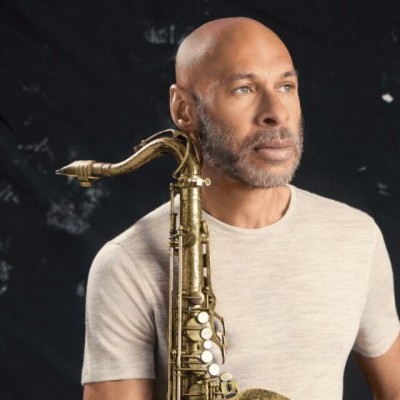
A solo concert by saxophonist Joshua Redman will close the first night of the Hyde Park Jazz Festival on Sept. 26.
Sep 22, 2026 12:26 PM
The Hyde Park Jazz Festival will take place for the 20th time on the final weekend of September 2026. Beginning half…
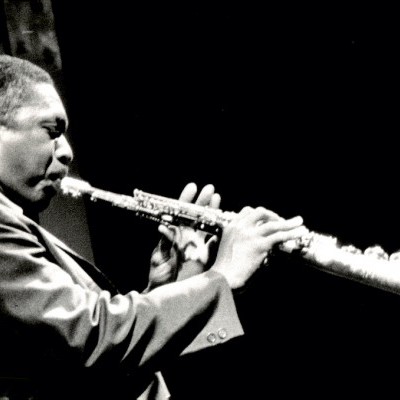
“It was just that suddenly … I could hear it,” Ravi Coltrane said of an epiphany he experienced during his late teens regarding his father’s music. “And it was almost like a calling, like something saying, ‘Hey, man, come on. It’s time to get serious.’ And the first time you really tune in and dial in and focus like that, it can be very life-changing.”
Sep 22, 2026 1:39 PM
Editor’s Note: Tomorrow, Sept. 23, is the 100th anniversary of John Coltrane’s birth. In honor of the tenor and…
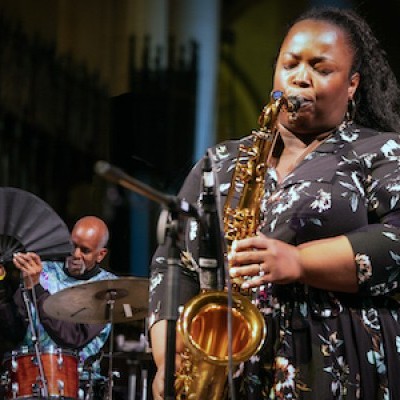
Camille Thurman took to the stage alongside bassist Kenny Davis and drummer Tommy Campbell for a rendition of Johnny Mercer’s “I’m An Old Cowhand” that recalled Rollins’ epochal 1957 trio outing Way Out West.
Oct 6, 2026 1:33 PM
As emcee Mark Ruffin noted at the commencement of an epic tribute to saxophonist Sonny Rollins at the Cathedral of Saint…
Record producer Bob Thiele’s classic photo that became the cover of John Coltrane’s landmark album A Love Supreme.
Sep 22, 2026 1:36 PM
A tribute to John Coltrane is one thing, but there is much more to the iconic saxophonist’s 100th anniversary…
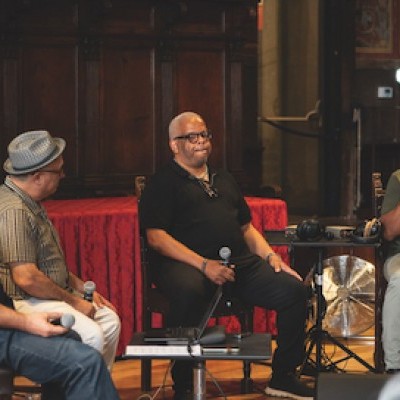
Ravi Coltrane (right) makes a point during a live Blindfold Test at the Umbria Jazz Festival while pianist Greg Burk (far left), journalist Ashley Kahn and trumpeter Terence Blanchard listen.
Oct 20, 2026 12:53 PM
The pairing of Terence Blanchard and Ravi Coltrane was billed as “The Miles/Coltrane Legacy,” a tour celebrating the…