Sep 3, 2026 10:44 AM
In Memoriam: Cassandra Wilson, 1955–2026
Cassandra Wilson, a singer, songwriter and producer who was one of the most acclaimed and successful jazz vocalists of…


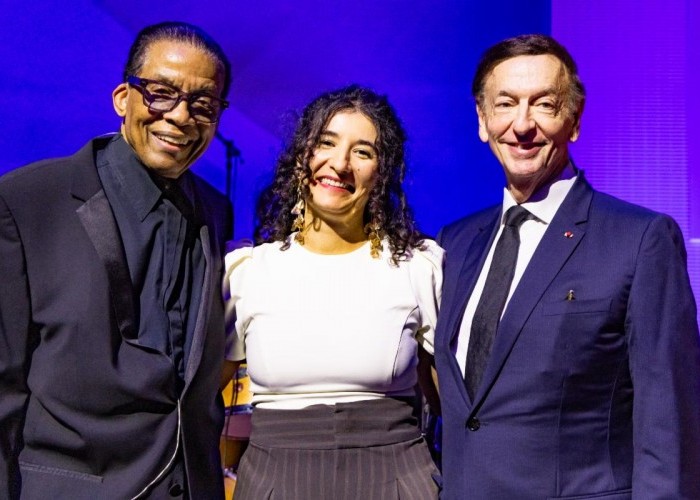
Competition winner Malou Oheix (center) with Herbie Hancock and Fondation Louis Vuitton’s Jean-Paul Claverie.
(Photo: Courtesy Herbie Hancock Institute)Malou Oheix, a 27-year-old singer from Nantes, France, took first place at this year’s Herbie Hancock Institute International Jazz Vocals Competition on Oct. 11, winning a $50,000 scholarship. This year was the first time the nearly 40-year-old event, originally known as the Thelonious Monk Institute of Jazz Competition, was held outside of the U.S. In this case, the Paris-based Fondation Louis Vuitton partnered with the Hancock Institute and provided the hosting space.
At the finals, Oheix delivered a sparking rendition of Jimmy Dorsey and Paul Madeiria’s ballad “I’m Glad There Is You” on which she allowed her piercing soprano to shine like a blue laser beam as she began a capella before pianist Carmen Staaf joined her. Well-paced with graceful displays of tension and release, it demonstrated Oheix’s penchant for embodying lyrics.
Listening to Oheix’s attack and soft timbre, it was evident that Gretchen Parlato — one of the competition’s judges and winner of the 2004 Thelonious Monk Institute International Jazz Vocal Competition — was one of her main influences. That fact was reiterated when she cited her as a guiding light after the competition.
Nevertheless, it was Oheix’s follow-up that seemed to seal the deal for her first-place win. She tackled Michael Brecker’s late-’90s post-bop composition “Madame Toulouse” with the dexterity and enthusiasm of a racecar driver. Drummer Kendrick Scott and bassist Ben Williams steered the piece at a quicksilver tempo while Oheix scatted extended, labyrinthine improvisations. Then she upped the ante by trading fours with Scott.
“I’m really influenced by a lot of instrumentalists and the sound of instruments like saxophonists or trumpets,” Oheix said after the competition. “I like to transcribe a lot of instrumentalists to explore some of the possibilities with voice. But among vocalists, I’m inspired by Bobby McFerrin and Gretchen Parlato.”
Gregory Porter, another of the esteemed judges, described Oheix’s performance as “music forward,” which earned her the highest honor. “Her own personal charisma was almost secondary to her music,” he said. “Her musicality was special. And she can take the music probably in an interesting direction that we haven’t seen before.”
During the semifinals, though, second-place winner Georgia Heers from Greenville, South Carolina, was arguably the competition’s frontrunner. She powered her rich alto magnificently on Bessie Smith’s “You’ve Been A Good Ole Wagon,” to which she brought humorous convention and elegance before reimagining George Duke’s mid-’70s jazz fusion gem “Someday” into a sweeping straightahead excursion packed with sunny ebullience and rhythmic pliancy worthy of Betty Carter. Of the 11 semifinalists, the 27-year-old Heers brought the most assured performance.
And much of that aplomb carried over into Heers’ finals performance on her inventive reading of Patty Waters’ mid-’60s ballad “Moon, Don’t Come Up Tonight.” Heers imbued the foreboding lyrics with spine-tingling suspense and emotional immediacy in rubato fashion alongside Staaf’s glimmering piano accompaniment before the rhythm section joined, concocting a classic film noir soundtrack sensation. Heers also showed her scatting ingenuity on Richard Rogers’ “Thou Swell,” on which she alternated between jabbing and elongated phrases, crisply articulating the lyrics while also enlivening them with emotive inflections and engrossing displays of tension and release. Heers’ finals performance earned her a $25,000 scholarship.
Whereas Oheix exhibited the most pyrotechnics at the finals, and Heers revealed the most poised elegance, third-place winner Lucy-Anne Daniels, a 24-year-old from Leeds, United Kingdom, had the most engaging stage presence. Daniels brought a flirty energy to the proceedings, subtly transforming her competition recitals into club performances as she engaged the audience with anecdotes about her song choices. And she proved to be a superb storyteller, as evidenced by her absorbing rendition of Bobbie Gentry’s “Ode To Billie Joe” during the semifinals.
At the finals, she began with a haunting rendition of Eden Ahbez’s classic “Nature Boy,” on which her warm alto stretched and twisted the wondrous lyrics across a West-African-tinged groove. She peppered her scat improvisations with dramatic howls, sighs and West African intonations. Rhythm proved to be Daniels’ strongest musical ally, particularly during her daring take on Burton Lane and Yip Harburg’s classic “Old Devil Moon,” which she retooled as a feisty, improvisational drum-and-vocal duet. Her performance earned her a $10,000 scholarship.
In addition to Parlato and Porter, the semifinals judges included Dee Dee Bridgewater, Roberta Gambarini and Angélique Kidjo (subbing for Patti Austin). For the finals, however, the judging panel slimmed down to four people because of Kidjo’s absence. As far as the rest of the 11 semifinalists, they all brought dynamic performances, many of which revealed strong reverences of the modern jazz singing of other former Institute winners: Jazzmeia Horn and Cécile McLorin Salvant.
“All of the contestants from both nights were shockingly good,” Porter said, after describing the difficulties of the deliberations. “But I said to myself, ‘We’re in good hands.’ Every one of them are going to be all right [in terms of embarking on a successful career].”
Before the announcement of Oheix as the winner, the evening gave way to all-star performances, paying multiple tributes. The first was a fierce performance of Arturo Sandoval’s “Capricchosos De La Habana,” a samba-driven jazz composition powered by drummer Terri Lyne Carrington, bassist John Patitucci and pianist John Beasley (the event’s music director) while trumpeter Till Brönner and tenor saxophonist Walter Smith III handled the frontline horn melodies.
Afterwards, Sandoval was presented with the Maria Fisher Founder’s Award. He then treated the audience to a sanguine vocal-and-trumpet rendition of Charlie Chaplin’s “Smile” accompanied by Carrington and Patitucci.
The evening paid homage to the host city with a sumptuous rendition of Josephine Baker’s “J’ai Deux Amours,” featuring Bridgewater fabulously singing the lead vocal; Porter’s soulful rendition of Vernon Duke’s “April In Paris”; and a spry makeover of Bud Powell’s “Parisian Thoroughfare” featuring Monty Alexander hammering the ivories and a sensational horn section consisting of trumpeter Ambrose Akinmusire, trombonist Nils Landgren and saxophonists Tineke Postma and Smith III.
In addition to hosting the event alongside actor Jeremy Irons, Herbie Hancock paid tribute to the centennial birthday of one of his most famous mentors – Miles Davis – with an invigorating take on “So What” that featured the same lineup as the one accompanying Alexander on “Parisian Thoroughfare.”
The biggest highlight of the evening beyond the actual competition, however, was the world premiere of Danilo Pérez’s’ “The Ever Changing World,” composed in honor of the legacy of architect Frank Gehry, who designed the gorgeous Foundation Louis Vuitton museum and cultural center. Featuring many of the aforementioned musicians as well as cellist Pierre-François Dufour, violinist Sébastien Surel, clarinetist Stéphane Chausse and Pérez on piano, the chamber jazz composition took on a grand, heroic character that at times recalled John Adams’ work. Still, after nearly three decades of working with Wayne Shorter, the influential saxophonist’s compositional voice was easy to detect in Pérez’s commissioned piece, especially in its jarring melodic motifs, stirring harmonies and sheer sense of adventure.
After announcing the competition’s winner, the evening closed with an all-hands-on-deck romp through Aaron and Milton Sparks’ “Every Day I Have The Blues.” DB
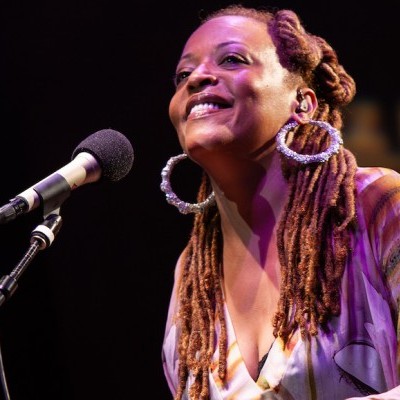
Wilson’s ability to connect to audiences helped her to win two Grammy awards and multiple other accolades. She was named an NEA Jazz Master in 2022.
Sep 3, 2026 10:44 AM
Cassandra Wilson, a singer, songwriter and producer who was one of the most acclaimed and successful jazz vocalists of…
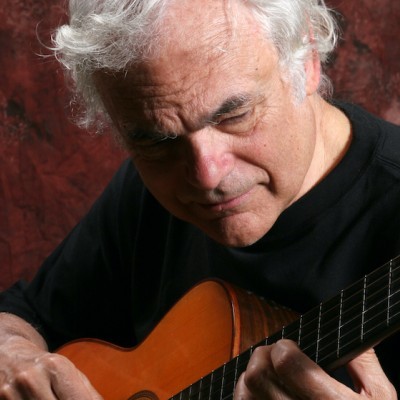
Bertoncini was a specialist and advocate for the nylon-string acoustic guitar, turning down high-profile opportunities that were unsuited to the sound and techniques that he used with that instrument.
Sep 1, 2026 11:06 AM
Gene Bertoncini, an esteemed jazz guitarist, composer, arranger and educator, died Aug. 29 at the Lillian Booth Actors…
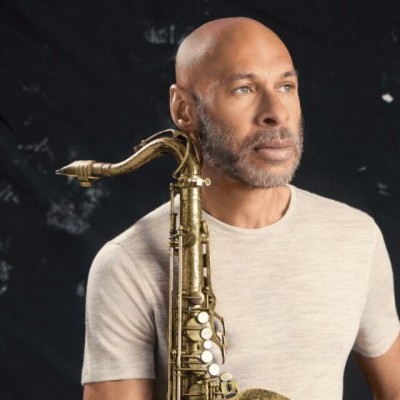
A solo concert by saxophonist Joshua Redman will close the first night of the Hyde Park Jazz Festival on Sept. 26.
Sep 22, 2026 12:26 PM
The Hyde Park Jazz Festival will take place for the 20th time on the final weekend of September 2026. Beginning half…
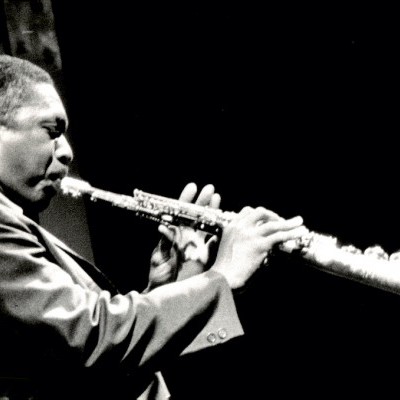
“It was just that suddenly … I could hear it,” Ravi Coltrane said of an epiphany he experienced during his late teens regarding his father’s music. “And it was almost like a calling, like something saying, ‘Hey, man, come on. It’s time to get serious.’ And the first time you really tune in and dial in and focus like that, it can be very life-changing.”
Sep 22, 2026 1:39 PM
Editor’s Note: Tomorrow, Sept. 23, is the 100th anniversary of John Coltrane’s birth. In honor of the tenor and…
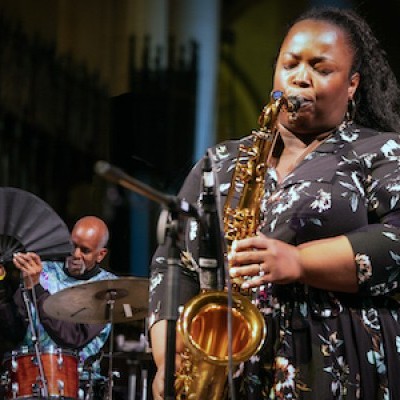
Camille Thurman took to the stage alongside bassist Kenny Davis and drummer Tommy Campbell for a rendition of Johnny Mercer’s “I’m An Old Cowhand” that recalled Rollins’ epochal 1957 trio outing Way Out West.
Oct 6, 2026 1:33 PM
As emcee Mark Ruffin noted at the commencement of an epic tribute to saxophonist Sonny Rollins at the Cathedral of…