Sep 3, 2026 10:44 AM
In Memoriam: Cassandra Wilson, 1955–2026
Cassandra Wilson, a singer, songwriter and producer who was one of the most acclaimed and successful jazz vocalists of…


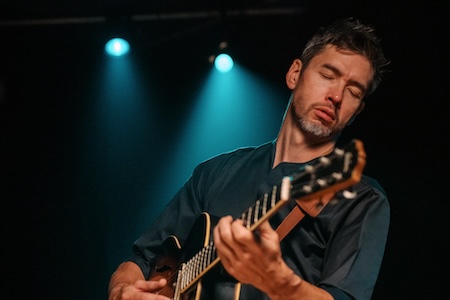
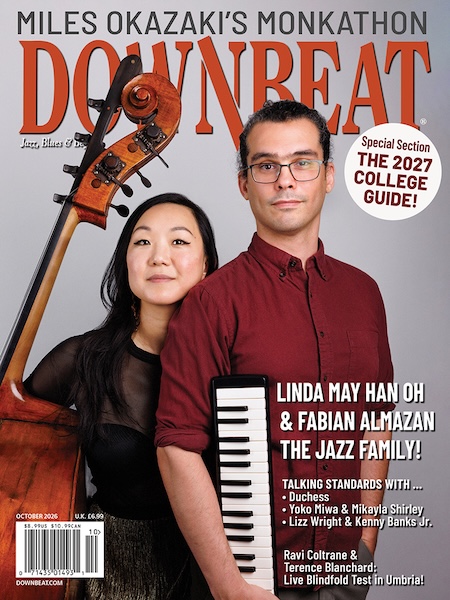
“I’m not going to create a powerful performance by overpowering the audience,” Okazaki explained. “I’m going to create a powerful performance by maintaining interest in what’s going to happen next.”
(Photo: Jesse Wakeman/Dead Letter Office)Like much of the United States, New York officially marked the nation’s semiquincentennial in July with grandiose displays of one-dimensional patriotism.But over at the Jazz Gallery, a modest space five floors above West 27th Street in Manhattan, Miles Okazaki was fashioning an alternate narrative about America: one that both embraced its complexity and served as a cautionary tale about the hubris of empire. The occasion was the last of four mid-July sets in which the guitarist, leading a remarkably resourceful nonet, was debuting music from Boomtown, his latest release on Pi Recordings.
Inspired by a motor tour he took around Wyoming, the music proved a haunting and hallucinatory work of imagination that evoked both the severity and serenity of the landscape: a road trip of the mind that collapsed time as the spaces and places of a once-wild West opened up before him.
“It has to do with things that are fleeting,” he said, “things that are passing, things that we think are going to last forever — such as our democracy — that maybe aren’t in such great shape. Every boomtown becomes a ghost town eventually.”
The project — and, by Okazaki’s own account, his esthetic approach in general — was “modeled” on Thelonious Monk’s oeuvre, particularly the late-period composition “Ugly Beauty.” As Monk’s only tune not written in common time, its pitches, arranged at the appealingly odd angles to which he was given, force themselves into the metric fabric in unexpected ways. The result is deep Monk: a transgressive yet tantalizing work that reflects the oxymoron of the title.
In its “duality,” Okazaki said, the piece — and Monk’s work more broadly — have helped guide his creative process. And that holds whether he is working on his own compositions or those of others — not least, of course, those of Monk, which he had previously rendered in an exhaustive marathon, also at the Jazz Gallery. A film of the acclaimed performance, The Monkathon, was set to be screened in part on Sept. 22 at Brooklyn’s Roulette Intermedium.
“The central thought is always the same,” he said. “There’s something that invites people in. Then there’s something that’s going to make you a bit uncomfortable as well, that’s at least going to challenge you.”
At the Jazz Gallery on that July night, the Monk effect was evident from the first bars of the opening tune, “Hole In The Wall.” Coaxing from his guitar a simple set of singable pitches shaped by a reverb-laden microtonal twang, Okazaki delivered a melody that seemed at once familiar and foreign. As he did, it was easy to conjure the illusion — captivating but disconcerting — of 19th-century outlaws emerging phantomlike from the infamous hideout of the tune’s title.
In writing the piece, Okazaki said, he aimed to “build a world” of sound and implied image by eschewing standard Western temperament, citing as his organizing principle a rigorously conceived tuning system that yielded “a third that’s right in between the major and the minor.” That, he said, would lend the music a quality “like a blues jam but with a bit of an alien flavor to it.”
“It was just a very small idea: ‘Let’s play with these two notes and we’ll go from there,’” he said.
In the hands of tenor saxophonist Jon Irabagon, the idea was very much in play. Swooping up, over and around the microtonal interval, he produced a comically mawkish and thoroughly menacing mix of lines suffused with the surreal and tempered by a strangely celebratory edge. As each succeeding musician joined the fray, moving at his or her own pace with or against the run of play, the mix grew denser and the contrasts wider, escalating to the point where it threatened to become a cacophonous spiral leading nowhere.
But the threat proved illusory. Though Okazaki professed to have no intention of eliciting specific feelings in listeners, the sense of disorientation this listener felt was both palpable and pleasurable. By tune’s end, the musicians’ shared sensibility prevailed and, with a few sharp gestures from Okazaki’s guitar, the near-cacophony coalesced in a moment of clarity that seemed inevitable.
Chatting before the set, Irabagon said the complexity of Okazaki’s vision belied its intent: “Everything is so scientific and researched and ‘perfectionized.’ The theory is all there: microtone things, 12-tone things. But he doesn’t hang his hat on that stuff. He wants it to be organic and folky and sonorous. And that’s the stuff that takes over more than the theoretical stuff.”
Okazaki, reflecting in the days after the concert, saw the ensemble less as a scientific mechanism than as a societal microcosm: “I’m building the environment and people are in it. And whatever it is, it’s America, right? People are doing whatever they’re doing within this confined space. Some people are going to rebel against it and some people are going to go with the flow. And somehow we have to make it work.”
For his part, guitarist Rodney Jones, Okazaki’s long-time friend and one-time teacher at the Manhattan School of Music, offered a more reductive view: “Miles can hear, in apparent chaos, order.”
Okazaki’s affinity for imposing order began early. As a young child in Port Townsend, Washington — a boomtown-gone-bust that has reinvented itself several times — he sought to make sense of the world through drawing. At age 12, his main interest having become music, he took tape deck in hand and systematically combed through Monk’s versions of “’Round Midnight,” transcribing instances in which Monk had played something different at the same spot.
Now 51, Okazaki finds that Monk has become a life-long project, one that reached a high point in 2018, when he self-released Work, a six-volume set of solo versions of Monk’s 70 known compositions. That event proved preparation for the live performance at the Jazz Gallery, where, on each of two nights in October 2024, he rendered 66 of those compositions solo and by heart. The performance was lauded as a unique accomplishment.
“Who else could do that?” Jones asked, rhetorically.
As documented in the film, the sets are an uncluttered affair. Footage shot from the window of the Jazz Gallery tracks Okazaki as he walks purposefully up Broadway to the performance space. The focus then shifts to the starkly appointed stage, where, over more than four hours, Okazaki bares something of himself.
Beyond Okazaki’s power of memory and concentration, the film reveals a degree of reticence. Even at the performance’s close, after a standing ovation following a stunning seven-minute exploration of “’Round Midnight,” he manages little more than a shy smile and a few half-bows of the head before hauling out a framed portrait of Monk, laying down his guitar and exiting the stage without a word.
“I’m not a natural solo performer,” he acknowledged. “It’s quite uncomfortable, actually.”
Okazaki’s preparations for the performance, detailed in an impressive notebook, are equally revelatory. He reminds himself to “use the silence”; to stress “clarity over tempo”; and not to equate velocity or volume with energy or excitement. (“I’m not going to create a powerful performance by overpowering the audience,” he explained. “I’m going to create a powerful performance by maintaining interest in what’s going to happen next. And you can’t do that without clarity.”)
Okazaki reveals more of himself in the notebook’s stage directions. He notes director Frank Heath’s reminder that he “be vulnerable.” He reminds himself at what points he should sit or stand (the latter, he explained, often yields a more “dynamic” take). He admonishes himself to “look at the audience”: an admonition that, as the film shows, he had difficulty following.
“When you’re directed inwardly,” he said, “you’re just not inviting people to share in the experience as much.”
Strikingly, Okazaki’s preparation for the performance paralleled and intersected with his preparation for the New York City running marathon. The two events were held only two weeks apart in 2024, and, in an extraordinary instance of Okazaki’s affinity for imposing order on real life — as well as his ability to draw connections between seemingly divergent life activities — he integrated and documented his training for both.
In their solitude, the connection between marathon running and solo concertizing might seem clear; both, Okazaki said, are “by-yourself” situations. Less obvious, perhaps, is that both can benefit from the use of tools common to one, in this case the metronome. Wearing a watch with a metronomic timer as he ran, Okazaki could set a precise pace and even subdivide it into various rhythmic patterns, bridging the musical and the athletic as the miles mounted up. On one notebook page, he traces a run during which he recorded five different time signatures.
On another page, he documents the culmination of his joint-training efforts in a side-by-side comparison of statistics from the Oct. 18 Jazz Gallery show against those of the Nov. 3 New York City marathon: total time (4:14:15 vs. 3:42:44), average pace (3:47 minutes per song vs. 8:30 minutes per mile) and training (35 weeks and 66 songs vs. 12 weeks and 31 runs plus strength). That effort represents the kind of sustained dedication to multidimensional detail that elicits superlatives.
“More than anyone I have ever taught,” Jones said, “he has a profound level of genius.”
Okazaki’s lists for the Monk sets are similarly thought through. Grouped in “chunks” — a term, he said, that comedians use to denote discrete parts of their routines — the ordering is mostly chronological and associated with various albums. Thus, the opening “Genius” chunk is drawn mostly from the Genius of Modern Music Blue Note volumes of the late 1940s and early ’50s. By opening with tunes in this group like “Humph” and “Skippy” — among the trickiest in the Monk book — Okazaki nods to a kinship he feels with early Monk in that both men, at that point in their careers, “worked through some sort of period” writing “very verbose types of things.”
The “5-Spot” chunk, from the middle of Monk’s peak period, draws from the 1958 album Live At The Five Spot and includes tunes like “In Walked Bud” and “Misterioso” played by an ensemble with Roy Haynes and Johnny Griffin that is high on Okazaki’s listening list. “Epistrophy,” in a chunk labeled only by the date, 1958, stands out for the sheer technical artistry with which he translates multiple piano voices onto the guitar.
Monk’s later period is represented by the “Underground” chunk. It draws largely on the 1968 Columbia album Underground, one Okazaki declared “a singular record.” It is the last of his albums to feature the classic quartet with Charlie Rouse, Larry Gales and Ben Riley. And it is one of the last times Monk produced a tranche of new tunes, among them his one-off waltz, “Ugly Beauty.”
That tune is a lodestar for Okazaki, but for those trying to understand the guitarist, the album’s cover art may be as instructive. It shows Monk at the piano amid a World War II resistance fighter’s lair, long gun on his shoulder, bound Nazi soldier to his side and a determined look on his face. “It may be the greatest album cover of any kind of music ever,” Okazaki said, noting that a poster of it adorned the wall of his Brooklyn studio.
In the cover’s portrayal of Monk as resistance fighter against fascism, some people will no doubt see similarities to America today. Okazaki might have reason to be one of them, even if his caution about democracy stops short of drawing the fascist comparison.
“What does it mean to be an American?” he asked. “I have a Japanese name, and some people don’t think I’m an American.”
To those inclined to hear it, his stark take on the American boomtown, writ large, warns of a fate that could befall a nation. As for his continuing encounters with Monk, well, it’s hard not to hear echoes of past rights battles in the language he invokes to describe the hours he spends grappling with the man’s music on a fat-body, thick-string guitar.
“It’s quite a struggle to even play this instrument,” he said. “But I want that struggle to be part of it.” DB
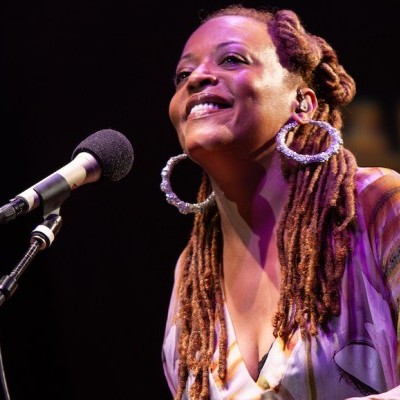
Wilson’s ability to connect to audiences helped her to win two Grammy awards and multiple other accolades. She was named an NEA Jazz Master in 2022.
Sep 3, 2026 10:44 AM
Cassandra Wilson, a singer, songwriter and producer who was one of the most acclaimed and successful jazz vocalists of…
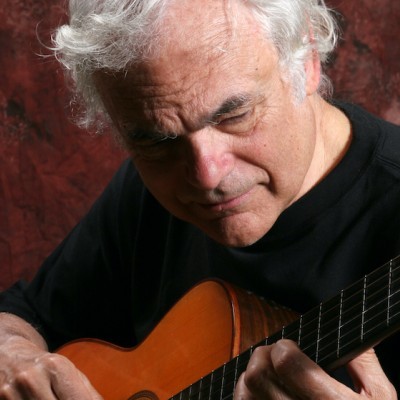
Bertoncini was a specialist and advocate for the nylon-string acoustic guitar, turning down high-profile opportunities that were unsuited to the sound and techniques that he used with that instrument.
Sep 1, 2026 11:06 AM
Gene Bertoncini, an esteemed jazz guitarist, composer, arranger and educator, died Aug. 29 at the Lillian Booth Actors…
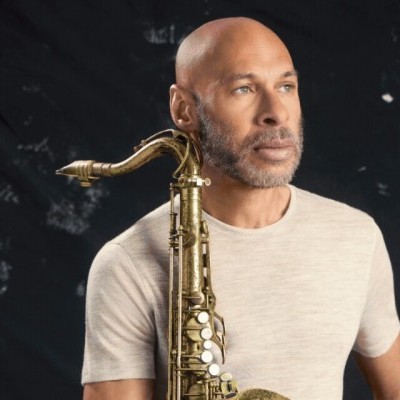
A solo concert by saxophonist Joshua Redman will close the first night of the Hyde Park Jazz Festival on Sept. 26.
Sep 22, 2026 12:26 PM
The Hyde Park Jazz Festival will take place for the 20th time on the final weekend of September 2026. Beginning half…
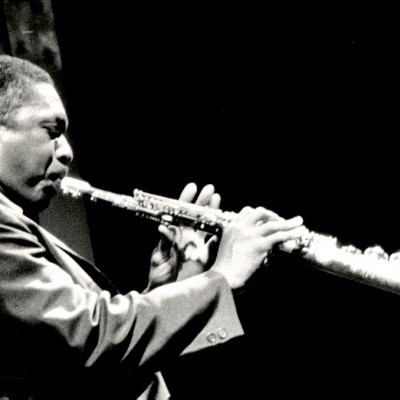
“It was just that suddenly … I could hear it,” Ravi Coltrane said of an epiphany he experienced during his late teens regarding his father’s music. “And it was almost like a calling, like something saying, ‘Hey, man, come on. It’s time to get serious.’ And the first time you really tune in and dial in and focus like that, it can be very life-changing.”
Sep 22, 2026 1:39 PM
Editor’s Note: Tomorrow, Sept. 23, is the 100th anniversary of John Coltrane’s birth. In honor of the tenor and…
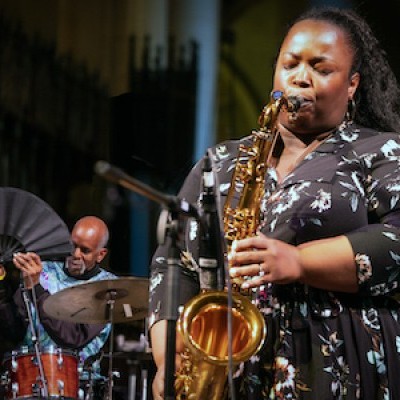
Camille Thurman took to the stage alongside bassist Kenny Davis and drummer Tommy Campbell for a rendition of Johnny Mercer’s “I’m An Old Cowhand” that recalled Rollins’ epochal 1957 trio outing Way Out West.
Oct 6, 2026 1:33 PM
As emcee Mark Ruffin noted at the commencement of an epic tribute to saxophonist Sonny Rollins at the Cathedral of…