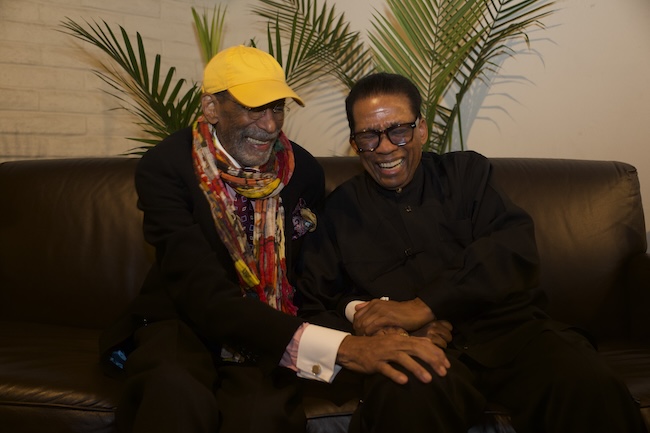
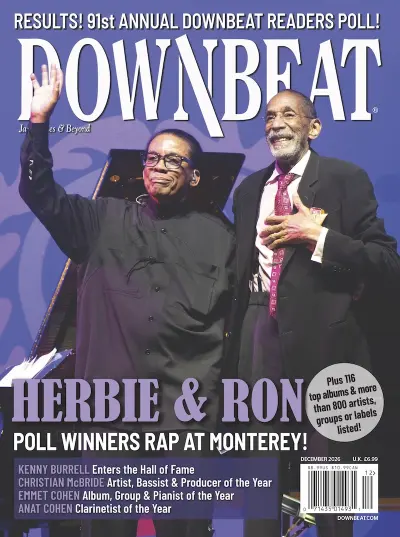
Ron Carter and Herbie Hancock, shown here backstage at the 2026 Monterey Jazz Festival, topped the 91st Annual DownBeat Readers Poll on their respective instruments.
(Photo: Nic Coury)
If you listen to the album Miles Davis Quintet Live At The 1963 Monterey Jazz Festival (Monterey Jazz Festival Records), you can hear it’s a lovely performance. George Coleman is on tenor saxophone—Wayne Shorter would not take the tenor chair until 1964—but neither he nor Miles ever played the melody. Sixty-three years later, at this year’s Monterey Jazz Festival, Herbie fixed that. In a sly nod to history, playing their first ever set as a duo, Hancock and Carter not only opened their set with “Autumn Leaves,” Herbie played the melody. Sweet.
Carter and Hancock topped the Readers Poll this year on their respective instruments, something both have achieved numerous times. Hancock won Keyboardist of the Year for the fifth year in a row and came in second for Pianist of the Year, and this is Carter’s first win since in 1986, though he’s continuously placed near the top. Both are members of the DownBeat Hall of Fame. When the Davis quintet played Monterey the first time, they had been together only four months. Herbie had just received his first royalty check for his hit “Watermelon Man” and arrived in Monterey with the spoils—a 1963 Shelby Cobra, a car he once dusted Miles with, in a race against the boss’s Ferrari. Many other live recordings have been released over the years, including a box set from the iconoclastic 1965 stint at Chicago’s Plugged Nickel, but the band’s place in jazz history was cemented over the course of six studio albums: ESP (1965), Miles Smiles (1967), Sorcerer (1967), Miles In The Sky (1968), Nefertiti (1968) and Filles De Kilimanjaro (1969).
What follows is an edited transcript of an interview with the duo in Monterey, the day before their Sunday performance. Though some of their stories have been told before, the two were so open, affectionate and convivial that readers surely will enjoy hearing them again, with new twists. It was disarming to see how, even after all these years, Hancock, 86, was a little nervous about doing a duo concert with his old bandmate Carter, with whom he had not shared the Monterey stage in 34 years. Carter, 89, for his part, came across, as always, the elegant gentleman, happy to helm the ship. Their performance that night? Superb.
Paul de Barros:So, Ron, you joined the band first, right?
Ron Carter: Uh-huh. I was working with Art Farmer at a place called Basin Street, on the Lower East Side, by the waterfront. I signed up for a two-week job. After the first set, Miles walked in the door and called me over to where he was standing, by the juke box, and said his bass player, Paul Chambers, and the piano player, Wynton Kelly, were going to leave him to join a quartet with Wes Montgomery. And he said could I join his band? And I said, “Mr. Davis, I’m working with Art Farmer for the next two weeks. You’ll have to ask Art Farmer if he’ll let me out of my commitment.” And he said [speaks in Miles’ raspy voice] “OK.” So he went up and talked to Art—they had known each other for a long time—and Art said, “You go ahead and leave the band and join Miles.” Art came to me at some point later and thanked me for showing him a high level of respect. Because at the time, Miles’ name was better than dirt. For someone to tell this bandleader that he’s got a commitment and he’s not going to break that commitment, that wasn’t the norm at the time.
de Barros:Indeed. How do you come into the picture, Herbie?
Herbie Hancock: People were telling me Miles was looking for me. I didn’t believe a word of it. I was like, “Yeah, yeah.” I was staying in the apartment that Donald Byrd—he’s the one that had brought me out of my hometown of Chicago, you know, when I joined his band—anyway, Donald said to me, “Look, Miles is going to call you. If Miles calls you don’t tell him you’re working with anybody.” I said, “Donald, I couldn’t do that to you! You’ve helped me so much. You are the one that told me you would help me set up my publishing company and because of that, my song “Watermelon Man,” I kept the publishing and …
de Barros:You got the car!
Hancock: Right! The car, the whole thing, right? And I said, I couldn’t do that! And about 30 minutes later, the phone rings and I say, “Hello?” [speaks in Miles’ raspy voice] “You workin’ with anybody?” “No.” [laughter] He said, “Come over to my house tomorrow afternoon, at 2:30,” or something like that. Click. I didn’t know where Miles lived. Donald said, “Don’t worry. I know where he lives.”
de Barros:Didn’t he invite Tony, too?
Carter: I didn’t know that he had invited everybody. He just said, “Meet me at my house,” and I get there and Herbie and Tony were there. George Coleman was nearby. We went down to Miles’ basement studio and we’d gone through maybe a couple of choruses of a song and then Miles says, “I’m going upstairs. You’re in charge.”
Hancock: I remember that. We did that for about three days, I think.
de Barros:Did it feel immediately like, “This is it”? Or was it more like, “Yeah, I’m feeling my way into this”?
Carter: Both. [laughter]
de Barros:Before Monterey, at the Jazz Workshop, in San Francisco, they let teenagers in because Tony was 17. I had never heard anything like that in my life. Had you?
Hancock: Same thing. I had never heard anybody play the drums like that. But I actually had played with Tony a few times before we met at Miles’ house, at a gig at a club in Brooklyn [the Blue Coronet]. Jackie McLean called me to play this gig, and he told me Tony was playing drums. I said, “Oh, that kid from Boston? Can he really play?” And Jackie said, “I’ll tell you what. Why don’t you come to the gig and find out for yourself?” I said, “OK!” And the first tune starts with four bars on the drums, and it just floored me so much that I couldn’t come in on the first chorus. It was like somebody had hit me in the face. And I look over at Tony, and I finally came in and started to play and I was like, “Oh, my God? What is happening?” It just blew my mind.
de Barros:Ron?
Carter: I hadn’t played with him at all.
de Barros:It must have been a bit of a shock.
Carter: Well, I think when you got four guys who are all curious, it’s not a shock. It’s kind of the next progression of getting better, and this is the environment that you’re thrown in to get better at.
de Barros:Which is what happened. We all had a front-row seat, watching you reinvent the jazz rhythm section. After the Jazz Workshop, you came here to Monterey. You opened with “Autumn Leaves,” but Miles never played the melody. How come?
Carter: He never played the complete melody for “My Funny Valentine,” either. And what he didn’t play we didn’t miss.
de Barros:Did Miles ever express his approval or disapproval of what you were doing?
Carter: For the six years we were together he never gave us specific directions [like] “Don’t do that!” Maybe once or twice, but he never directed the band away from what we were trying to do. He was a captive bandleader. We were basically on our own, and understanding that he was as much subject to our will as we were to his. He was like the band leader, but he’s not really leading the band. The band’s kind of leading him. And there wasn’t any discussion about that. But one quick thing, when Miles would come off the bandstand and then come back and pick up his horn again, the horn was always colder when he came back. He would always ask me after the first three notes, “Sharp or flat?” Those were the only two things he ever said about this picture. Is he sharp or flat?
Hancock: When I first started playing with Miles, I thought, OK, I should probably play like the other piano players that played with him. Play like Red Garland, you know, or Wynton Kelly, or Bill Evans. But I never thought of him as listening to me! But I remember after two months or so, I heard Miles do something that followed something that I did. “Oh, he’s listening to me!” It changed everything. I realized he was listening to Ron, he was listening to Tony. We were the rhythm section playing behind him. And it was like [waves his hand like cosmic revelation], Psh-h-h-h-h!
de Barros:Ron, I remember you once said to me, “Everyone always asks us, what did we learn from Miles Davis?” But they never ask, “What did Miles Davis learn from us?” What did you hope Miles learned from you?
Carter: I think he began to develop a vocabulary that let him understand as far as the bass player in this band was concerned, how much power each note had that I played. I think he understood that, but he didn’t have the vocabulary to explain exactly what that meant to him, other than that he understood that when I play a certain note that must be the bridge. If I play this note, that must be the downbeat. Like Miles said, “Ron, you’re in charge.” I kind of treated it like that.
de Barros:Somebody needed to be doing that, right? Because you guys eventually got to sound like some kind of Cubist rhythm section. Did you ever get lost?
[Herbie raises his hand, smiling mock-sheepishly. Everyone laughs.]
Carter: Miles got asked that question and he said, “Yeah, I got lost once in 1964 but no more since then.”
de Barros:That sounds like Miles. So, Herbie, what would you hope that Miles learned from you?
Hancock: Tony and I had been listening to more avant-garde players. Sometimes on my solos we would do something that we wouldn’t do behind Miles. I think we were in Detroit and Miles said, “Why don’t you play behind me some of the things you and Tony are doing with Ron?” Because we would do some stuff that we wouldn’t do behind him. We were playing a little freer. So we did that and Miles was struggling. Then the next day there was less struggle. And the next day, I was struggling. He got it, right? And I’m gonna change the way I play behind him because of what he’s doing. It was kind of a back-and-forth thing. It happened that way.
de Barros:When the quintet returned to Monterey in 1964, it seemed like you played almost every tune incredibly fast.
Hancock: That was early. It got worse. Everything was “Bap! Bap! Bap! Bap! Bap! Bap! Bap!” [clapping hands] Man, we used to play a lot of fast, fast tunes.
Carter: And faster.
Hancock: Something happened when we played the Plugged Nickel [in Chicago, in 1965]. I was in a car that was taking me and Tony from the hotel to the Plugged Nickel for that first day, right, and Tony said, “You know, it’s getting too easy for us to play together. It’s getting a little stale. I’m going to play ‘anti-music,’ starting now. You want to join me, Herbie?” I knew what he was talking about. Things were getting kind of settled in a certain kind of way, and so I knew we had to do something. What I didn’t know was that we were going to be recorded. I mentioned it to you [looks at Ron], you just nodded your head. I told Wayne and Wayne heard it, but he didn’t say anything.
Carter: He did a Wayne thing.
Hancock: He ignored it. I was afraid to tell Miles. So he kicked off the first tune, and we didn’t do any of the things he might have expected us to do.
Carter: Right.
Hancock: And I knew that the audience, they were going to be guinea pigs for this, but we had to go for this to get to whatever the next level was going to be. We were there for a whole week. A friend of mine called, months later, and he said, “Did you know the Plugged Nickel record is out?” And I said, “Oh, no, I didn’t.” And I said, “I don’t think I want to hear it.” He said, “I think you ought to listen to it.” Then I had to go get the record, right? And I got it, and I listened, and I wasn’t that happy with what I did, but what Ron played and what Wayne played, and Tony, and Miles, it was a whole different take on it, you know? The same tunes, but a whole different response to those tunes in a way that I had never heard before.
de Barros:That music was so much freer. But it was the ’60s, right? “Freedom” was in the air. Did you think about the parallels between what was happening in the music and what was happening in society?
Carter: I generally object to the term “free.” But society was trying to change. And we, in our own way, not using the word “free,” we were actually doing things that freed us up from the style that jazz was associated with before we started this group. So we were free from the history, but we were not playing free.
de Barros: So, bringing it back to 2026, do we know what’s going to happen tomorrow [during the concert]?
Carter: I put together a program from Miles Davis’ library and from Herbie’s writing and one of mine, to get our personality in there, but I hope that people who are excited to see this go back in their heads and see that whatever guys are doing now, this stuff pre-dated all of that.
de Barros:[to Herbie] It sounds like you’re in good hands.
Hancock: [laughter] You know, once I looked at the list of tunes that we might do, I thought, “How can I practice?” Because I hadn’t played those tunes in a long time. Years, right? And I couldn’t figure out how to actually rehearse anything myself, because I don’t know how we’re going to do it. We don’t have a drummer. Who’s going to play the melody? Ron? Or me? So this last week I decided I would just practice a few scales that have nothing to do with these tunes, just to warm my fingers up.
de Barros:Sounds like it’s going to be an interesting rehearsal. I’ll let you guys get on with it. Thank you so much for taking the time beforehand.
Post-Script
And how did the concert turn out? Here’s what de Barros wrote in a review on downbeat.com:
Back-to-back shows Sunday by the Charles Lloyd Quartet and a first-time-ever duo set by former Miles Davis sidemen bassist Ron Carter and pianist Herbie Hancock transported the central venue, the Jimmy Lyons Stage, back to the innocence and optimism of the 1960s. Playing tenor saxophone and alto flute with an all-star quartet featuring [Gerald] Clayton (piano), Larry Grenadier (bass) and Brian Blade (drums), Lloyd reprised the title track of his million-selling live recording from the 1966 festival, “Forest Flower.” As always, Lloyd slyly led the crowd to a hypnotic payoff like a wizard beckoning followers to his lair, offering an infectious pas de deux with Grenadier on “Passin’ Through” and rocking the cradle of his classic “Dream Weaver” before finally caressing his familiar anthem.
Hancock and Carter, who followed, started out tentatively with “Autumn Leaves,” perhaps not coincidentally the same tune they opened with at the 1963 festival with Davis. They quickly found their groove on an atmospheric “Footprints” and a defiantly relaxed “Stella By Starlight,” which, Carter noted, “Miles always wanted to play faster and faster ’til the last man standing.” Carter’s athletic solo performance on his traditional showcase, “You Are My Sunshine,” revealed an 89-year-old bassist still at the top of his game. Herbie’s solo outing on “Maiden Voyage” brought the crowd happily back to the gauzy mood where Lloyd had left them. DB
In other news... DownBeat's Most Read Stories
In other news... DownBeat's Most Read Stories
A solo concert by saxophonist Joshua Redman will close the first night of the Hyde Park Jazz Festival on Sept. 26.
The Hyde Park Jazz Festival will take place for the 20th time on the final weekend of September 2026. Beginning half…
“It was just that suddenly … I could hear it,” Ravi Coltrane said of an epiphany he experienced during his late teens regarding his father’s music. “And it was almost like a calling, like something saying, ‘Hey, man, come on. It’s time to get serious.’ And the first time you really tune in and dial in and focus like that, it can be very life-changing.”
Editor’s Note: Tomorrow, Sept. 23, is the 100th anniversary of John Coltrane’s birth. In honor of the tenor and…
Camille Thurman took to the stage alongside bassist Kenny Davis and drummer Tommy Campbell for a rendition of Johnny Mercer’s “I’m An Old Cowhand” that recalled Rollins’ epochal 1957 trio outing Way Out West.
A tribute to John Coltrane is one thing, but there is much more to the iconic saxophonist’s 100th anniversary…
Ravi Coltrane (right) makes a point during a live Blindfold Test at the Umbria Jazz Festival while pianist Greg Burk (far left), journalist Ashley Kahn and trumpeter Terence Blanchard listen.