Sep 22, 2026 12:26 PM
Hyde Park Jazz Fest on Chicago’s South Side to Present 20th Edition
The Hyde Park Jazz Festival will take place for the 20th time on the final weekend of September 2026. Beginning half…


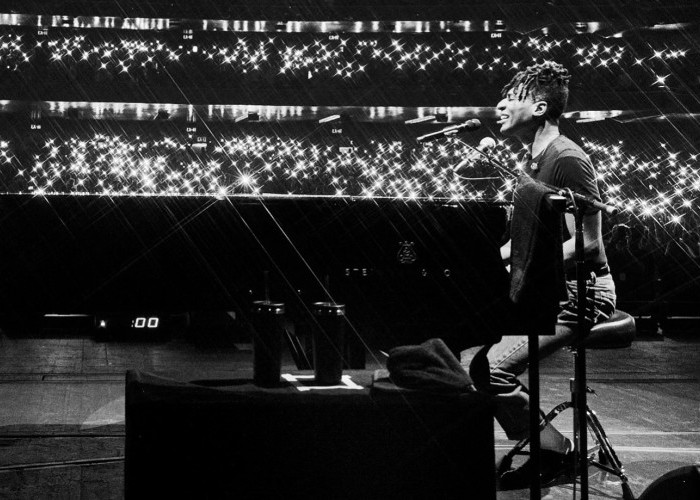
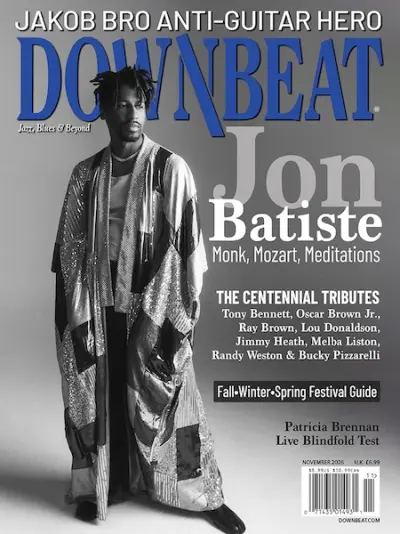
“There’s a full-circle thing that happens when you look at how the Diaspora arrived in America,” says Jon Batiste. “You get Louis Armstrong and you get Duke Ellington and you get Nina Simone, Big Mama Thornton — all of these different forms of expression from that same lineage.”
(Photo: Jen Rosenstein)In the early aughts, the late set was the emblem of New York nightlife. Mayor Bloomberg’s smoking ban was beginning to take effect, leaving clubs a little less atmospheric, maybe, but the music persisted.
Jon Batiste was barely a young man then. He’d moved to New York from his native Kenner, Louisiana, a short drive from New Orleans, where’d he been a regular on the club-and-festival circuit. Through foundational moments with his hometown mentors, the eight-time Grammy-winning artist developed a reverence for the music, and a desire to explore both its lineage and its contemporary contexts in the city that never sleeps.
One spot in particular became a home away from home. Though it closed in 2019 after 30 years on the Upper West Side, Cleopatra’s Needle still resonates with Batiste. “That was a very special place to go for us,” he says. “It’s where I first had the opportunity to play with the late, great Abbey Lincoln; when I went there for a jam session, I was discovered by some of the musicians in her band [Jaz Sawyer and Michael Bowie]. I remember going down there to hear Eric Lewis. I think it was every Monday night, he would play a set. That was a huge inspiration around 2004.”
Another club that proved transformative was Sweet Rhythm, a mainstay on 7th Avenue South, blocks below Smalls and the Vanguard. Known for many years as Sweet Basil, the venue provided a steady leader gig for Batiste during its final days: “Shout out to James Browne, too, for giving me those regular gigs even though nobody would come.” One night, when he was playing with Louis Hayes’ trio, Roy Hargrove walked in and stayed playing.
“We crossed paths about four or five times before he remembered,” Batiste says of Hargrove. “Every time he was like, ‘I love playing with you, what’s your name? … I love playing with you, what’s your name?’ [laughs] After that [night], I felt like I had really been initiated into New York jazz. I’m so grateful to be a part of that time.”
During those early days, Batiste experienced a moment familiar to so many ambitious artists — one he’d revisit decades later, conceiving his 2026 Piano Series Vol. 2–4 trilogy releases Monk Movements and Monk Meditations (both on Verve) and Black Mozart (Decca). A fated session at Cleo’s brought Batiste to a sobering realization: His big ideas had been done. “I had all these visions for the music,” he says. “And, particularly, for where I wanted to take jazz. … I could feel it in my soul and I knew exactly what I wanted to do. And I had that intensity to pursue it.” But at some point in the session, someone called “Evidence” and everything changed.
“There was a facet to the music that resonated with something that I was pursuing at that time, which was this musical rhythm and logic and humor,” he says. “A balancing of musical phrases that feels somewhat asymmetrical. It feels like it’s off if you’re listening on a surface level. But then when you check it out, the reason you feel compelled toward it, at least the reason I felt compelled, is because of its order and its symmetrical depth.” Rather than leaving him deflated, the moment left him inspired. Hearing Monk’s articulation of what he naively thought were his own ideas, Batiste became determined to advance the music from a new point of entry.
“That was the big realization that I had: There’s nothing new under the sun. And [we’re here to] find those things that already exist that align with the spark that we have, and then to draw all of those embers in and create our own flame.”
For more than 20 years, that’s what Jon Batiste has aimed to do. His work as an award-winning pianist and composer has taken him around the world, creating and collaborating across styles and mediums. He’s an artist who’ll share a fundamentals master class with students at the Louis Armstrong House Museum in Queens and check out a concert by K-pop band BTS at MetLife stadium in the same weekend.
“I’ve gotten to be friends with [BTS singer] V,” he says. “He’s in the midst of this cultural phenomenon, but he’s drawn to jazz. I think jazz, ultimately, is where everybody ends up [laughs].” From 2015 to 2022, Batiste became a visible presence on The Late Show with Stephen Colbert as the leader of the show’s house band Stay Human. And over the years, he’s performed alongside era-defining artists, including Prince, Stevie Wonder, Abbey Lincoln, Wynton Marsalis, Lil Wayne, Trent Reznor, Madonna and, most recently, Flea, who joined him at Newport. “[The set] felt great because it was very spontaneous.”
An autobiographical musician and an advocate, Batiste centers Black expression and community in his work. Just a Tony shy of an EGOT, he’s issued multiple seminal albums, including his four-time Grammy-winning release WE ARE (Verve, 2021), which, for so many listeners, became a loving and nuanced portrait of the Black experience in America, and his internationally acclaimed 2024 solo release Piano Series Vol. 1, Beethoven Blues (Verve/Interscope). “I never know what something is going to do,” says Batiste. “You never know.” But after the latter’s warm reception, including among many listeners who’d never shown particular interest in sonatas, the August release of Vol. 2–4 felt both welcome and inevitable.
In conceiving the release, Batiste sought connections not only between two seemingly contrasting composers but also between what felt a little distant to him, musically, and what felt like home.
“I didn’t immediately resonate with Mozart,” he says. “And I really didn’t have a relationship with his music in the way that I have with Beethoven … and not nearly as much as Thelonious Monk, which is one of the reasons why I wanted to do the album. But I also felt that [Mozart’s] music, because of the kind of things it doesn’t have as a part of it, would be a great place to go to the piano and bring these forms of what I consider to be Black American classical music — gospel, blues, jazz, soul, R&B, country, folk, all those inflections — to it.”
Batiste recorded the trilogy in one solo session. Monk Movements and Black Mozart relate to each other almost as inverses, while Monk Meditations — his tribute to the composer’s works as new-age vessels for spiritual enlightenment — came together almost as a denouement. While each album serves a distinct purpose, all three relate to one another in concept and format.
The suite, for example, emerges as thematic in the trilogy release; Batiste creates layers of them unfolding throughout the gesture. Certain songs develop sections and chambers that become movements. But Batiste views the albums, too, as extended suites, forming movements from song groupings. And together, the trilogy itself becomes a three-movement suite.
For Batiste, this conceptual layering is intentional and defiant. In releasing music that requires extended listening, he joins the vanguard of contemporary artists creating against the algorithm’s tyranny. “I love that artists are focusing on the body of work, rather than thinking about it as just a backdrop to a hit single,” he says.
“Because of the over-saturation of AI music and just the domination of the algorithm, you really have to come up with something that’s genuine … from a place of authenticity [that] has a depth of conception that’s not just about reaching the top of the charts, or breaking through the noise with the silver bullet of a hit song. It requires you to have a story that not only extends from your album but across albums. And it’s a form of fostering a community.”
Extending the suite metaphor into motivic engagement — including, for example, references to “Blue Monk” and “Reflections” through Monk Movements and Monk Meditations, respectively — the trilogy captures a striking similarity between both composers’ works. “It was very important to do it that way,” Batiste says, “to give it a sense of thematic development.”
When he sat down at the piano, Batiste’s goal wasn’t to sound like the Thelonious Monk, or even to play his voicings and architectures as he’s heard them all his life, though he reveres them. His intention was to sound like Jon Batiste transmitting what he considers the essence of Monk’s music. The melodies on “Brilliant Corners” and Monk’s version of “Lulu’s Back In Town” resonate deeply with Batiste, so he spotlights those on Monk Movements, the latter becoming “Susu’s Back In Town” in tribute to his wife, acclaimed journalist and New York Times best-selling memoirist Suleika Jaouad, who’s been candid about her personal experiences with illness.
“It’s a motion of life that you feel, that excitement when someone you love returns,” he says. But the song also explores something elemental to both composers’ works: melody. “Thelonious Monk often would play the melody continuously behind the improv as the melody statement has already occurred … as accompaniment to a Charlie Rouse or Johnny Griffin solo … [it’s] like this eternal loop that gets richer and richer each time you play it. It’s like a pirouette, the spin. It’s circular. It’s not linear. Infinity. It’s going. And every time it goes around, it means something different and it feels different. I don’t improvise on the melody. It has a power; it’s complete. The statement is the melody.”
Throughout the session, on pieces like “Enlightenment Of Ruby,” his mediation on “Ruby My Dear,” Batiste sought to transmit Monk’s ethos that every note matters, both with intention and as an unconscious gesture. “There’s a moment before you play a note that lights up within you,” he says. “Then you play the note and you transfer that light outward through the instrument. It’s really a practice of recognizing when that’s happening, and allowing for that to happen. But it really starts from within.”
Sharing this light with the world has become an important facet of Batiste’s artistry, particularly in uplifting his own community and the African Diasporic communities across the world. His video for “Gospel Andante,” directed by Alan Ferguson and creative directed by Batiste, facilitates that act of uplifting through multiple mediums. “I’m thinking about Black Mozart [Chevalier de Saint-Georges], and how he was one of the first musicians who had that genius that was recognized publicly, but still he’s unsung,” says Batiste.
“It was recognized enough for Mozart to be inspired by it. And there’s a full-circle thing that happens when you look at how the Diaspora arrived in America. You get Louis Armstrong and you get Duke Ellington and you get Nina Simone, Big Mama Thornton — all of these different forms of expression from that same lineage. And this album combines the divinity of both of those lineages, the Afro-Diasporic lineage and the European classical lineage.
“That track captures the quality of divinity that’s in Mozart’s melody, and I blend it with the sacred music that has that quality in the Black American church tradition. Like Mahalia Jackson, or the late, great Richard Smallwood. And I blend those kind of harmonies into that track. You see that angelic imagery. And you see Black people represented in that way. I thought it was a great way to illustrate the essence of the album and the essence of that track.”
Being so public for so many years as a beacon of light and advocacy is a source of pride for Batiste, and a true honor. At the same time, the responsibility takes its mental toll. He’s always working and always visible. “I don’t complain about it,” he says. “I don’t even really talk about it very much because it’s not something that I would want to change. But it definitely does weigh on me. A lot of times I can be made out to be this superhero because I just seem to, on the outside, keep going and keep rising and keep creating … but it’s all very hard fought. And I think it’s important for folks to understand that there’s a loneliness epidemic and there’s a mental health crisis, all at the same time.”
Identifying as “very likely neurodivergent,” Batiste navigates fame in his own, personal way. “I’ve learned to calculate many of the decisions that I make on 10 different levels at a time: my wife battling cancer, making decisions about my mental health and understanding my capacity to be — I’m very easily overstimulated — or understanding the depth of artistry that I want to reach and measuring that against the greats of all time, and trying to reach that.”
While providing him an ongoing sense of joy, even ecstasy, his musical roots also have contributed to a sense of isolation throughout his career. “It’s like I’m an outsider amongst a lot of the successful circles that I’m in because none of them are coming from jazz,” he says. “They’re not usually coming from a place where they were playing Sweet Rhythm when they were 17 [laughs].”
Releasing this trilogy record has great potential to bring listeners together, but also to alienate Batiste further. His take on the essence of these two iconic composers, for example, may be at striking odds with those of other listeners and artists. Monk fans in particular might pick up Movements expecting to hear a clash or cluster that he’s opted to alter. But according to Batiste, he’s long since reconciled with criticism.
“I’ve really had a lot of years of being disappointed by mentors who didn’t really get what I was up to when I was developing my sound and evolving my ideas. I also had a lot of great mentors who really did believe in my gift. There’s been a lot of success, and a lot of younger musicians who are now influenced by things that I’ve been able to do, which is encouraging, even if there’s still people who don’t get it.”
About critical responses to his work and the work of other artists, he adds, “Nobody really has the right to examine someone else’s artistry and to say there’s a right or wrong way for them to express themselves. And artists, we have to be liberated from the dogma that marginalizes expression and makes people feel that this or that idea that they have is invalid. AI is coming to take all our ideas. So we need to express the limitless potential that our imagination affords all of us.”
As his career has taken unusual shape, Batiste’s output has gone through many changes. On Nov. 11, he turns 40. Ever reflective, he contends what matters more than anyone’s perception of his work is the potential for self-expression, collectively, to deliver artistic liberation in the worst of times:
“The way that the music industry is, you can’t create music and release it on your own terms without the ownership of tech companies lording over reaching the people who need it. We’ve all been dealing with this, and kind of quietly been moving forward as if it’s OK. I know it’s not OK. I may be able to win battles and find a way to break through and outsmart the system in my own way from my own little corner, but we all have to come together. The consciousness, the vibration of frequency of our whole community has to rise in order for this to actually be a win across the board.” DB
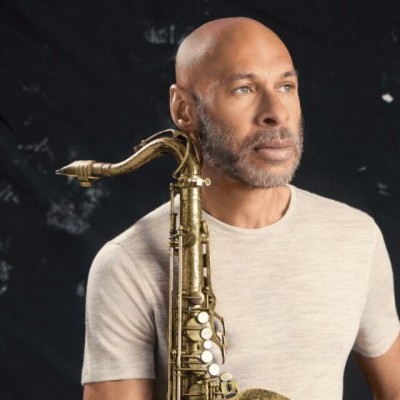
A solo concert by saxophonist Joshua Redman will close the first night of the Hyde Park Jazz Festival on Sept. 26.
Sep 22, 2026 12:26 PM
The Hyde Park Jazz Festival will take place for the 20th time on the final weekend of September 2026. Beginning half…
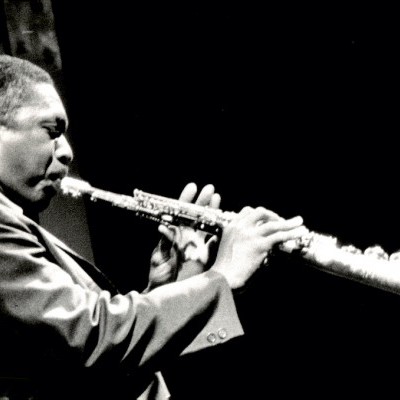
“It was just that suddenly … I could hear it,” Ravi Coltrane said of an epiphany he experienced during his late teens regarding his father’s music. “And it was almost like a calling, like something saying, ‘Hey, man, come on. It’s time to get serious.’ And the first time you really tune in and dial in and focus like that, it can be very life-changing.”
Sep 22, 2026 1:39 PM
Editor’s Note: Tomorrow, Sept. 23, is the 100th anniversary of John Coltrane’s birth. In honor of the tenor and…
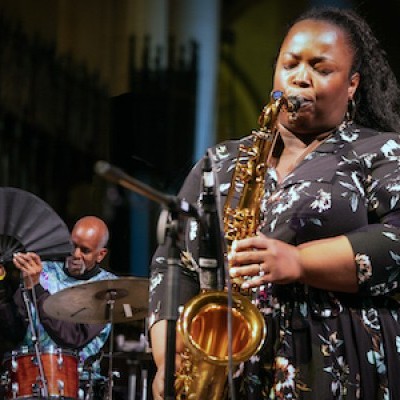
Camille Thurman took to the stage alongside bassist Kenny Davis and drummer Tommy Campbell for a rendition of Johnny Mercer’s “I’m An Old Cowhand” that recalled Rollins’ epochal 1957 trio outing Way Out West.
Oct 6, 2026 1:33 PM
As emcee Mark Ruffin noted at the commencement of an epic tribute to saxophonist Sonny Rollins at the Cathedral of Saint…
Record producer Bob Thiele’s classic photo that became the cover of John Coltrane’s landmark album A Love Supreme.
Sep 22, 2026 1:36 PM
A tribute to John Coltrane is one thing, but there is much more to the iconic saxophonist’s 100th anniversary…
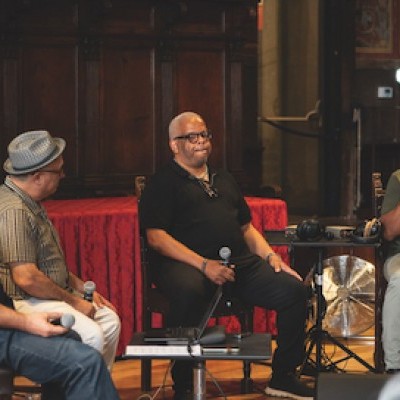
Ravi Coltrane (right) makes a point during a live Blindfold Test at the Umbria Jazz Festival while pianist Greg Burk (far left), journalist Ashley Kahn and trumpeter Terence Blanchard listen.
Oct 20, 2026 12:53 PM
The pairing of Terence Blanchard and Ravi Coltrane was billed as “The Miles/Coltrane Legacy,” a tour celebrating the…